
Ontario dairy goat producers welcome the province’s decision to pause high somatic cell count penalties to allow for further research.
On Jan. 1, 2026, the Ontario Ministry of Agriculture, Food and Agribusiness was set to impose penalties for goat milk with a somatic cell count (SCC) exceeding 1.5 million cells per mililitre. However, it would contravene Milk Act regulations.
This included cutting farmers off from delivering milk until the counts dropped below the accepted rate, as is the case for cow milk producers when they are over a certain threshold.
WHY IT MATTERS: When it comes to somatic cell counts or SCC, there’s a big difference between dairy cows and goats, as their levels can spike due to various stressors like heat cycles rather than infection.
Ontario Goats’ animal health and research committee presented international research on dairy goat SCC and its impacts on animal health and milk quality. Together with processors and producers, they consulted with OMAFA officials about the unique properties of SCC in goat milk. This informed the pause.
“By penalizing goat milk producers with unsustainable standards, the regulations will stifle a vital and growing sector,” wrote dairy goat producer Marlie Vanderlip in the Change.org petition launched in December 2025. “Ontario, renowned for its progressive agricultural policies, must recognize that the unique characteristics of goat milk require tailored standards.”
Emily Zur Linden from Upper Grand Veterinary Services gave Ontario Goat members credit for their work in helping the government understand the nuances of somatic cell count in goat milk during the annual meeting in April.
“We get a little bit of a reprieve, which is amazing. But that doesn’t mean that the work stops here. We’ve got to keep moving forward,” Zur Linden explained. “Because ultimately we’re going to expect some number to come down the line, and we want to make sure that we have our best foot forward when that does happen.”
Non-pathogenic somatic cell
Cattle and sheep with mastitis show increased inflammatory cells, resulting in a positive California Mastitis Test paddle.
“It won’t react with the other cells that are kind of naturally there,” explained Zur Linden, whereas goats naturally produce neutrophils, some breeds have higher levels than others, unrelated to pathogens.
Unlike cattle, which are managed by treatment or removal from the milking line with a very high somatic cell count, goats require a rolling somatic cell average before an animal is marked and removed.
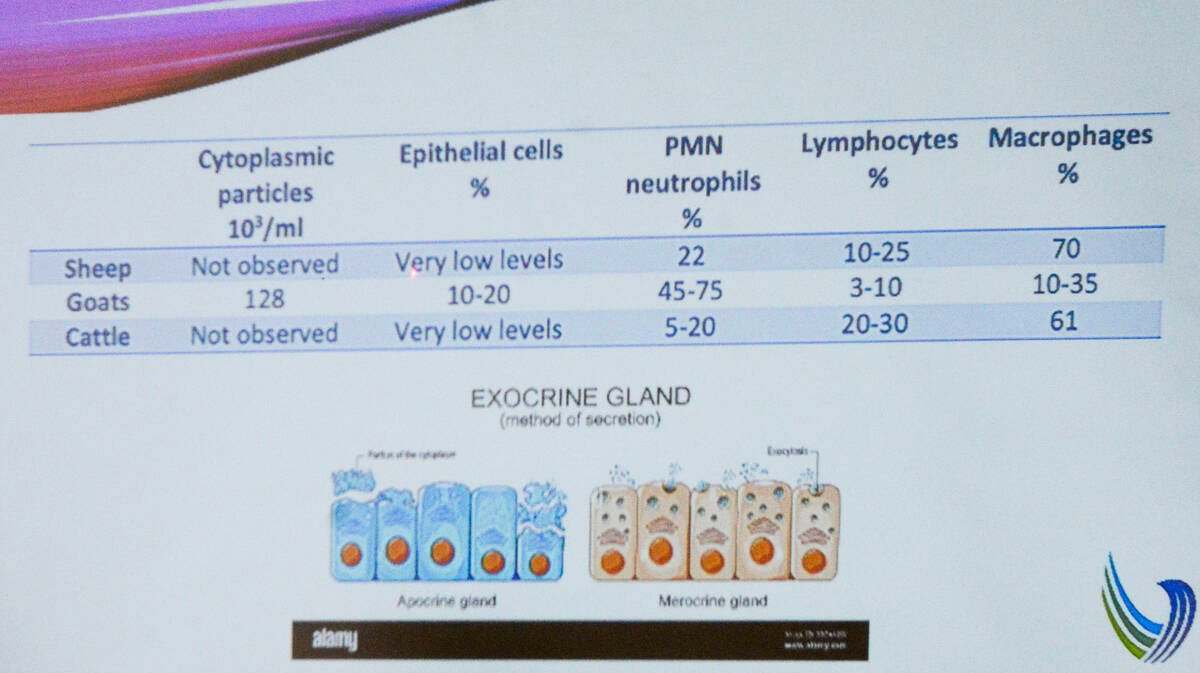
“With cattle, it’s one-to-one. High somatic cell – you have an infection in the udder. With goats, it could be anything,” she explained. “We have our infectious causes, mastitis and CAE, and then we have our non-disease.”
This includes how many kids the goat has had, lactation stage, stress, estrus, seasonal variation and breed.
Dairy goat-specific challenges
Additionally, goats store 70 per cent of their milk in the gland cistern. This milk contains a mixture of ‘cellular debris’, such as cytoplasmic particles and epithelial cells. In contrast, cattle store milk in the alveolar tissues, resulting in cleaner milk.
“These non-pathological factors account for almost anywhere from 50 to 90 per cent variance in somatic cell count in an individual doe,” Zur Linden said.
READ MORE: Seven tips for better dairy goat performance
Instead of immediately removing a goat, producers check her at the next lactation because the positive could be gone.
Research shows that parity three plus animals maintained a higher somatic cell count for several days following a stress event, such as a dog barking for 20 minutes. Parity one animals showed a short blip that lasted only a day.
Managing transient increases
“How do we effectively manage a goat that has a transient rise? She’s three days, now she’s pulled, but now it’s gone,” Zur Linden asked. “Maybe we never figure out what that stress was. They have a rise in somatic cell just by going through a heat — that’s about as natural as it gets.”

The challenge is how veterinarians and farmers use the information to ensure proper, effective management that includes antibiotic stewardship, especially for animals with transient rises.
She relies on decades of data and new research, including the newly launched Ontario-specific duration-milking study, to account for the natural increase in non-pathogenic SCC and to develop SCC limits and tools to address it going forward.
“People who have been in violation or risk of penalty, we still need to work forward at reducing our somatic cells, whatever the problem,” Zur Linden said. “And whether I agree with the (SCC) regulations or not, it doesn’t matter. I’m bound to help my producers become compliant with whatever rule there is.”
The post Ontario halts goat milk SCC penalties amid industry pushback appeared first on Farmtario.


