
Dr. Rebecca Hallett has been trapping, testing and quantifying canola flower midge (CFM) populations since 2021.
“Is canola flower midge using canola as a host plant in Ontario?” Hallett asked Ontario Canola Growers members during the annual general meeting on Feb. 5. “Ten days ago, I would have said, ‘Doesn’t look like it.’”
The University of Guelph entomologist’s research manager informed her that, of 5,513 larvae collected from 23 infected plants in July 2025, about 32 could be CFM. The rest are confirmed swede midge.
The distinct DNA bands indicating CFM in the testing pool are faint, Hallett explained, and require individual testing to confirm the numbers.
WHY IT MATTERS: While canola flower midge crop damage isn’t an immediate concern, the potential detection of CFM larvae allows growers to prepare for early monitoring and management.
This isn’t the first curveball Hallett’s research has been thrown.
In 2021, Hallett’s swede midge and CFM pheromone traps in Ontario canola fields confirmed the presence of both pests.
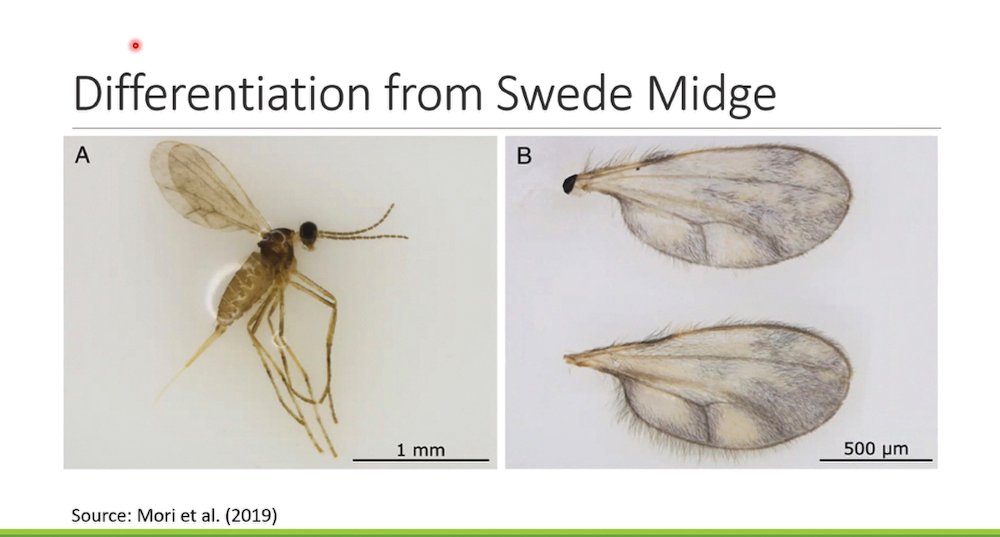
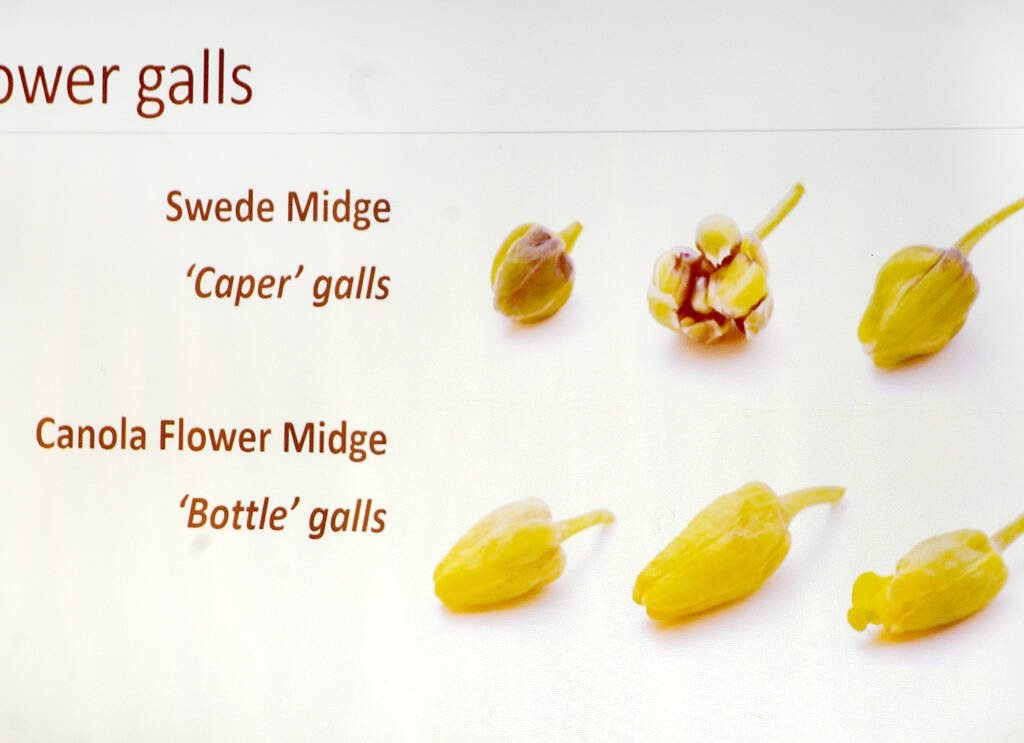
In 2022, morphological IDs initially indicated that 692 of the nearly 5,800 adult midges emerging from infected canola plants were CFM. However, molecular IDs barcoded a subset of the CFM-identified adults, showing they were all swede midge.
“This was the start of a big effort to do some molecular identifications to really get to the bottom of what was going on with canola flower midge,” she stated, leading to a CFM-specific molecular DNA assay and primer designs for both species.
The technology has 100 per cent efficacy and specificity, ensuring a clear delineation between CFM and swede midge, Hallett explained.
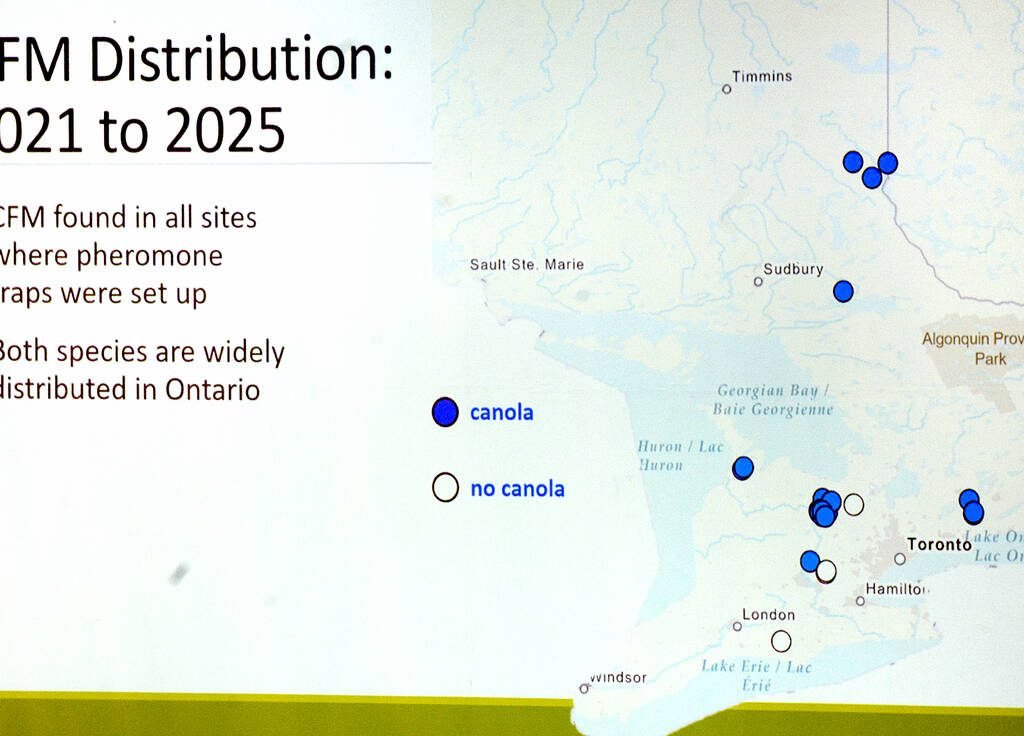
From 2022 to 2025, pheromone trap placement expanded to include canola- and non-canola-growing regions to assess provincial distribution, whether and how the pests’ life-cycle events converge, and the potential impact on the crop.
“Figuring out what species is feeding where is important in terms of determining the economic impact of the species and also figuring out management strategies,” she said.
Low CFM populations
The traps confirmed widespread distribution of both midges and potential coexistence. Weekly plant collections from 2022 to 2024 indicated swede midge populations were greatest in canola fields, while CFM was more abundant in non-canola fields.
In 2024, approximately 17,355 larvae were collected from 130 infected canola plants and four other brassica plants; half were tested for DNA from 58 canola plants, and 20 larvae from the other plants. None were CFM.
“The only (CFM) bands that showed up were positive controls that we included to make sure that things were running properly,” noted Hallett.
She suggested that low population density in 2024 made CFM undetectable during testing, whereas the larger pool of 28,510 larvae in 2025 highlighted potentially limited numbers.
Hallett won’t rule out CFM becoming a provincial issue in the future, saying it’s likely a native species that, as seen in Western Canada, adapted to canola over time as crop acres increased.
Yield impact
“We know it’s a concern in the West,” she confirmed, and despite Western Canadian experts’ research on the pest since 2012, including defining it as a species unique to swede midge in 2016, its potential impact on yield remains unquantified.
Referring to her original question about CFM’s use of canola as a host plant, Hallett theorized Ontario’s population still prefers other landscape hosts, for now.
“It’s a relatively low population density here in Ontario, but it’s at high density in or near canola fields,” she admitted. “We don’t know what those alternate hosts are, but right now it doesn’t seem like this is an issue of any economic concern for canola growers in Ontario.
Higher swede midge damage reported in 2025 may align with higher pheromone trap counts from late June to mid-July.
“I think damage could be higher as a result of that timing because it’s hitting those younger plants and probably causing damage to the meristem,” Rebecca Hallett said during the Ontario Canola Growers annual general meeting
Emergence timing
Unusual springs in eastern and southern Ontario affected insect populations, with March 2024’s unseasonal highs triggering early development of species, followed by a cold snap that reduced populations.
“That might have been the case for swede midge,” Hallett said, adding that it requires a rainfall trigger to exit diapause and emerge as adults.
Weather also greatly impacts pest overwintering, increasing the potential risk of infestation for Ontario’s winter canola throughout early fall.
Hallett noted that winter canola’s early growth provides an advantage, despite potential pest pressure, because it has already passed the most vulnerable stage for spring damage.
“That, as well as degree day accumulation in the spring, may affect when it (swede midge) emerges,” she explained.
The insect specializes in canola, so if spring and winter canola are consistently planted near each other, population buildup could change the damage potential, Hallett clarified, adding that “crop rotation is absolutely key.”
Synopeas myles, the parasitoid wasp targeting the swede midge, is widespread throughout the province.
While it doesn’t control population levels, it certainly has a consistent impact, according to Hallett.
Reducing insecticide use can be beneficial; however, she warned that traps to monitor populations are necessary, including in areas where early spraying might be recommended.
“You need to have traps to monitor,” she stated. “I don’t advise just going in the spring without knowing what your numbers are, because I think it’s best to keep the parasitoids.”
The post Ontario’s canola flower midge is abundant but not currently a threat appeared first on Farmtario.


