
2D Materials and Heterostructures for (Opto)Electronic Applications
Open Call for Papers until 21 October 2026
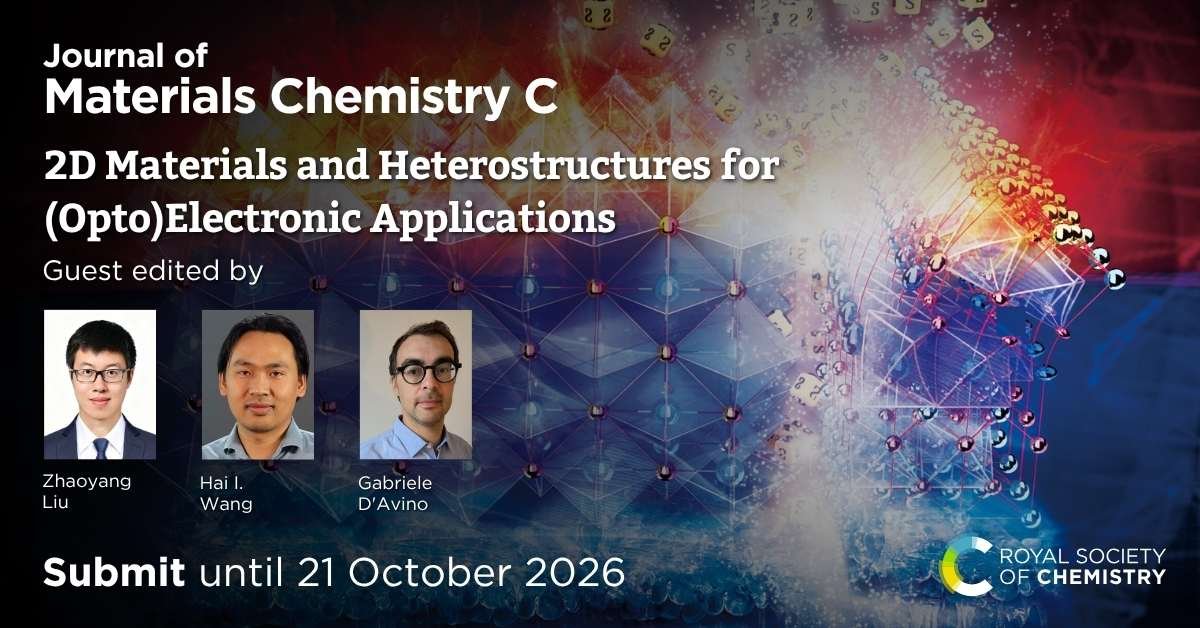
We are delighted to announce this open call for papers to contribute to a themed collection for Journal of Materials Chemistry C on 2D Materials and Heterostructures for (Opto)Electronic Applications, guest edited by Professor Zhaoyang Liu (Jilin University, China), Professor Hai I. Wang (Utrecht University, The Netherlands) and Professor Gabriele D’Avino (Ca’ Foscari University of Venice, Italy).
Scope
Two-dimensional (2D) materials provide a powerful platform for next-generation (opto)electronics, sensing, and quantum technologies. Their full potential is realized not only through their intrinsic properties but also through precise molecular-level control—via covalent and non-covalent functionalization, intercalation, doping, and the construction of tailored heterostructures.
This themed collection in Journal of Materials Chemistry C will highlight cutting-edge research at the intersection of chemistry, materials science, spectroscopy and devices. We invite contributions on the synthesis, molecular design, modeling, interface control, characterizations, and property modulation of 2D materials and their heterostructures, with a focus on advancing their (opto)electronic properties and/or performance.
Topics of interest include, but are not limited to:
- Synthetic chemistry of novel 2D materials (organic, inorganic, and hybrid, including but not limited to 2D COFs, 2D MOFs, 2D SOFs, 2D Organic Molecular Crystals, Graphene, TMDCs, BP, perovskites, MXene, and other layered materials)
- Surface and edge functionalization (covalent and non-covalent) for property tuning
- Molecular doping and defect engineering in 2D systems
- Design and fabrication of van der Waals and mixed-dimensional heterostructures (including but not limited to inorganic-inorganic, or organic-inorganic heterostructures)
- Interface engineering for charge injection, transport, and light–matter interactions
- Advanced characterization, including static and time-resolved laser spectroscopies of charge and energy dynamics in 2D materials and hybrids
- Ab initio and multiscale modelling of optical, electronic and transport properties
- Device applications demonstrating the role of molecular engineering in transistors, photodetectors, LEDs, and sensors
Submit your high-quality research
This call for papers is open for the following article types:
- Communications
- Full papers
If you would like to contribute to this themed collection, you can submit your article directly to the online submission service for Journal of Materials Chemistry C. Please mention that this submission is a contribution to the 2D Materials and Heterostructures for (Opto)Electronic Applications collection in the “Themed issues” section of the submission form and add a “Note to the Editor” that this is from the Open Call. The Editorial Office reserves the right to check suitability of submissions in relation to the scope of both the journal and the collection, and inclusion of accepted articles in the final themed issue is not guaranteed.
Please also note that all submissions will be subject to initial assessment and rigorous peer review to meet the usual high standards of Journal of Materials Chemistry C.
If you have any questions about the journal or the collection, then we would be happy to answer them.
Guest Editors

Professor Zhaoyang Liu (Jilin University, China)
Zhaoyang Liu is a professor at the State Key Laboratory of Supramolecular Structure and Materials, College of Chemistry, Jilin University. He received his Bachelor’s degree in 2009 and Master’s degree in 2012 from Jilin University, under the supervision of Prof. Wenjing Tian. He then joined the group of Prof. Klaus Müllen at the Max Planck Institute for Polymer Research (MPIP), where he earned his Ph.D. in 2017. Subsequently, he conducted postdoctoral research in the group of Prof. Paolo Samorì at the Institut de Science et d’Ingénierie Supramoléculaires (ISIS), Université de Strasbourg. In 2022, he established his independent research group at Jilin University. His research interests focus on the design, synthesis, and property tuning of two-dimensional materials using supramolecular approaches, with applications in energy storage and optoelectronics.

Professor Hai I. Wang (Utrecht University, The Netherlands)
Hai Wang received his Bachelor’s degree in Materials Science from Zhejiang University in 2007 and a Baster’s degree in Nanoscience from KU Leuven and TU Delft in 2011 through the Erasmus Mundus fellowship program. From 2012 to 2016, he worked with Mischa Bonn and Enrique Canovas on ultrafast charge transfer processes at oxide interfaces, earning his PhD with highest honors from Max Planck Institute for Polymer Research and University of Mainz. After a postdoctoral appointment with Mathias Kläui, he led the Nano-optoelectronic Materials group at MPI-P from 2017 and became a tenured assistant professor at Utrecht University in 2023. Employing time-resolved, ultrafast spectroscopies (in particular THz spectroscopy), the central theme of Hai’s current research lies in understanding fundamental charge carrier dynamics and low-energy excitations in solid-state low-dimensional materials and interfaces, relevant for energy and optoelectronic applications.

Professor Gabriele D’Avino (Ca’ Foscari University of Venice, Italy)
Gabriele D’Avino received his PhD in Materials Science at the University of Parma in 2010. After a first postdoc at the University of Bologna and two Marie Curie fellowships at the University of Liege and at the University of Mons, in 2019 he joined CNRS with a researcher position at the Institut Néel in Grenoble. Since 2024 he is associate professor of physical chemistry at Ca’ Foscari University of Venice. His research work focuses on the theoretical modeling of organic functional materials for advanced applications in electronics and energy generation, synergistically combining quantum and classical techniques in a multiscale fashion. The goal of his research is the establishment of the relationships between structure and (electronic, optical, vibrational, dielectric) properties in complex molecular systems with special emphasis on environmental and cooperative phenomena in the solid state.


