
Rational Engineering of Functional Magnetic Nanoparticles
Open Call for Papers until 30 September 2026
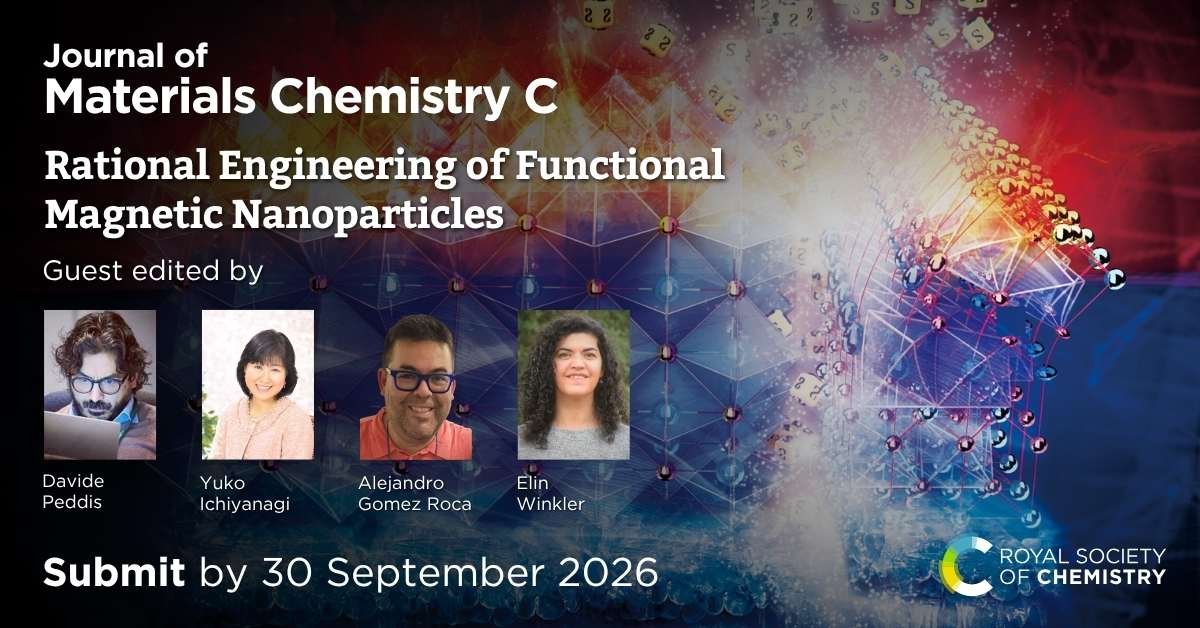
We are delighted to announce this open call for papers to contribute to a themed collection for Journal of Materials Chemistry C on Rational Engineering of Functional Magnetic Nanoparticles, guest edited by Professor Davide Peddis (University of Genoa, Italy), Professor Yuko Ichiyanagi (Yokohama National University and Osaka University, Japan), Dr. Alejandro Gomez Roca (Catalan Institute of Nanoscience and Nanotechnology, Spain), and Professor Elin Winkler (Bariloche Atomic Center and Instituto Balseiro, Argentina).
Scope
Research on magnetic nanoparticles is a rapidly expanding field, driven by advances in the understanding of nanoscale phenomena and by the development of innovative fabrication methods that enable precise control over size, composition, and increasingly complex nanoarchitecture.
Since Néel’s pioneering work in the 1950s, key phenomena such as superparamagnetism, exchange bias, exchange spring behaviour, proximity effects have been discovered and extensively investigated. Together with progress in surface chemistry, functionalization and the synergy between the catalysis and magnetism opened new avenues for the design of advanced functional magnetic materials. These scientific developments have evolved in parallel with innovations in chemical and physical synthesis routes and state-of-the-art characterization techniques, enabling the rational engineering of nanoparticles with tailored structural, magnetic, and functional responses.
The field is inherently interdisciplinary, situated at the intersection of physics, chemistry, materials science, biochemistry, and medicine. Current research focuses not only on the development of materials with enhanced performance for advanced permanent magnets, imaging contrast agents, and magnetic data storage, but also on functional systems capable of dynamically interacting with their environment. Engineered magnetic nanoparticles are now widely explored as remotely controlled actuators capable of generating motion, force, and heat, opening new opportunities in biomedicine, soft robotics, sensing, energy technologies, and sustainable and circular systems.
This Special Issue Rational Engineering of Functional Magnetic Nanoparticles will feature invited contributions from leading experts and emerging researchers, as well as original research articles covering all aspects of magnetic nanoparticles, from the design, modelling, and fabrication of novel nanoarchitectures to their implementation in targeted technologies. We especially encourage submissions that showcase innovative research in the following areas:
- Fundamentals and Theory
- Design of Magnetic Nanoparticles
- Advanced Characterization techniques
- Advanced Magnetic Nanoparticles for Targeted Applications
- Nanoarchitectures based on Magnetic Nanoparticles for Targeted Technologies
- Magnetic Nanoparticles for Sustainable and Circular Technologies
Submit your high-quality research
This call for papers is open for the following article types:
- Communications
- Full papers
If you would like to contribute to this themed collection, you can submit your article directly to the online submission service for Journal of Materials Chemistry C. Please mention that this submission is a contribution to the Rational Engineering of Functional Magnetic Nanoparticles collection in the “Themed issues” section of the submission form and add a “Note to the Editor” that this is from the Open Call. The Editorial Office reserves the right to check suitability of submissions in relation to the scope of both the journal and the collection, and inclusion of accepted articles in the final themed issue is not guaranteed.
Please also note that all submissions will be subject to initial assessment and rigorous peer review to meet the usual high standards of Journal of Materials Chemistry C.
If you have any questions about the journal or the collection, then we would be happy to answer them.
Guest Editors

Professor Davide Peddis (University of Genoa, Italy)
Davide Peddis (PhD; 2007) is a Full Professor of Physical Chemistry at the University of Genoa and Associate Researcher at CNR-ISM. He has held research positions in Italy and abroad, including Senior Scientist at the Vinča Institute (Belgrade), and visiting appointments in France, Sweden, and the USA. DP has authored over 230 peer-reviewed papers (h-index ~50) and seven book chapters; he contributed to more than 450 conference communications. His research focuses on magnetic nano-heterostructures, with emphasis on the interplay between structure, morphology, and physical properties, spanning fundamental magnetism and applications in biomedicine, catalysis, and energy. He has participated in 29 funded projects (5 as Principal Investigator, 12 as local PI, and 12 as key team member), managing ~€3 million in research funding.

Professor Yuko Ichiyanagi (Yokohama National University and Osaka University, Japan)
Yuko Ichiyanagi received her PhD (Applied Physics) at Yokohama National University in 1996. She has been a full professor since 2019 at Yokohama National University. She concurrently holds a visiting professor at Osaka University since 2017. She has been frequently invited to and chaired at international conference. Her recent main research interests are phase transition of magnetic nanoparticles and biomedical applications. Now she has published more than 120 papers and books, and has been serving as an international advisory committee member of some reputed conferences. She is a member of the editorial board of IEEE Magnetics Letters since 2018. She has served as a program committee member and session chair for many IEEE conferences. Prior to her academic position, she worked for a private company for three years, designing circuits, and contributing to the establishment of electronic equipment interference regulations in Japan (VCCI).

Dr. Alejandro Gomez Roca (Catalan Institute of Nanoscience and Nanotechnology, Spain)
Alejandro G. Roca is a Tenured Scientist at the Spanish National Research Council (CSIC) based at the ICN2. He previously conducted research in Spain (ICMM, INA‑UNIZAR, ICMA), the UK (University of York), Japan (Tohoku University), and the private sector. Dr. Roca has authored 57 peer‑reviewed publications (>4,300 citations, h‑index 30), edited two books, contributed two book chapters, and is co‑inventor on two patents. He has participated in 21 research projects, serving as Principal Investigator on five. His work focuses on the synthesis of magnetic nanoparticles for biomedical and energy applications and on the structural and magnetic characterization of nanostructures using laboratory, synchrotron, and neutron techniques. He has delivered 14 invited talks at international conferences and organized several scientific events. Dr. Roca has supervised doctoral and master’s students, contributed to academic teaching at the UAB, served on international evaluation panels, and is actively engaged in science outreach.

Professor Elin Winkler (Bariloche Atomic Center and Instituto Balseiro, Argentina)
Elin Winkler is a Researcher at National Council for Scientific and Technical Research (CONICET) and the National Atomic Energy Commission (CNEA) and a member of the Institute of Nanoscience and Nanotechnology (CNEA/CONICET) in Argentina. She is also an Adjunct Professor at the Balseiro Institute, which depends on the Universidad Nacional de Cuyo (UNCuyo) and CNEA.
She is co-author of 98 peer-reviewed publications (>3100 citations, h-index 30) and 4 book chapters. Her research focuses on the development of new nanostructured materials based on magnetic nanoparticles and study of their physicochemical properties to optimize their performance in applications such as environmental remediation, nanomedicine and energy.
She currently serves as Associate Editor of Journal of Materials Chemistry C and Materials Advances.


