
Organic fish farming, or organic aquaculture, is a way of raising fish and other aquatic organisms that follows the same natural, “no-chemicals” principles as organic crop or livestock farming. In organic aquaculture, all practices – from feed and stocking to disease control – emphasize environmental protection, animal welfare, and natural processes.
Organic fish farms do not use GMOs, synthetic pesticides or fertilizers, or routine antibiotics or growth hormones, and they keep fish at lower densities to reduce stress. In this sense, organic aquaculture is distinguished from conventional fish farming by strict standards on feed, health care, and environmental management.
The core philosophy of organic fish farming is to mimic natural ecosystems and promote sustainability. Producers seek to maintain clean water and healthy habitats, protect biodiversity, and let farmed fish express natural behaviors.
The goal is to produce seafood that is free of chemical residues and raised in humane conditions, while reducing pollution and pressure on wild fish stocks.
Organic farming supporters argue that fish raised this way can be a healthier, more nutritious product – for example, without antibiotic residues – and consumers often pay a premium for organic certification. Indeed, organic standards explicitly aim to ensure a “high-quality product” with full traceability.
Historically, organic aquaculture is a relatively young sector. Germany’s Naturland organisation certified the first organic fish (carp) in 1995, and the UK’s Soil Association pioneered organic aquaculture standards in the late 1990s, producing the first certified organic Atlantic salmon in 1998.
Production remained very small for many years: in 2000, only about 5,000 tonnes of organic farmed fish existed worldwide. In recent decades, however, the industry has begun to grow. According to a 2022 survey by the Research Institute of Organic Agriculture (FiBL), global organic aquaculture production exceeded 306,000 metric tons in 2020.
Asia (especially China) accounted for roughly 55% of that, Europe 31%. In the European Union, organic aquaculture reached about 74,000 tonnes in 2020, up 60% from 2015, driven by increases in organic mussel, oyster, seabass and seabream farming.
Notably, organic mussels now make up about 10% of all EU mussel production. These figures show that organic fish farming, while still a small fraction of overall aquaculture, is expanding as consumers seek sustainable seafood and governments support organic growth.
Principles and Standards of Organic Fish Farming
As of 2024, global demand for organic seafood is rising rapidly, with organic aquaculture projected to grow at an annual rate of over 10% in the next five years. Europe continues to lead, with organic aquaculture accounting for around 6% of total aquaculture output, while Asia is showing steady growth due to consumer demand in China and Southeast Asia.
Certification programs are expanding worldwide, making core principles and standards more important than ever. Organic aquaculture is defined by strict principles and certification standards that go beyond conventional fish farming rules. Key differentiating principles include:
A. Juvenile sourcing
Organic operations generally require fingerlings (juvenile fish) to come from organic hatcheries or nurseries. Use of wild-caught juveniles is limited, since wild capture can spread disease and is hard to regulate. The emphasis is on traceability from the very start of life.
B. Feed requirements
All fish feed must be certified organic (or approved non-synthetic) and nutritious enough for healthy growth. Permitted feeds include organic grains, vegetable proteins, and fish by-products (e.g. fish trimmings not for human consumption) from well-managed fisheries.
Conventional fishmeal and fish oil (from wild stocks) are allowed only in limited amounts; organic standards typically insist that at least half of the dietary protein comes from organic or waste sources. Importantly, feeds must contain no synthetic additives:
- no GMOs
- no synthetic amino acids
- no artificial growth promoters
- no chemical preservatives or coloring agents.
Organic rules often forbid using probiotics or feeds derived from the same species as the farmed fish, to prevent contamination or ecological imbalance. In practice, organic fish feeds resemble those for livestock – based largely on plant and natural ingredients – but tailored to fish nutrition.
Feed must also be managed carefully to minimize waste: rations are designed so fish eat naturally and little uneaten feed escapes into the water.
C. Stocking density
Organic regulations strictly limit how densely fish may be stocked in cages, tanks or ponds. Stocking rates are set much lower than in conventional farms to allow each fish enough space. This promotes stronger fish, better water quality, and lower disease risk.
For example, EU organic rules and Soil Association standards mandate maximum biomass densities (typically about half of conventional levels). Fish overcrowding is avoided, as organic principles require that “the organisms should be allowed to meet their basic behavioural needs”.
D. Animal health and welfare
Organic aquaculture relies on preventive health management rather than treating problems after they occur. Farms maintain good water quality, adequate oxygen, and low stress so that fish build natural immunity.
Prophylactic use of antibiotics, steroids or hormones is strictly prohibited; antibiotics are only allowed if prescribed by a vet to treat a diagnosed illness. Instead, organic farmers may use approved immunostimulants (such as probiotics or herbal extracts) and vaccines to prevent disease.
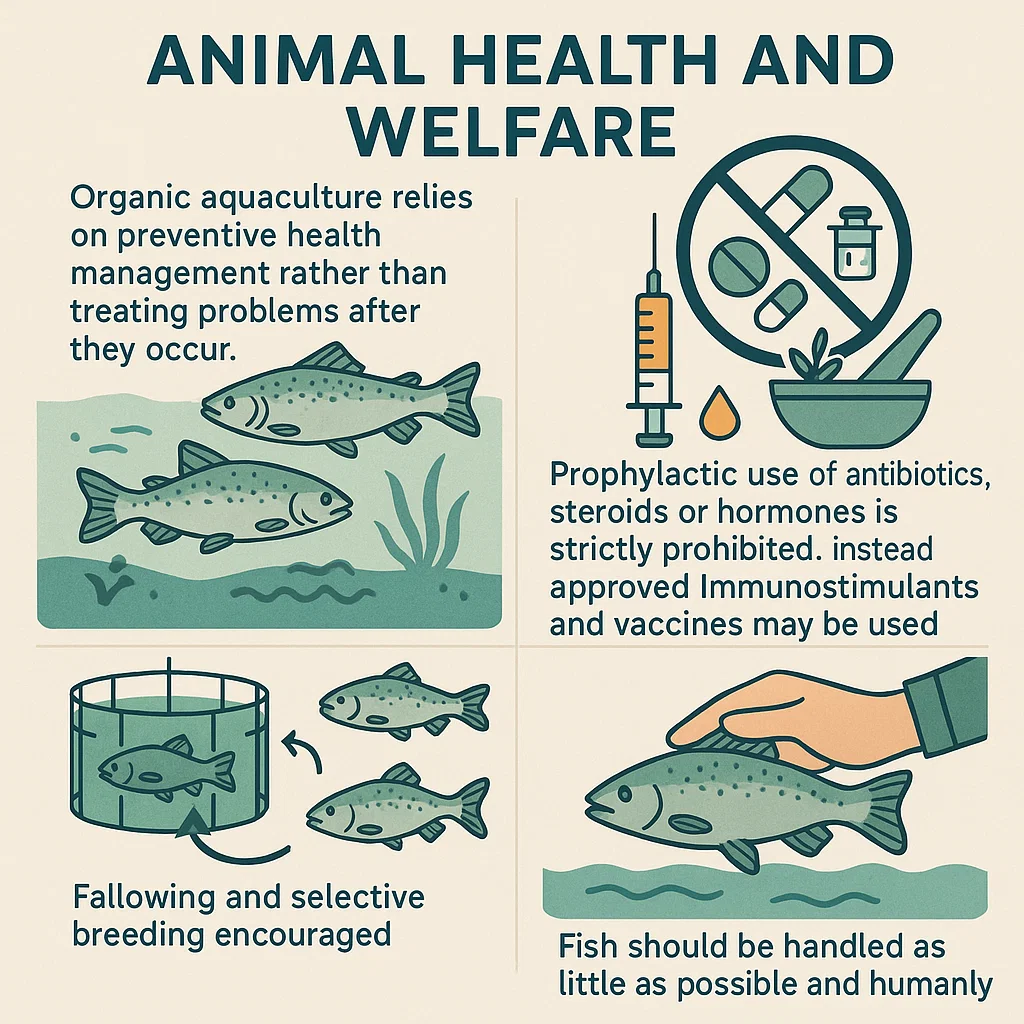
Standard practices like fallowing (rotating ponds or cages to break disease cycles) and selective breeding for resilient strains are encouraged. Fish should be handled as little as possible and humanely.
E. Environmental sustainability
Protecting local ecosystems is central to organic aquaculture. Farms must maintain clean water (often through water exchange or filtration), and any discharge of nutrients and waste must be minimized.
Authorities typically require that organic fish farms be sited to avoid polluting wild habitats or overcrowding sensitive areas. Many organic operations integrate additional species to recycle waste: a common practice is integrated multi-trophic aquaculture (IMTA), where filter-feeders (oysters, mussels) and seaweeds are grown alongside fish.
These organisms consume excess feed and nutrients from fish waste, effectively acting as living biofilters. Other farms may use aquaponics (growing plants and fish together) or reuse effluent as fertilizer for crops.
These principles are codified by national and international standards. Key certification bodies and schemes include the EU Organic Regulation (Reg. 2018/848), Germany’s Naturland, the UK’s Soil Association, BioSuisse in Switzerland, and Canada’s COR.
Key Practices in Organic Fish Farming
By 2023, recirculating aquaculture systems (RAS) accounted for over 20% of new aquaculture projects in Europe and North America, showing a trend toward more sustainable and organic-friendly practices.
IMTA systems are also expanding, with pilot projects in Asia showing that waste recycling can improve production efficiency by up to 30%. These facts highlight how practical innovations are shaping organic fish farming today.
Implementing organic principles means choosing suitable sites and systems, managing feed and health carefully, and integrating with nature.
A. Site Selection & System Design: Organic fish farms typically select sites with clean water and minimal pollution. Freshwater farms might use natural ponds or flow-through raceways with a constant exchange of water to keep it fresh.
Sea farms may use coastal net pens or cages in areas with good currents. Increasingly, land-based Recirculating Aquaculture Systems (RAS) are used. Offshore cage farms in open ocean waters are also possible, but they undergo strict environmental impact review.
B. Feed Management: Organic farmers source only certified organic feeds. Feeding is managed to minimize waste: for instance, slow-release feeds and smart feeders can reduce uneaten feed sinking to the bottom. Farmers monitor feeding closely and adjust rations so that fish eat efficiently.

C. Health Management: Preventing disease is a top priority. Organic farmers employ probiotics and immunostimulants in the water or feed to keep the fish’s natural immunity high. Vaccinations are common to prevent specific diseases. Hygiene measures and farm fallowing help break disease cycles. Handling of fish is done gently to minimize stress.
D. Waste Management & Ecosystem Integration: Organic farms adopt practices to reuse or neutralize waste. One strategy is Integrated Multi-Trophic Aquaculture (IMTA), where the waste from fish feeds mussels and seaweed. In freshwater systems, fish pond effluent can be reused for algae or hydroponics.
Benefits of Organic Fish Farming
Consumer research in 2022 showed that over 70% of European seafood buyers prefer eco-labeled or organic seafood, with a willingness to pay 15–20% more for organic certification. Global surveys also show that organic fish farming reduces nutrient pollution by up to 40% compared to conventional systems, highlighting its environmental edge. Organic fish farming offers several advantages:
-
Environmental Benefits: Reduced pollution, lower impact on wild fish stocks, and enhanced biodiversity.
-
Consumer Benefits: Production of a product free from synthetic chemical residues, with perceived higher nutritional quality.
-
Economic Benefits: Access to premium markets and higher price points.
-
Animal Welfare Benefits: Improved living conditions and health for the farmed fish.
Challenges and Criticisms
As of 2024, organic aquaculture makes up less than 1% of global aquaculture production, largely due to high costs and strict certification rules. Feed expenses are reported to be 30–40% higher than in conventional farming, and disease management without chemicals remains a major challenge. Despite its benefits, organic fish farming faces several challenges and criticisms:
-
High Production Costs
-
Regulatory Hurdles
-
Technical Challenges
-
“Greenwashing” Concerns
Common Organically Farmed Species And Future
In 2020, global organic aquaculture produced around 25,500 tonnes of organic salmon, 25,400 tonnes of mussels, and 7,400 tonnes of shrimp. Europe is the leader, but organic tilapia and carp are increasingly produced in Asia.
A variety of aquatic species are farmed organically. Finfish like salmon, trout, carp, tilapia, seabass and bream, shellfish like mussels, oysters and shrimp, and even aquatic plants like seaweed are included.
The global organic seafood market is expected to surpass USD 10 billion by 2030, growing at a double-digit annual rate. Demand for sustainable seafood, coupled with innovations in feed like insect meal and algae, will accelerate this growth.
The organic aquaculture sector is poised for growth, driven by innovation and market trends. Feed innovations, RAS expansion, consumer demand, and stricter regulations are key drivers.
Conclusion
Organic fish farming is a growing sector that combines traditional ecological balance with modern technology to meet rising demand for healthy and sustainable seafood. While challenges like higher costs and certification hurdles remain, innovation and consumer demand are pushing the industry forward.
With ongoing improvements in feed, system design, and global standards, organic aquaculture is set to play an increasingly important role in ensuring a sustainable future for seafood production.


