

Japanese electronics manufacturer Panasonic has started operating a fuel cell system and an air-to-water heat pump at the Hydrogen House, a demonstration facility run by the Central Finland Mobility Foundation (Cefmof) in Jyväskylä, central Finland.
Panasonic said the project is testing an integrated energy system combining its Pure Hydrogen Fuel Cell technology with an Aquarea air-to-water heat pump. The system supplies electricity to the building and thermal energy for space heating, with the aim of improving overall energy efficiency and optimizing hydrogen consumption.
The company said limited daylight hours in central Finland during winter make it difficult to rely on solar generation throughout the year. The demonstration will therefore assess the performance and scalability of the combined fuel cell and heat pump system under local conditions.
The Hydrogen House combines rooftop PV with hydrogen production and storage. Electricity from the solar array powers an electrolyzer that produces hydrogen, which is stored in tanks with a total capacity of up to 90 kg and distributed across the property through an underground pipeline.
The stored hydrogen supplies several applications, including a fireplace, oven, grill and sauna. When PV generation is insufficient, the fuel cell converts hydrogen into electricity. The system also recovers waste heat from the fuel cell for thermal applications.
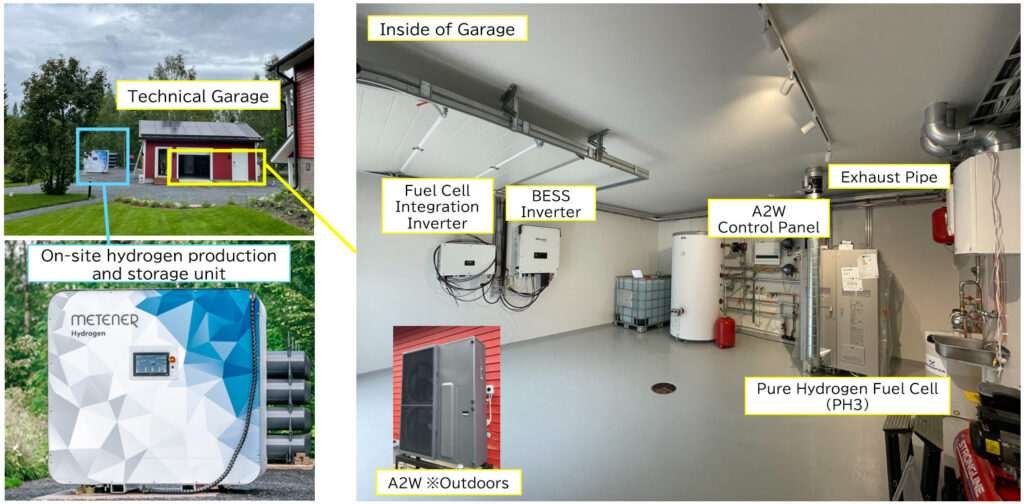
The heat pump provides the house’s main space heating and hot water, using electricity from the PV system or, when solar generation is insufficient, electricity produced by the hydrogen fuel cell.
“At full capacity, the Pure Hydrogen Fuel Cell delivers 10 kW of electrical output, while the air-to-water heat pump provides 9 kW of thermal output,” Panasonic said, without providing further technical details about the system.
“This project is thought to be one of the first integrated hydrogen energy demonstrations in Europe, comparable to existing projects in Japan,” it added. “It is expected to provide valuable insights into the feasibility of indoor hydrogen energy systems and their integration with heating equipment under Finland’s harsh winter conditions.”
Panasonic launched its H2 Kibou pure hydrogen fuel cell system in 2021. The original 5 kW unit uses hydrogen with a purity of more than 99.97% and has an electrical efficiency of 56%. Panasonic said heat recovery can increase the system’s overall energy efficiency to as much as 95%.
Panasonic has also deployed the technology in systems combining hydrogen fuel cells, solar PV and battery storage. In 2022, it commissioned a demonstration facility at its fuel cell factory in Kusatsu, Japan, featuring 99 H2 Kibou units with a combined capacity of 495 kW, alongside a 570 kW PV array and 1.1 MWh of battery storage. Panasonic later deployed a similar configuration at its microwave oven factory in Cardiff, Wales, combining 21 5 kW hydrogen fuel cell generators with 372 kW of PV and 1 MWh of battery storage.
Panasonic has marketed its Aquarea air-to-water heat pumps in Europe since 2008. The systems provide space heating and domestic hot water by extracting heat from ambient air. The company has expanded the Aquarea range over the years, including models that use propane (R290) as a refrigerant.
Panasonic subsequently introduced its Aquarea L series for residential applications. The R290 units have heating capacities ranging from 5 kW to 8 kW and can supply hot water at temperatures of up to 75 C. They are also smart-grid ready for integration with rooftop PV systems.
In July 2025, Panasonic further expanded its R290 portfolio with the launch of the Aquarea DHW Heat Pump, a dedicated domestic hot water solution. The system uses ambient air as an additional energy source and is available in both wall-mounted and floor-standing configurations.
The post Panasonic deploys fuel cell, heat pump at PV-powered hydrogen house appeared first on pv magazine Global.


