
Phytonutrients: Nature’s Pharmacy
Bite into a deep purple blueberry, a bright orange carrot, or a deep red tomato and you’re tasting more than protein, carbs, and fat. You’re also tasting phytonutrients, the compounds that give food unique colors, flavors, and much of its power to protect health. Never heard of them? Well, you’re not alone. Most nutrition conversations only discuss the “macro’s” of protein, carbs, and fat. This is a big missed opportunity for agriculture and public health, because phytonutrients are crucially important for plant defense systems and nutrient density of the food we eat.
What Are Phytonutrients?
Phytonutrients, or phytochemicals, (“phyto-” meaning plant) are chemical compounds that plants manufacture to defend themselves from threats, both living and non-living. A more official definition lists them as, “bioactive compounds generated from secondary plant metabolism in response to environmental changes.”1 Unlike vitamins and minerals, they aren’t strictly “essential” for survival, which is one reason why they aren’t discussed nearly as often as they should be. You might say these compounds are “quality of life” compounds that make plants stronger, healthier, and more likely to reproduce.
Why Plants Produce Phytonutrients
Plants are what smarty-pants scientists call “sessile”, meaning they can’t run from danger. Therefore, they have turned to chemical wizardry to protect themselves from being sitting ducks to threats in the environment, including insect and animal herbivory, but also from abiotic (non-living) forces like the sun or deficient/excess water. So, every phytonutrient a plant produces is essentially a response to some kind of pressure, be it insect pressure, disease pressure, UV exposure, or competition from neighboring plants. You may have heard of many phytonutrient families like polyphenols, carotenoids, terpenoids, and phytosterols, each of which bring their own chemical toolkit to the plant in question.
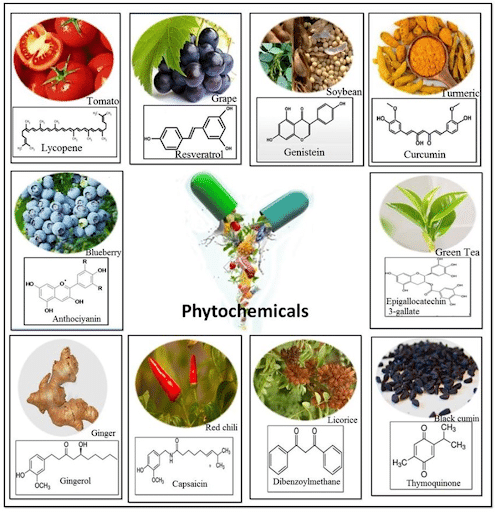
A plant under stress in a fertile, biologically active environment ramps up production of defensive compounds in the process. This is one reason why plants grown in more challenging, biologically diverse conditions can carry a heavier phytonutrient load than plants coddled in systems that remove the very pressures the plant would otherwise be fighting off, such as in some indoor settings or high-input settings that try to sterilize a plant’s natural environment.
How Soil Health Drives Phytonutrient Richness
A plant’s ability to produce a rich, diverse array of phytonutrients depends heavily on what’s happening in the soil beneath it. Healthy soil is packed with life of all sizes from bacteria, fungi, and protozoa, up to a web of macroscopic organisms, all of which play a role in the cycling of nutrients, building of stable aggregates, and formation of symbiotic relationships with plant roots (For a deeper look at how nutrients move through soil, plants, and animals, check out my nutrient cycle blog series here.) . Roughly 80% of plants partner with mycorrhizal fungi, trading sugars from photosynthesis for water, minerals, and even chemical signals that prime the plant’s immune defenses. That partnership, and the broader diversity of microbial life supporting it, gives plants access to a wider palette of raw materials and biochemical cues than they’d have in biologically depleted, input-dependent soil. For more information, search for induced systemic resistance (ISR) and systemic acquired resistance (SAR) to learn more about plant immunity!
Thankfully, research is shedding light on this soil health → plant health connection. For example, one 2022 study led by geomorphologist David Montgomery compared crops from paired regenerative and conventional farms across the U.S. and found that the regeneratively grown crops averaged 34% more vitamin K, 15% more vitamin E, 20% more phenolics, and 22% more phytosterols than their conventionally grown neighbors, alongside meaningfully higher levels of several other vitamins and minerals. The common thread across the farm pairs wasn’t organic certification or any single practice, but rather soil organic matter and a more active soil microbiome.2
Phytonutrient Benefits to Animals and Humans
In animals and humans, phytonutrients are utilized as chemical messengers and defenders. Many function as antioxidants by neutralizing oxygenic free radicals before they can damage cells and DNA. Others interact directly with cellular signaling systems that influence how and when genes get expressed. Some even mimic hormones or block enzymes tied to disease processes, which is part of why certain phytonutrients are linked to lower cancer risk. In short, the same defensive chemistry a plant evolved to protect itself from pests and disease gets repurposed inside an animal or human body to protect cells and tissues, just against a different set of threats.
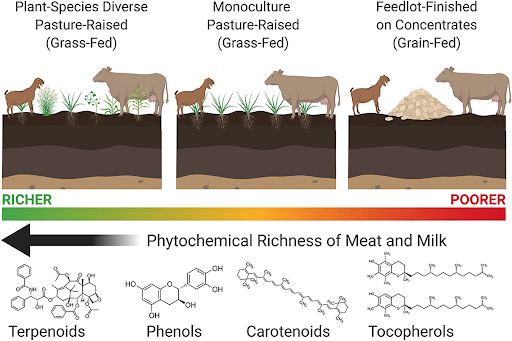
Metabolomic research led by Stephan van Vliet at Utah State University shows that livestock grazing diverse, nutrient-rich pasture accumulate meaningfully higher levels of health-promoting phytonutrients, including polyphenols, tocopherols, and carotenoids, in their meat and milk compared to animals raised on monoculture pasture or finished on grain in confinement. Pasture-raised beef in some of his studies carried roughly two and a half times more phytochemicals, along with a healthier ratio of omega-6 to omega-3 fatty acids.3
So, for those of you food eaters out there (ie. everyone), color and flavor in food are going to be your best sensor of this phytonutrient density in your groceries. The deeper the color of natural products, the more phytonutrients are typically doing their work inside. I say “natural products” because the food science industry has undermined this sensory system with artificially deep hues to trick our brains into thinking these products are more desirable. This, combined with hyperpalatable combinations of sugars, fats, and salts, is an incredibly irresistible hook that has taken hold of the Western world, in particular. (Is it a coincidence that the western diet taking over the world is SAD?)
For natural plant and animal products, phytochemical richness is recognized by deeper, richer color in our eyes and delicious flavor in our bodies. As a matter of fact, taste receptors are located all throughout the body of animals, not just the tongue! These taste buds on the tongue are the only ones that report flavor to the brain, in conjunction with olfactory (smell) receptors. Taste receptors throughout the body report nutrient density to keep the brain continually updated on nutrition status, which plays a role in the creation of hunger and fullness signals. This is likely one reason why empty calories from junk food leave us always wanting more and why nutrient dense foods leave us full and satisfied for longer periods of time.

There’s something even more interesting as it pertains to human health and phytonutrients, though. Phytonutrients are notoriously difficult for the human body to digest on its own. It’s our gut microbes that break these compounds down into smaller, usable molecules, which is one more reason a diverse, phytonutrient-rich diet and a diverse gut microbiome go hand in hand. An abundant gut microbiome, built through that kind of diet, is linked to a reduced risk of conditions like ulcerative colitis, Crohn’s disease, and even anxiety and depression.4

The Soil-to-Health Connection, Full Circle
Diverse, abundant soil microbiomes support nutrient- and phytonutrient-rich plants. Those plants, whether eaten directly or grazed by livestock, feed diverse and abundant animal and human gut microbiomes. And a diverse, abundant gut microbiome is one of the strongest predictors we have of long-term health and resilience.
Abundant, diverse life creates health and balance, whether you’re talking about a handful of soil, a cow’s rumen, or the human gut. Regenerative practices that build life and an abundance of life, are, quite literally, how we are going to grow more nutritious food. If you want to understand how regenerative practices build that abundance, my webinar series on the four ecosystem processes (the energy cycle, water cycle, nutrient cycle, and community dynamics) is a great place to start. So the next time you notice a tomato that actually tastes like something, a strawberry that makes you do a little happy dance, or an egg yolk that’s the rich golden color of a sunset, you’re sensing phytonutrients in action and you’re nourishing your cells with those invaluable “quality of life” compounds.
Is growing phytonutrient rich food something you are interested in doing on your farm or ranch? Schedule a conversation with our team at Understanding Ag to learn more.
References
1https://pmc.ncbi.nlm.nih.gov/articles/PMC9102588/
4https://www.discovermagazine.com/health/why-bacteria-are-the-new-disease-fighters

The post Phytonutrients: Nature’s Pharmacy appeared first on Understanding Ag.


