
Canada-based startup Picketa Systems has raised a CAD$2.1 million ($1.5 million) round to expand its portable crop nutrient sensing tech, which uses AI-powered spectroscopy to give growers estimates for 13 key nutrients in minutes.
The round was led by Tall Grass Ventures with participation from new investors BDC Seed Fund, Verdex Capital and Skull Diamond & Heart Capital. Returning investors NBIF, Koan Capital, and East Valley Ventures also increased their commitment.
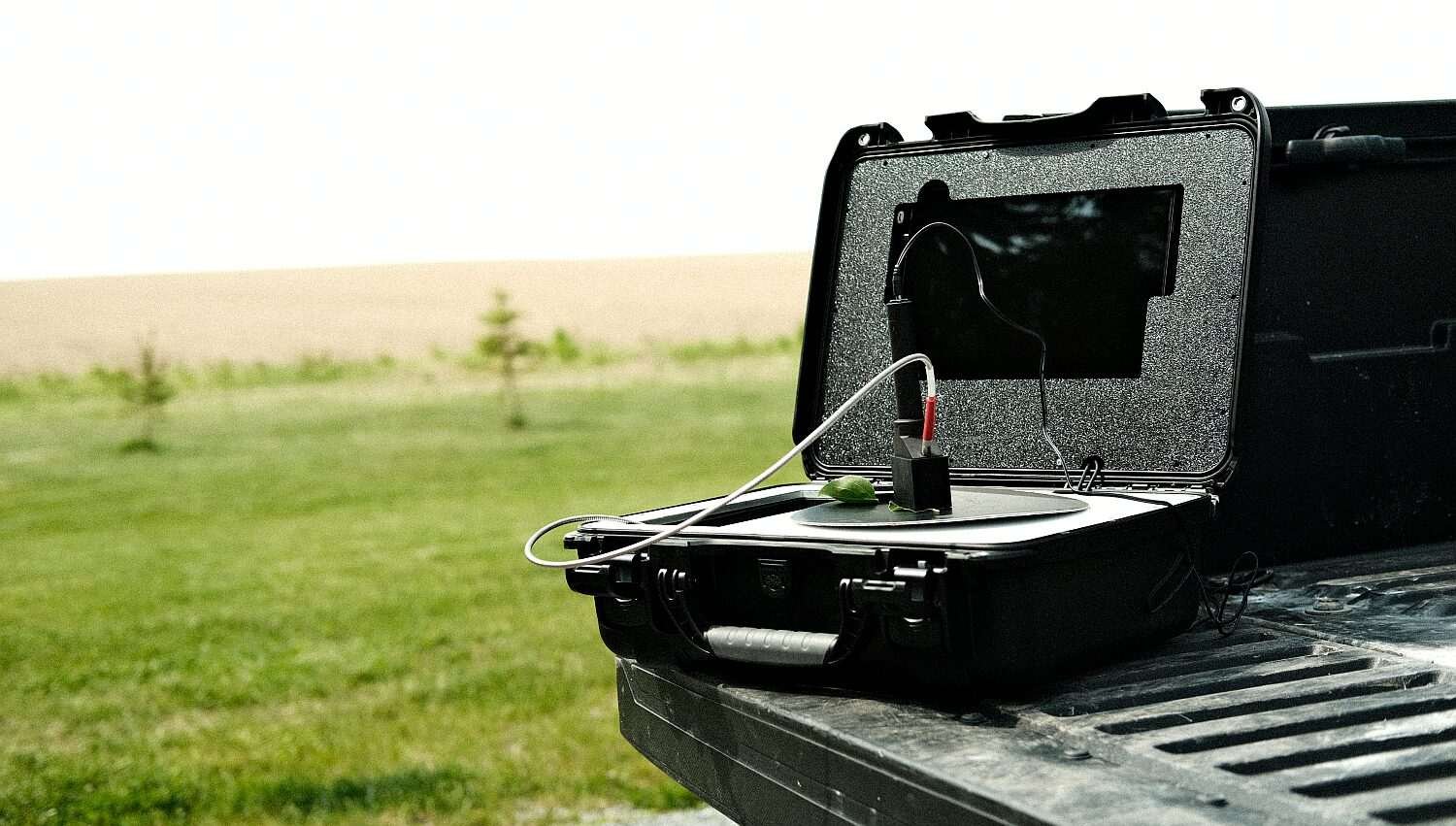
The LENS (leaf evaluated nutrient system) data has been validated using third party lab (chemical) testing. This is coupled with Picketa’s Fieldbook platform, which helps farmers use the LENS data to reduce fertilizer costs by up to 20% and improve yields by applying the right level of nutrition at the right place at the right time.
“Within 10 years, with advances in crop sensing, specialized inputs and autonomous vehicles, we will close the fertilizer loop entirely,” predicted cofounder and CEO Xavier Hebert-Couturier.
“Farmers will not need to think about fertilizers anymore, as their systems will sense what the crop needs, prescribe the right application, and apply it automatically.”
A faster read on crop nutrition
Several novel soil or crop nutrient sensing solutions have emerged in recent years from Crop Diagnostix’s RNA sequencing tech to TerraBlaster’s laser-induced breakdown spectroscopy. However, most farmers still use traditional leaf sampling and lab testing to get a read on levels of key nutrients such as nitrogen and potassium in their crops, Hebert-Couturier tells AgFunderNews.
This typically involves getting a handful of samples and sending them off to a lab for third party analysis, a costly and time-consuming process, he says.
Picketa’s portable system uses optical sensors that measure how a leaf reflects light across a spectrum. It then deploys machine learning to translate that data into nutrient concentrations. Rather than working from a handful of samples, agronomists can now take hundreds of samples from multiple places in the field and get results back in minutes, he explains.
“We’re getting interest from fertilizer companies now as this is research level data on a commercial scale.”
Through the Fieldbook software, agronomists can then share the LENS data with growers, clients, or other team members.
A more granular approach
When Picketa first started talking to farmers, the team was amazed at how few actively tissue test for crop nutrient status at all, says Hebert-Couturier. “Typically the ones that do are either very forward looking and have a yield goal, or something’s gone wrong and they’re trying to figure out what’s happened.
“We talked to hundreds of farmers, and found that one, it’s too slow [for results to come back]; two, it’s expensive; and three, the recommendations you get [for appropriate nutrient levels for a given crop] are somewhat arbitrary. So the standard we’re really competing against right now is not the lab, it’s a visual inspection [farmers looking at the crop for signs of distress, for example].”
Picketa, which has been working with third parties including the University of Guelph, the University of Missouri, the University of Nebraska-Lincoln, and Cornell to calibrate its platform and build the dataset that powers its nutrient models, has more nuanced recommendations.
According to Hebert-Couturier: “The critical [nutrient] levels that the labs use were mainly made in the 1970s, and they’re pretty broad, and might just be one per crop. For something like onions, there might only be a recommended level for the crop for the whole year. We’ve worked with leading agronomic institutions and our industry partners to get region- and variety-specific or even goal-specific recommendations for crops.”
He adds: “Since it’s so easy to go sample with LENS, they can now look at the data before and after an application and see the impact [of a fertilizer application] and learn from that. This is something agronomists value a lot, because oftentimes they make a recommendation to farmers but don’t know if it worked. Now they can say to farmers, let’s do a trial in these two spots and see the before and after.”
Scaling across crops and geographies
Picketa—which was founded in 2020—has validated the LENS tech on potatoes, corn, and canola, and is now expanding support to soybeans and wheat, bringing the platform to crops representing more than 70% of North American acreage. Cotton, onions and tomatoes are also in the pipeline.
“We have been watching Picketa and the LENS technology develop from an early concept in New Brunswick potatoes to this stage across multiple crops in multiple geographies,” said Tall Grass Ventures managing partner Wilson Acton.
“We believe Picketa is at an important inflection point as the uptake among leading agronomists in North America has continued to accelerate. The current fertilizer pricing dynamic is only a further tailwind to approach application decisions with real-time data instead of guesswork or routine.”
A shift from ‘is this possible?’ to ‘how does it work?’
Picketa’s tech is now used by 45 ag retailers in North America. Growers using the platform include Chris Weaver, the world-record soybean yield holder, who is trialing it during the 2026 season.
According to Weaver: “The ability to get results instead of waiting 48 hours completely changes how quickly we can react to problems in the field.”
For $10,000 (USD) a year, Picketa offers the hardware, unlimited sampling, support, and the Fieldbook software. It then dedicates 10% of the fee to lab sample validation to continuously improve its platform.
A couple of years ago, says Hebert-Couturier, “We were still trying to convince people that this was possible. Now the questions are much more about how it works and the service provided.”
Further reading:
Crop Diagnostix launches RNA-based crop health early-warning system
TerraBlaster aims for late 2026 launch with real-time NPK soil mapping at tractor speed
The post Picketa raises $1.5m to bring crop nutrient testing to the field appeared first on AgFunderNews.


