
With fears that the ongoing Canada-U.S. trade war could cause fertilizer prices to soar on both sides of the border, many farmers will be looking in the coming days at what kind options might be available to help them keep a handle on input costs.
A recent contest staged by Agriculture and Agri-Food Canada (AAFC) at the federal agency’s Harrington Research Farm in Charlottetown, P.E.I. provided a bit of insight into what some of those options could be.
In September 2024, Manure Manager wrote about the second iteration of the contest at launch; since then, a winner has been declared – and, more importantly, what’s been learned from the results.
The Plowdown Challenge is the brainchild of science coordinator Scott Anderson and technician Roger Henry, who both work at the AAFC’s Charlottetown Research and Development Centre. The pair conceived of the contest as a way to encourage producers on the island to reduce the amount of nitrogen-based fertilizer they use on their farms.
The contest was rolled out for the first time in 2023. That year, Anderson and Henry planted Mountain Gem potatoes on a field without the use of nitrogen fertilizers following a cover crop of red clover that was planted the previous fall. Farmers and other members of the public were subsequently asked to submit a guess on what the marketable yield would be after harvesting and grading. The winning guess was 169 hundredweight per acre which was submitted by cattle farmer Paul Smallman, who farms in western P.E.I.
Anderson and Henry followed that up with the second annual Plowdown Challenge in 2024. This time there was a twist: they followed all the same steps from the previous year’s contest but added manure to the mix this time around.
Yield results
The actual yield for this years’ AAFC Plowdown Challenge field was a whopping 293 hundredweight per acre, nearly double the previous year’s winning total. The winning guess was 275 hundredweight per acre. It was submitted by Matt Dykerman, a former organic farmer who now works as a potato storage manager for Linkletter Farms in Summerside.
Anderson and Henry say the decision to add manure into the mix was made because an increasing number of farmers in P.E.I. have begun using manure again to boost the yield of their crops, but many haven’t cut back on the amount of fertilizer they use in those fields. The duo wanted to show growers who use manure they can safely cut back on nitrogen-based fertilizer without fearing a corresponding drop in yield.
“There’s various scientists in the region here who had done lots of work in that area trying to maximize crop production with minimal inputs and especially with respect to inorganic fertilizer,” says Anderson.
“But the adoption rate of that is slow because historically producers rely a lot on their fertilizer. What we’re trying to do is some sort of campaign that highlights that issue and does it in a sciency kind of way and fall back on some of that science just to show people that we can do good crop production with less fertilizer.”
The idea to incorporate manure into the contest this past year was actually suggested by the winner of the previous Plowdown Challenge.
“He [Smallman] is a beef producer and he was telling us, ‘You know, you guys would probably have got a lot more yield if you have put some manure on there too’,” Anderson says.
“It was kind of obvious, really. So we said, ‘OK, let’s do it again.’ We’ll do the same thing, but we’re going to add manure as well. What we were trying to do was push the envelope with our potato yields as much as we can without actually adding any inorganic nitrogen.”
This was the second time Dykerman entered the contest. He acknowledges he didn’t fare too well the first time around, finishing quite a ways back of the winning guess. “I guess my (first) guess was not very good,” he says, laughing.
Dykerman says he was encouraged to enter the most recent Plowdown Challenge by Henry, whom he bumped into at an agricultural trade show last fall.
Surprisingly, he didn’t spend a whole lot of time formulating his winning guess. He based it on the evidence he’s seen of what Mountain Gems can yield using traditional management practices on P.E.I. and adjusted that amount because of the alternative approach the contest organizers employed.
“I guess I had a bit of a competitive advantage in that I was quite familiar working in the past with a lot of manure and cover crops. I had a bit of a handle on what results that those types of inputs can produce,” he says. “Also, Mountain Gem is a variety of potato that we grow here on our potato farm (in Summerside) so I’m pretty familiar with them.”
And what did he think of the win?
“I’m not much of a public person so this kind of (attention) doesn’t come naturally to me,” Dykerman says, laughing.
“But I was pleased to win … and that they got as good of a yield as they did. I think they were within a stone’s throw of traditional agronomic yields and I think that’s a really good sign of the potential that manure has for crops in P.E.I.”
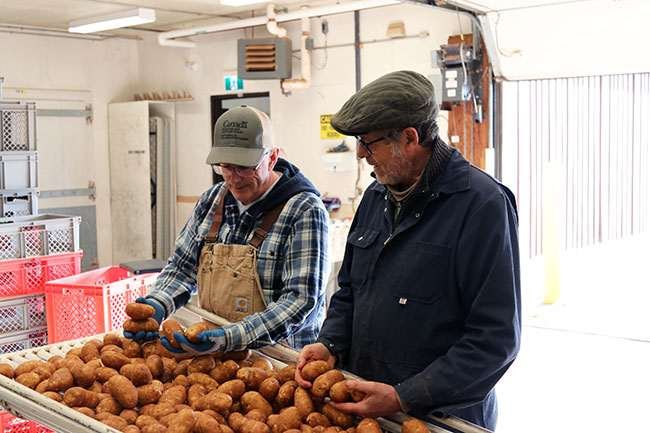
Scott Anderson (left) and Roger Henry of AAFC’s Charlottetown Research and Development Centre grade the potatoes grown for the most recent Plowdown Challenge.
Quantity and quality
While Anderson was confident that the addition of manure to this year’s contest would produce a positive outcome, he admits he was a little taken aback at the kind of crop it produced. The 293 hundredweight per acre was comparable to the 2024 estimated average for P.E.I. of 304.7 hundredweight per acre.
“Yeah, I was actually quite surprised,” he says.
“The crop was in quite early compared to the provincial potato crop. We certainly weren’t the first ones to put potatoes in, but it was still early in the season and early season was favourable. There was really good growth. Things tended to dry out here in August and that affected provincial production as a whole so we were quite happy with what we got.”
Interest in the second go-around of the Plowdown Challenge was up slightly over the previous year’s, a fact Anderson attributes to the use of social media and coverage from mainstream media. That interest included a number of farmers, many of whom came up to Anderson and Henry in the weeks following the contest to speak with them about the use of fertilizer and manure.
“Ultimately, that’s what we were looking for, just to spur on this conversation like, ‘Look what these guys did, maybe I can cut back on (fertilizer) a bit too,” he says. “It’s more about getting people to think about this whole subject rather than just getting entrants for the contest. The contest was just kind of a byproduct of it.”
An issue of access
Dykerman says he doesn’t think the results of the contest are going to change the views of P.E.I. potato producers regarding to the use of manure since most of them are already proponents of incorporating it into on-farm practices.
He says what needs to change is the access farmers have to manure on the island. The amount of manure available to P.E.I. farmers has declined significantly over the past two decades, due in part to Mad Cow disease (BSE) which decimated the Maritime cattle industry in the early 2000s. That trend has recently begun to reverse thanks in part to increased demand for beef products on the East Coast.
“I think most farmers already know the value of manure. I think if there were more available, there would be more widespread use … but there’s this imbalance between supply and demand,” Dykerman says.
“It’s a hard thing to manage if it’s not produced within your area. There’s some freight involved with it then and managing it in your field (is more difficult). I think a lot of farmers are kind of sitting on the sideline when it comes to using manure just because there’s a lack of capability here. I do see that situation improving from years ago, but I think it could still come a little ways more.”
The use of manure can impact potatoes and other row crops in two ways, according to Anderson. The first is that it can provide an important boost to overall soil health. The nutrients it provides means the soil receiving them won’t dry out as fast. That soil also has more fibre and better overall structure which plants love. Second, as manure decomposes it releases nitrogen into the soil which plants can then uptake.
Anderson points out that one of the spinoff benefits of the Plowdown Challenge is that in addition to getting producers talking about reducing the use of fertilizer, its also promoted discussion about proper crop rotations including cover crops and the management of previous crops.
“That’s part of what we’re trying to do is create an awareness of proper crop rotations and proper management of previous crops,” he says. “You can get a bump of nutrients if you manage previous crops well.”

Manure was incorporated into the soil as part of the most recent Plowdown Challenge.
A future plowdown showdown
All good things come to an end, and so it is with the Plowdown Challenge. Anderson and Henry are preparing one final challenge for the 2025 growing season. This time, they are planning to conduct a side-by-side comparison using two fields: one with no fertilizer and another with manure. Members of the public will then be asked to submit a guess on what the yield difference will be between the two fields.•


