

A research team led by scientists at Gdańsk University of Technology in Poland has developed a fabrication strategy for semitransparent perovskite solar cells (ST-PSCs) that protects the perovskite stack during indium tin oxide (ITO) sputtering. At the core of the strategy is the introduction of a solution-processed tin oxide (SnO₂) buffer layer between the phenyl-C61-butyric acid methyl ester (PCBM) electron transport layer (ETL) and the sputtered rear ITO electrode.
“The main novelty of our work is the development of highly efficient and operationally stable semitransparent p-i-n perovskite solar cells designed for four-terminal perovskite/c-Si tandem devices,” corresponding author Damian Glowienka told pv magazine. “We did not focus only on achieving high initial efficiency. We combined electrode and buffer-layer optimization with optical and electrical loss analysis, tandem integration, and long-term stability testing under both indoor and outdoor ISOS protocols.”
Glowienka explained that one of their most important follow-up directions is the development of wide-bandgap perovskite solar cells for the top sub-cell. “The perovskite bandgap used in the current study was not yet optimal for tandem operation,” he added. “A wider-bandgap absorber should transmit more low-energy photons to the silicon bottom cell, which can further improve the total tandem efficiency.”
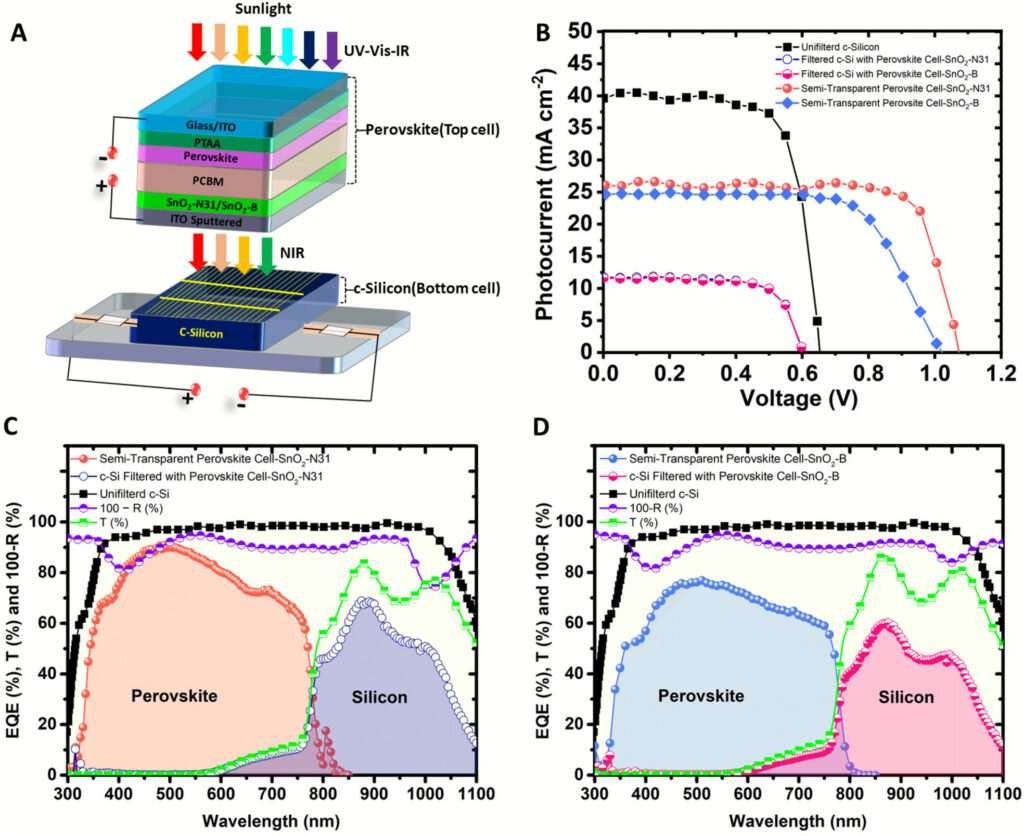
The researchers first fabricated conventional opaque p–i–n perovskite solar cells with the substrate made of glass and ITO, a hole transporting material (HTL) made of poly(triarylamine) (PTAA), the perovskite absorber, the PCBM ETL, a tin oxide (SnO2) buffer layer, a rear ITO layer and a silver (Ag) metal contact. The SnO₂ buffer layer was placed between the PCBM electron-transport layer and the sputtered ITO electrode to protect the underlying layers during room-temperature DC magnetron sputtering. Four commercial SnO₂ formulations (SnO₂-B, SnO₂-N30, SnO₂-N31, and SnO₂-T) were evaluated, while the rear ITO thickness was optimized by testing 200, 300, and 400 nm films.
The best-performing semitransparent device, using the SnO₂-N31 buffer layer and a 300 nm rear ITO electrode, was further integrated with a commercial crystalline silicon bottom cell to form a four-terminal (4T) tandem device. The tandem efficiency was analyzed by combining the efficiencies of the perovskite top cell and the filtered silicon bottom cell. Encapsulated devices were evaluated using standardized ISOS-L-1 light-soaking and ISOS-O-3 outdoor stability tests.
“The semitransparent perovskite solar cell reached a champion power conversion efficiency of 21.87%. When this device was mechanically stacked with a commercial crystalline silicon solar cell in a four-terminal configuration, the combined tandem efficiency reached 27.15%,” Glowienka said. “Another important result is the operational stability. The devices achieved a T80 of 1600 h under continuous light soaking according to the ISOS-L-1 protocol and maintained operation for more than 4000 h under outdoor ISOS-O-3 conditions. This shows that high-efficiency semitransparent perovskite devices can also be made sufficiently durable for realistic tandem-relevant testing.”
Furthermore, Glowienka added that a loss analysis showed that the main remaining limitations are not limited to the perovskite absorber itself. “Series resistance and optical losses, especially parasitic infrared absorption in the transparent electrodes, still play an important role in limiting the performance of the 4T tandem device,” he said.
“We are currently working on wide-bandgap p-i-n perovskite solar cells, while keeping the same key requirements: high transparency, low electrical losses, compatibility with transparent electrodes, and long-term operational stability. Further optimization of the transparent electrodes and reduction of parasitic near-infrared absorption will also be crucial for improving the performance of 4T perovskite/silicon tandems,” he concluded.
The new manufacturing technique was presented in “Efficient and Durable Semitransparent Perovskite Solar Cells for the Application in 4T Perovskite/c-Si Tandem Devices,” published in Progress in Photovoltaics: Research and Applications. Scientists from Poland’s Gdańsk University of Technology, the Polish Academy of Sciences, and Taiwan’s Ming Chi University of Technology have contributed to the research.
The post Polish scientists build 21.87% semi-transparent perovskite PV cell for tandem applications appeared first on pv magazine Global.


