
Water — whether for lawns, gardens or farms — is precious. As gardeners and farmers, we know how essential it is to water correctly: too little and plants suffer; too much and water — as well as time and money — goes to waste. That’s where a good irrigation controller comes in.
Recently I tried the Rain Bird SST1200OUT, a timer/controller designed to automate watering for multiple zones. In this review I share what it is, how it works, why it matters, and how it performed in my own gardening setup. If you care for a garden, lawn, or multiple planting beds — this might be useful to know.
What Is Rain Bird SST1200OUT Simple to Set Irrigation Controller?
The Rain Bird SST1200OUT is a “sprinkler/irrigation timer & controller” — basically an automatic brain for your sprinkler or drip-irrigation system. Instead of manually turning water on and off or running hoses, this device lets you program watering times and zones. Once set up, it controls when, how long, and where water goes — automatically.
This model is built for indoor or outdoor use, and can control up to 12 zones or stations (valves). It’s meant for home gardens, lawns, or medium-to-large residential landscapes, but its robust design also suits more demanding conditions. Some of the key features of the Rain Bird SST1200OUT include:
a. Controls up to 12 valves/zones — great for multiple garden beds, lawns, front yard, backyard, different soil types, etc.
b. Each zone’s watering schedule can be set independently with custom watering times, days, or even odd/even day cycles.
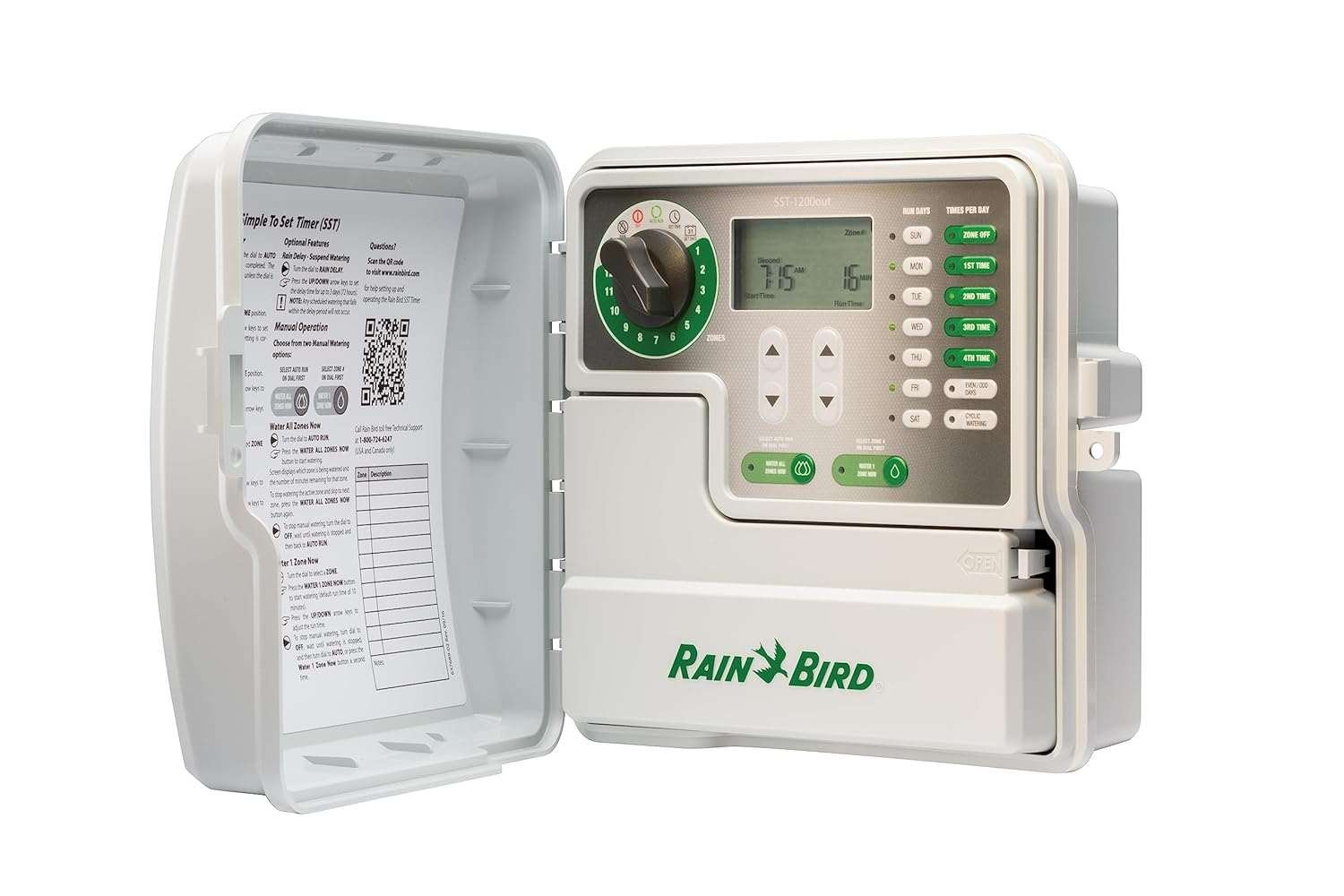
c. Supports up to four watering times per day, per zone — useful for complex watering needs (e.g. slopes, clay soil, plants requiring frequent but short watering).
d. Seasonal Adjust: you can quickly adjust watering duration for all zones — e.g. increase watering during hot, dry season or reduce during cooler/rainy seasons.
e. Rain Delay feature: skip watering for up to 72 hours when rain comes, then resume automatically.
f. Manual watering buttons: “Water one zone now” or “Water all zones now” — handy for immediate watering needs without reprogramming schedules.
g. Durable build: weather-resistant cabinet, sealed case to guard against moisture, insects, grime; built-in surge protection (useful in areas with unstable electricity).
h. Compatible with standard 24 VAC irrigation valves.
In short, Rain Bird designed this timer to be user-friendly, flexible, and rugged — suitable for both casual gardeners and more serious landscape watering setups.
Pros & Cons of Rain Bird Irrigation Controller
| Pros | Cons |
|---|---|
 Up to 12 zones — ideal for complex gardens or multiple beds. Up to 12 zones — ideal for complex gardens or multiple beds. |
 It is not a “smart” controller — no soil sensor, weather integration, or Wi-Fi. It is not a “smart” controller — no soil sensor, weather integration, or Wi-Fi. |
| Independent scheduling per zone + multiple daily start times. |
Requires manual programming and seasonal adjustments. |
| Seasonal adjust & rain delay to reduce water waste. |
Four start-times per day may be limiting for advanced irrigation. |
| Easy to program and operate, even for beginners. |
Digital display may be small or hard to read. |
| Durable, weather-resistant build for indoor/outdoor use. |
Not suitable for high-precision irrigation that needs sensors. |
Why Simple Irrigation Controller Matters?
Water scarcity is an increasing global concern; efficient irrigation is no longer a luxury — it’s a necessity. Using a timer/controller like SST1200OUT helps ensure water reaches roots when needed and avoids wastage. Studies on advanced irrigation controls (even beyond simple timers) highlight enormous water savings. For example: Research shows that advanced irrigation controllers (weather-based or sensor-based) can reduce water use by 15%–40% compared to conventional irrigation.
In many cases, households save 30% or more in water consumption simply by shifting from manual watering to automated scheduling and proper control. Annual water savings per household using efficient smart/well-managed timers can amount to thousands of gallons — reducing stress on water supply systems and lowering water bills.
While SST1200OUT is a traditional (non-smart) timer rather than a “smart controller,” its zone-based scheduling, seasonal adjust, and rain delay features nonetheless improve watering efficiency compared to purely manual watering. That means less water wasted in evaporation, runoff or overwatering — which benefits your plants and conserves resources.
From a plant-health perspective, correct watering timing and amounts reduce risks like root rot, nutrient leaching, or fungal issues caused by over-watering (or inconsistent watering). Automated, scheduled watering helps keep soil moisture more stable — a big plus for gardens, lawns, or crops. Here are some recent findings and data that support why using automated irrigation systems matters:
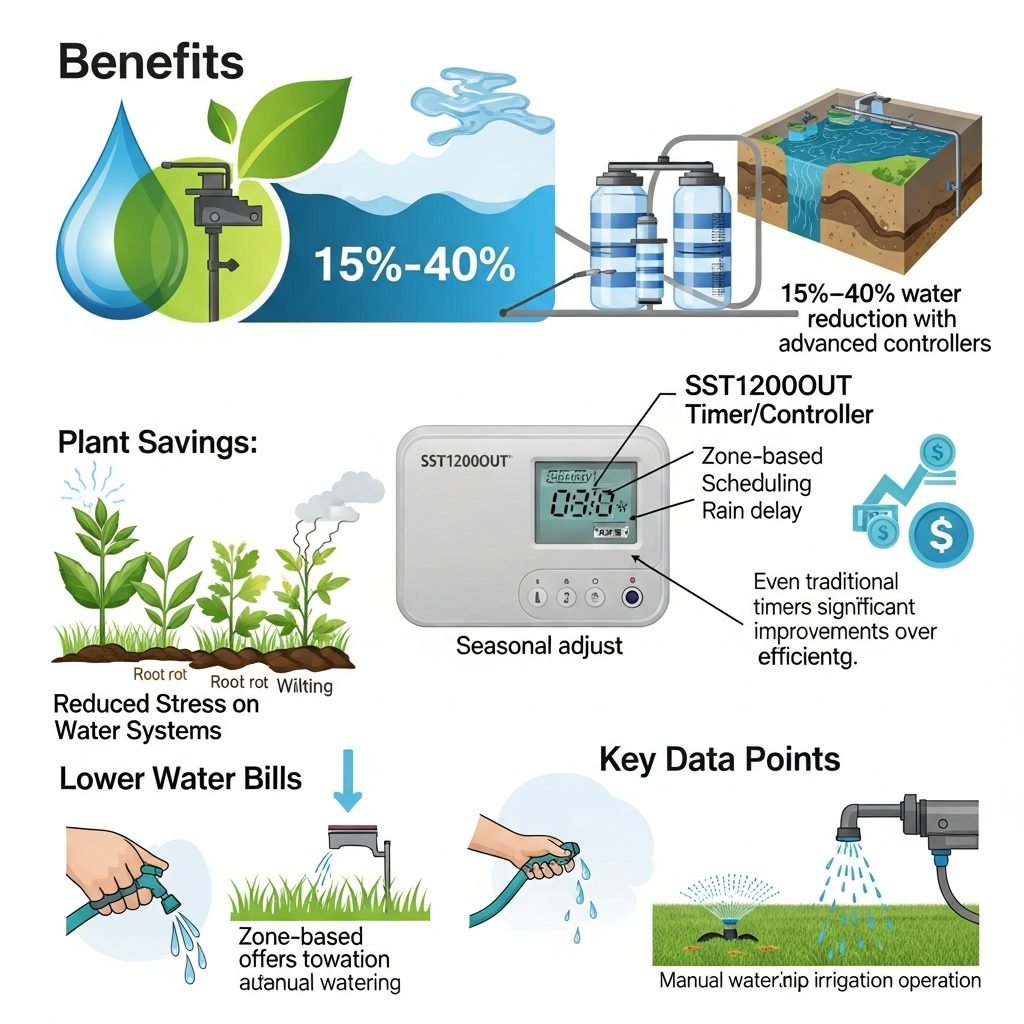
According to a review of multiple studies, advanced controllers (soil-moisture sensor, rain sensor, or weather-based) on average save 38% (soil moisture sensors), 21% (rain sensors), and 15% (weather-based controllers) in water use compared to traditional irrigation setups.
Some real-world case studies show up to 40% water savings for large landscapes when smart or well-managed controllers are used. Overwatering and inefficient manual irrigation contribute significantly to water waste globally. Automated systems can reduce that waste — contributing to water conservation efforts and reducing strain on water infrastructure.
For residential landscapes, using zone-based scheduling (instead of one-size-fits-all watering) ensures that different plant types — lawns, shrubs, flowerbeds, trees — get water appropriate for their root depth and needs. This precision supports healthier plant growth and reduces resource waste.
While many of these studies focus on “smart” controllers or sensor-based irrigation, the general principles — proper scheduling, zone-based watering, avoiding unnecessary watering — apply to manual timers like SST1200OUT too. By using a good timer well, you can still capture a portion of these benefits.
My Experience with Rain Bird SST1200OUT Irrigation Controller
I installed SST1200OUT in my home garden / small-scale farm setup (you can adapt this to your own situation — I’ll describe as I experienced it):
I have multiple planting beds: a lawn in front, a rose garden, some raised beds (vegetables/flowers), and a few shrubs/trees.
I wired the controller to different valves: lawn sprinkler valves, drip-line valves for beds, and a separate valve for trees. That meant using multiple zones — exactly what SST1200OUT is designed for.
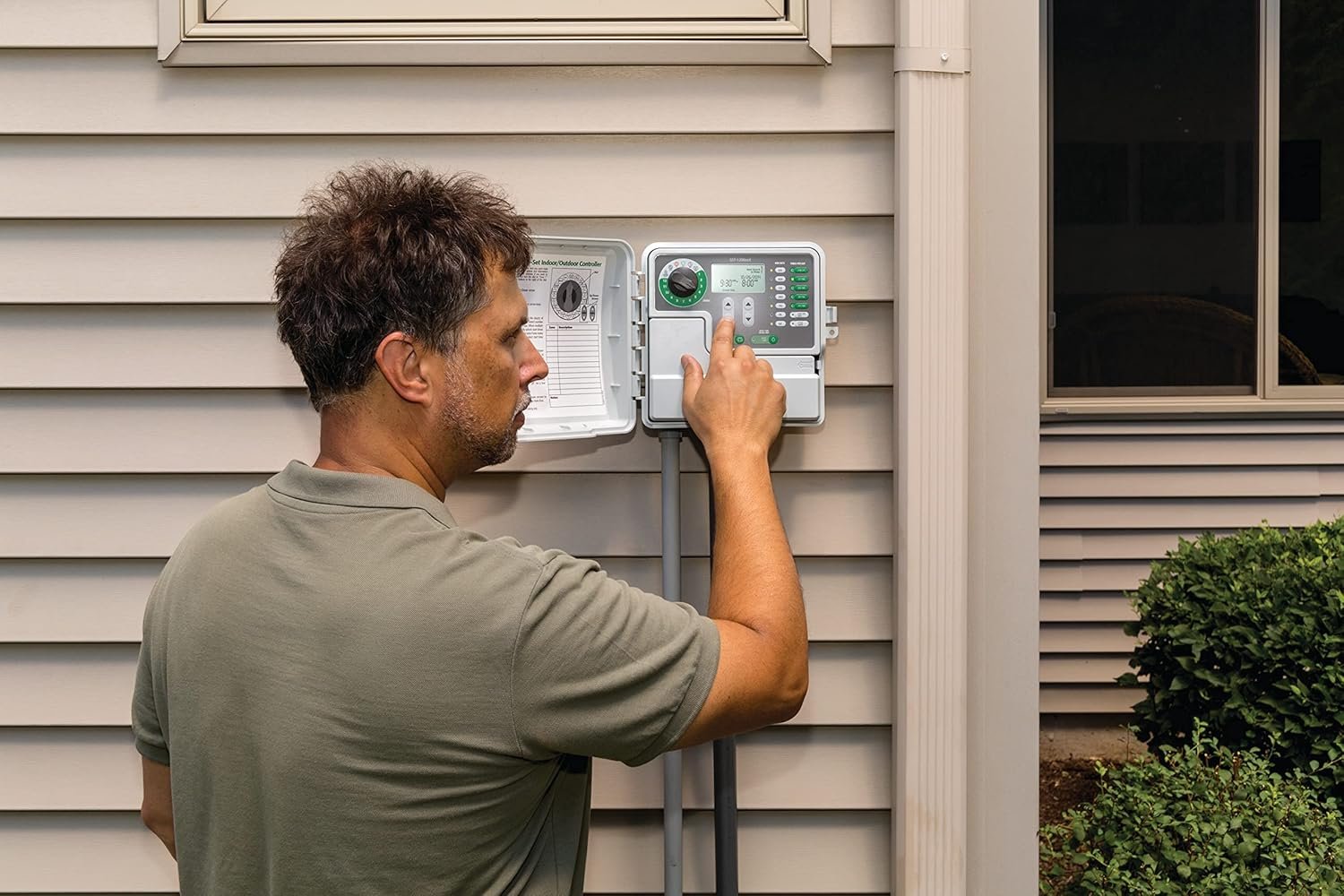
After installation (by an electrician, just to be safe, because of the wiring), programming was straightforward. I designated watering times for each zone, set days of week based on local climate, and defined different durations depending on plant type (short for beds, longer for lawn/trees).
What I noticed over time:
The convenience: once set, the system waters automatically — I no longer had to drag hoses or remember watering schedules. In hot weather, watering got done early morning without me getting up specially.
i. Water bill & water usage: I observed noticeable reduction in water usage compared to when we watered manually or used an old non-programmable timer.
ii. Plant health: lawns stayed greener, flower beds looked healthier, and trees seemed to thrive — likely because watering was more consistent and better matched to plant needs.
iii. Flexibility: With seasonal adjust, I could easily increase watering time during dry/hot weeks and reduce when we had rain or cooler weather. Also, the “rain delay” helped skip watering after rainfall.
iv. Durability: The weather-proof cabinet held up well to outdoor conditions — even during rainy days or high humidity (which we often have). No signs of moisture inside or malfunction.
v. Some minor drawbacks: the digital display is a bit small, so programming sometimes required good light or a flashlight. Also, because there is no “smart sensor,” I found myself checking soil moisture manually during heavy heat or dry spells — a “smart” controller might do that automatically.
Performance of Rain Bird Irrigation Controller
Overall, performance has been strong:
The SST1200OUT reliably switched zones on schedule, ran the set durations, and managed multiple zones independently without mixing up settings.
The build quality and protection (surge protection + weather sealing) seem solid — no damage so far despite summer heat and occasional voltage fluctuations.
Watering was even and consistent, avoiding both under- and over-watering. Garden beds and lawn responded well; plant stress due to uneven watering decreased.
Manual overrides worked: when I needed to water a particular bed immediately (e.g. after transplanting seedlings), the “Water One Zone Now” button proved handy.
In short: for a non-smart but well-designed timer/controller, SST1200OUT delivered dependable performance and convenience — exactly what one would expect from a quality irrigation controller.
Practical Tips for Rain Bird Simple Set Irrigation Controller
If you decide to use SST1200OUT (or similar timer), here are some practical tips based on my experience and common best practices
i. If you use SST1200OUT (or any similar timer/controller) in a garden/farm — especially in climates like Punjab (hot summers, variable rainfall) — here are some tips from my experience and research:
ii. Use Zone-Based Scheduling Wisely — Assign zones by plant type: lawns, shrubs, vegetables, trees. Each needs different watering depth and frequency.
iii. Program Multiple Start Times if Needed — For clay soil or raised beds, using shorter but frequent watering (instead of a single long run) helps water soak deeper and reduces runoff. SST1200OUT supports up to four start times/day per zone.
iv. Take Advantage of Seasonal Adjust — In hot, dry months increase watering +- percentage; during rainy or cool months reduce it. This prevents overwatering or underwatering.
v. Use Rain Delay After Rainfall — Skip irrigation for a few days after rain to avoid waterlogging and waste.
vi. Combine With Manual Soil Checks — Because SST1200OUT lacks soil-moisture sensing, occasionally check soil moisture especially for sensitive plants or during heat spells to avoid stress.
vii. Ensure Proper Installation & Surge Protection — Use qualified electrician if wiring is involved, especially in places with unstable electricity. The built-in surge protection helps.
viii. Adjust for Local Weather/Seasons — If you live where seasons vary, revisit your schedule at least monthly. Don’t rely on a “set once” program.
ix. Label Zones and Valves — When you set up multiple valves, keep a clear map/labels — makes maintenance and troubleshooting much easier.
Comparison with Alternatives Irrigation Controller
When thinking about watering gardens, lawns, or small farms, there are several different approaches — each with trade‑offs. Below is a comparison between the Rain Bird SST1200OUT and some common alternatives:
| System / Method | Approx. Cost | Number of Zones | Automation Level | Water Efficiency | Pros & Cons |
|---|---|---|---|---|---|
| Manual Watering (hose/watering can) | Low | 1 | No automation | Low | Pros: Simple, low cost Cons: Labor-intensive, inconsistent watering, potential water waste |
| Single-zone Timer Sprinkler | Low to Medium | 1 | Partial automation | Medium | Pros: Automates watering, easy setup Cons: Cannot differentiate zones, inefficient for mixed gardens |
| Rain Bird SST1200OUT Multi-zone Timer | Medium | Up to 12 | Full zone-based automation (manual seasonal adjust) | High | Pros: Flexible scheduling, durable, water-saving potential Cons: No Wi-Fi/smart features, requires programming |
| Smart / Weather-based Controllers | High | Up to 16+ | Automatic based on sensors/weather | Very High | Pros: Maximum water efficiency, minimal intervention Cons: Expensive, complex setup, sensor maintenance required |
| Drip Irrigation + Timer | Medium | Multiple (customizable) | Partial to full automation | High | Pros: Direct root watering, minimal evaporation, water-efficient Cons: Installation effort, prone to clogging, needs regular inspection |
Final Recommendation
For anyone who has a home garden, lawn, multiple planting beds, or a small farm — and wants a reliable, easy-to-use, reasonably priced controller — the Rain Bird SST1200OUT is a solid choice.
If you want automation without needing to check soil moisture daily or program every time weather changes, and if your irrigation setup involves multiple zones, then SST1200OUT offers good value: easy programming, flexibility, durability, and real-world savings in water use and labour.
However — if your goal is maximum water conservation or precise irrigation based on soil moisture/weather data (especially in harsh climates or farms with diverse crops) — you may want to consider a “smart” sensor-based controller or a system that adapts automatically.
In my experience, SST1200OUT struck a good balance between simplicity and efficiency. It made my watering management easier, saved water, and kept my garden healthy — which for me, as an agriculture lover and gardener, is the main goal.


