
If you love gardening and want your plants to stay green without you having to water them every day, a sprinkler timer can be a real game-changer. Manually watering your garden — especially in hot weather — can be time consuming, and it’s easy to forget or over-water, which can harm plants or waste water.
That’s why I tried the RAINPOINT Sprinkler Timer this season. In this review I’ll share my honest experience — what worked, what didn’t, and whether it’s worth buying for small to medium gardens.
What is RAINPOINT Programmable Sprinkler Water Timer?
The RAINPOINT Sprinkler Timer is a digital irrigation timer that you connect to your outdoor faucet (tap) and then to your garden hose or soaker hose. Once connected, you can program it to water automatically on a schedule — so your garden gets water even if you’re not home.
It offers settings like manual watering, automatic watering, and rain delay (to skip watering after rain). In simple terms: it turns your ordinary hose into a semi-automated sprinkler system. This timer is designed for home gardens, lawns, small farms, landscape areas, raised beds, vegetable patches, soaker hoses, fruit trees, and greenhouse irrigation.
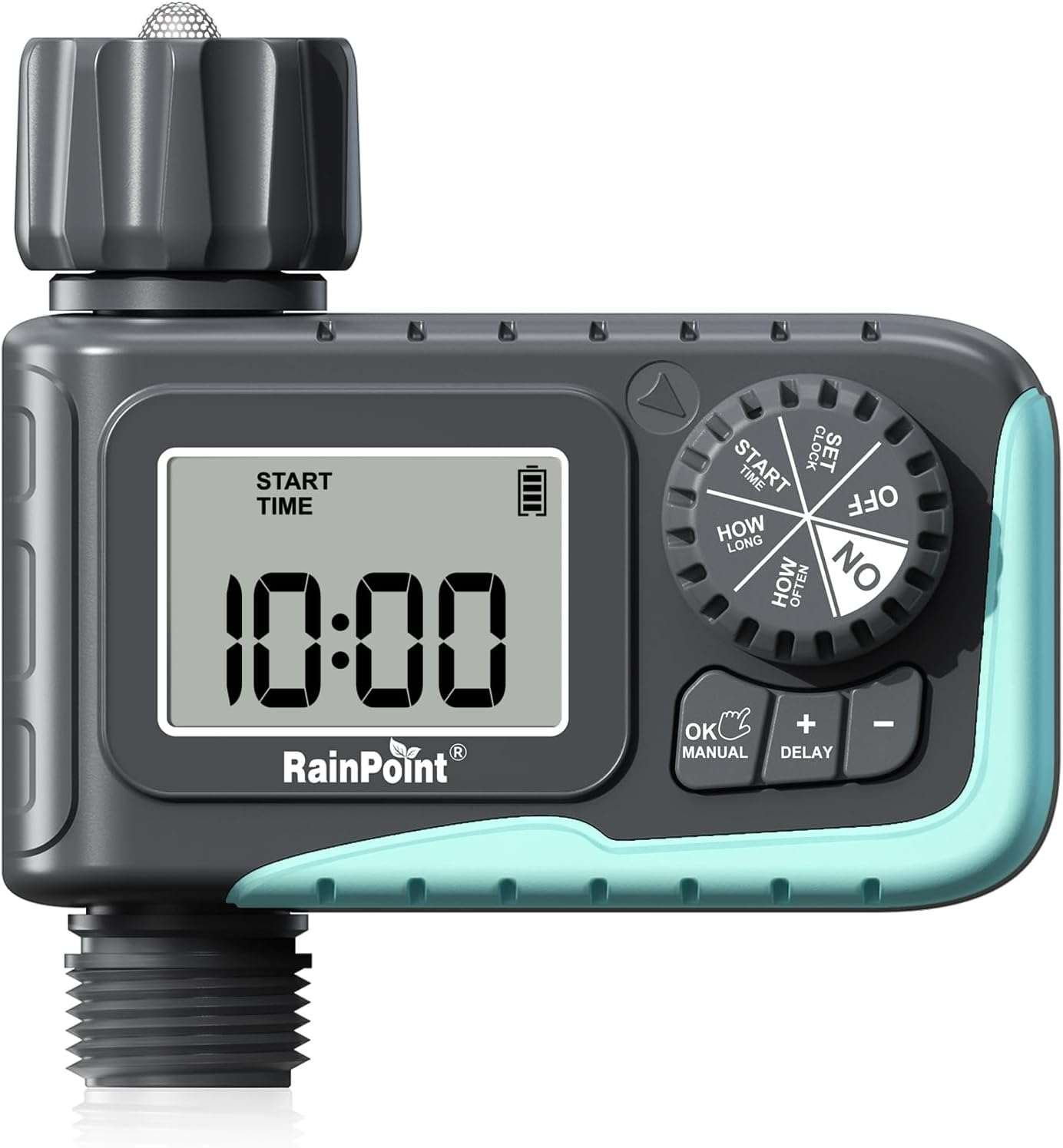
- Type: Garden hose water timer / sprinkler timer (1 outlet)
- Power: Battery-powered (so you don’t need electricity)
- Modes: Manual, Automatic schedule, Rain delay / pause
Use case: Home gardens, lawns, small to medium plots, new grass seed watering, flower beds, vegetable gardens, small orchards — basically anywhere you use a normal hose or soaker hose.
What it does: Opens/closes water flow according to programmed schedule. Automates watering even when you are away. Prevents over-watering or forgetting to water. Acts like a “set-and-forget” watering assistant.
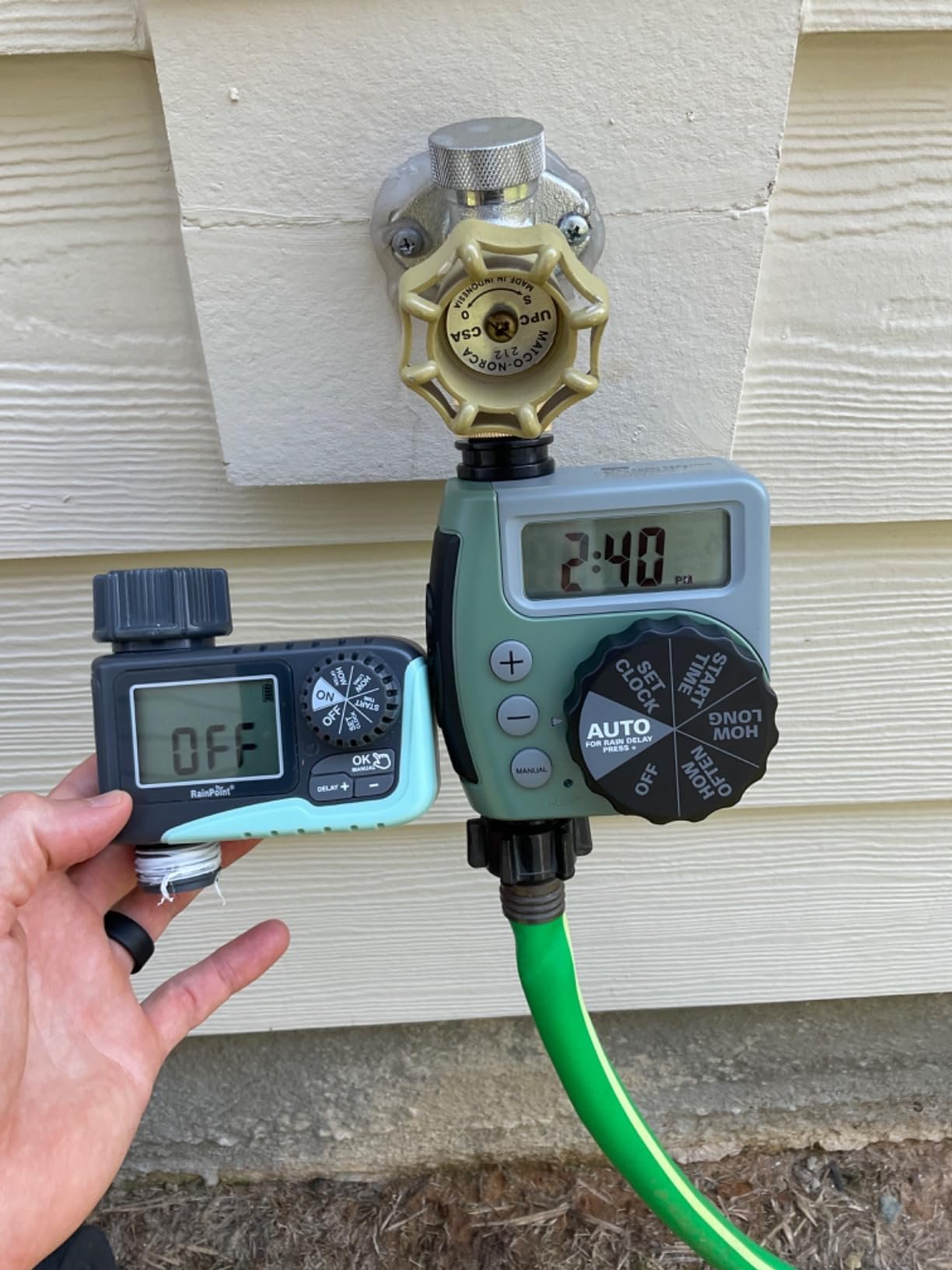
From my use: I hooked it to my faucet in my pasture and connected to the garden hose. It successfully watered my garden all summer long, exactly on schedule. I also used it to water new grass seed recently, and it worked perfectly.
Pros & Cons of RAINPOINT Water Timer
Here’s a quick table of what I found good and what could be improved:
| Pros | Cons |
|---|---|
 Very easy to install and program — straightforward even for beginners Very easy to install and program — straightforward even for beginners |
 Plastic fittings feel a bit lightweight / less heavy-duty Plastic fittings feel a bit lightweight / less heavy-duty |
| Automatic watering — no need to manually water daily |
Programming can be a bit confusing for first-time users; interruptions if you manually override the schedule |
| Rain delay / automatic timer helps avoid water waste and overwatering |
Timer-based system — doesn’t adjust automatically to rainfall or soil moisture |
| Saves time — frees you from daily watering chores, very helpful in hot climate or busy schedule |
For large gardens or complex multi-zone irrigation, a single-outlet timer may not be enough |
| Affordable compared to advanced smart irrigation controllers |
No advanced sensors or soil moisture detection — less precise than smart systems |
Why Water Timer for Garden Hose Matters?
Watering plants properly is essential for healthy growth. But manual watering — especially under irregular schedules — often leads to problems: Overwatering or underwatering, both of which stress plants. Overwatering can cause root rot, fungal diseases, or nutrient leaching. Underwatering can stunt growth or kill plants.
- Missed watering — when you forget to water.
- Water waste — watering at wrong time (hot midday) increases evaporation; or watering even when soil already moist.
A timer-based irrigation system like RAINPOINT helps address many of these issues: it ensures consistent watering, reduces human error, and can water at optimal times (early morning / late evening) when evaporation is lower.
Automated watering systems have become an important part of sustainable gardening and small-scale agriculture — especially in regions with water scarcity or irregular rainfall. Using timers or smart controllers helps conserve water, ensure plant health, and save time.
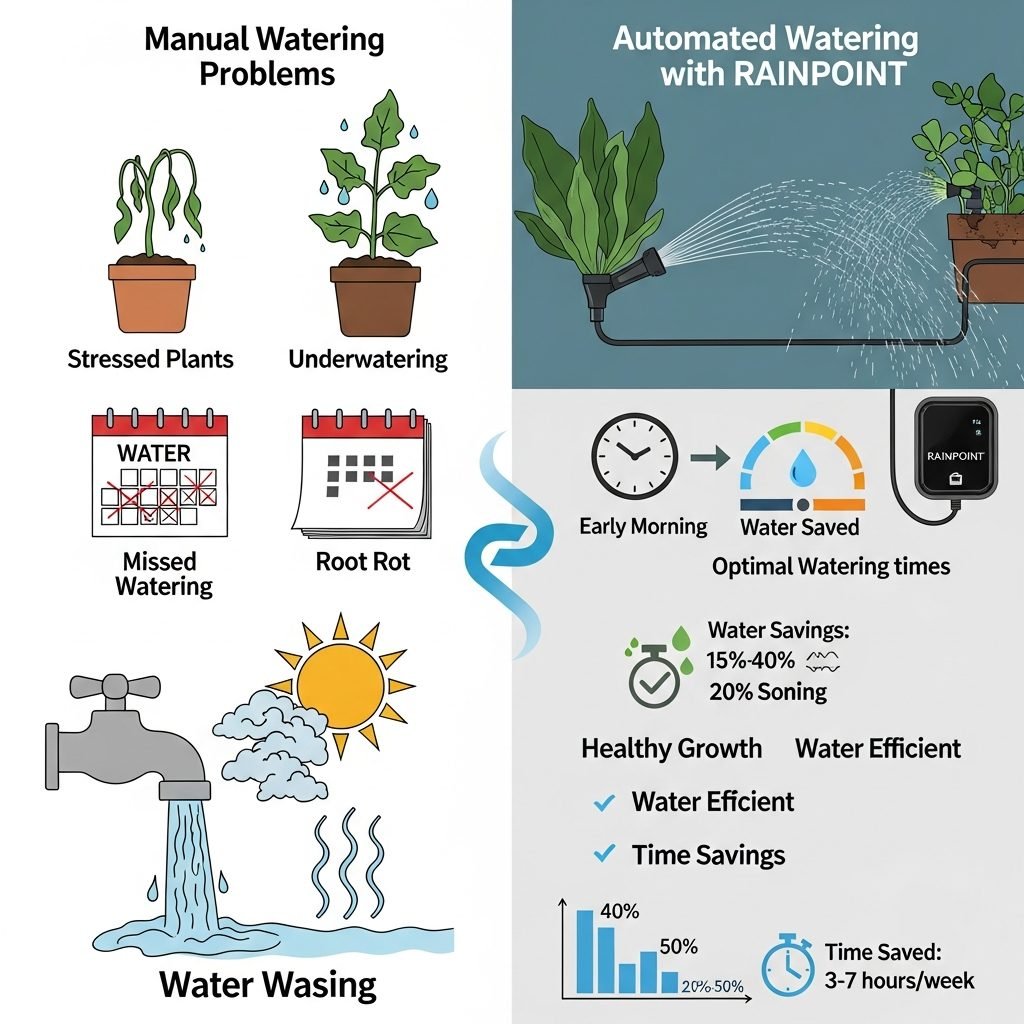
Research shows that automated irrigation controllers (with weather or soil-moisture sensors) can reduce outdoor water use by 15%–40% compared to traditional manual watering or non-optimized systems.
Some smart irrigation controllers report 20%–50% water savings compared to conventional methods (especially in climates with changing weather), thanks to adaptive scheduling. For gardens using standard timers (like RAINPOINT), benefits still include time savings—automated systems can save gardeners 3–7 hours per week by eliminating manual watering work.
Automated watering helps provide consistent moisture to soil, which supports healthier root growth and reduces plant stress — resulting in better yields or healthier lawns and plants. While many studies focus on sensors or “smart” controllers, even simple timer-based waterers like RAINPOINT contribute to more disciplined, scheduled watering — which translates into water savings, less waste, and healthier plants compared to random manual watering.
My Experience with RAINPOINT Programmable Water Timer
In my case, I used the RAINPOINT Sprinkler Timer on a small–to–medium garden patch at home. I hooked it up to my outdoor faucet, connected a hose with sprinklers/soaker, and programmed it for regular watering during summer — when rainfall was scarce and temperature high.
I used the timer mostly during the hot months. I set it to water early in the morning (to reduce evaporation), and scheduled watering intervals depending on weather: more frequent in hotter dry spells, less when occasional rains came.
Here’s what I observed:
For the entire season, the garden stayed consistently watered and green. I didn’t have to worry about remembering to water or being away.
The silicone tape included helped create a leak-free connection — I didn’t get drips or waste at the faucet or at hose joints after initial setup.
The battery held up well; after two weeks of operation it was still going strong (as per the meter).
Once, I mistakenly turned off the faucet — but the timer was still running (countdown), so no water came out. That moment reminded me that although the timer automates scheduling, it still requires correct manual setup (faucet ON, hose connected).
Overall, for a “set and forget” solution — it performed very reliably. From my perspective, for a simple home garden / lawn, this is a great solution: inexpensive, easy to use, and trustworthy.
Performance of RAINPOINT Water Timer
In my experience, performance was very good. The timer delivered water on schedule; plants remained healthy; soil moisture stayed consistent; and water waste was minimized (no overwatering, no daily manual watering). For new grass seed, the growth and coverage were uniform — which might be harder if you water irregularly by hand.
However, performance has limits: because this is a timer-based system (not “smart”), it does not automatically adjust watering according to weather, rain, or soil moisture. That means if unexpected rain occurs, the timer doesn’t know — you have to manually pause or adjust.
In my climate (relatively dry), this wasn’t a big problem — but in a region with unpredictable rain, that’s something to watch out for. Also, for larger gardens or multi-zone irrigation, a single-outlet timer may not suffice — you may need multiple timers or a more advanced multi-zone controller.
Practical Tips for RAINPOINT Water Timer for Garden Hose
If you decide to use RAINPOINT (or similar timer), here are some tips to get the best results:
i. Use plumber’s tape / silicone tape on threaded connections to avoid leaks (as manufacturer recommends).
ii. Program watering for early morning or late evening, when temperature is lower — this reduces evaporation and ensures better soil absorption.
iii. Keep faucet/spigot ON if timer uses internal valve — otherwise no water will flow when timer triggers (happened to me once).
iv. Check battery regularly — timer is battery powered; ensure battery has good power, especially before hot/dry season.
v. Use proper hose size and nozzles — ensure hose and sprinkler/soaker hoses are appropriate for pressure and flow; avoid too thin hoses that may reduce water pressure.
vi. Monitor soil moisture manually once in a while — since the timer doesn’t sense rain or soil moisture, it’s good to manually check soil after rain or heavy watering to avoid over- or under-watering.
vii. For larger gardens, consider multiple timers or upgrade to a multi-zone / smart controller — single outlet may limit water coverage.
viii. Seasonal adjustments — adjust schedule based on season, weather or plant growth stage.
Comparisons with Alternatives Water Timer
Let’s compare RAINPOINT Sprinkler Timer with some other common irrigation approaches:
| Feature / Brand | RAINPOINT | Orbit | Melnor | Smart Wi-Fi Timer |
|---|---|---|---|---|
| Ease of Use | Very easy to program | Moderate learning curve | Easy but some buttons confusing | Requires app & setup |
| Price | Budget-friendly | Slightly expensive | Mid-range | High-end |
| Durability | Good for outdoor use | Very durable | Durable | Depends on model |
| Watering Modes | Automatic + Manual + Rain Delay | Automatic + Manual | Automatic + Manual | Automatic + Manual + App scheduling |
| Outlets | 1 outlet (dual version available) | 1–2 outlets | 1 outlet | 1–4 outlets |
| Best For | Small to medium gardens, beginners | Lawn and medium gardens | Home gardens, moderate users | Tech-savvy users, smart homes |
Final Recommendations
If you are a gardener or small-scale farmer and you want easy, affordable, and reliable watering automation for your lawn, garden, or small orchard — then RAINPOINT Sprinkler Timer is a very good choice. It’s easy to install and program, it saves time, and ensures more consistent watering than manual methods.
I recommend it especially if:
- Your garden is small to medium size.
- You don’t want complicated setups or expensive smart systems.
- You want a “set-and-forget” watering solution.
- You are okay with periodic manual checks (for rainfall or soil moisture).
However, if you have a large garden, or want maximum water efficiency, or need irrigation that adapts automatically to rain or soil moisture, then consider investing in a smart or sensor-based irrigation controller (or a drip irrigation + timer / controller system). For my use and in my climate, RAINPOINT worked very well — I’m satisfied, and I would 100% recommend it to other gardeners.


