Ranked: AI Competitiveness by Country
Key Takeaways
- The U.S. leads global AI competitiveness by a wide margin, with China and India following.
- This ranking reflects not just R&D output, but economic strength, policy engagement and public awareness of AI.
- Smaller high‑income countries like Singapore and UAE outperform many larger economies relative to their size.
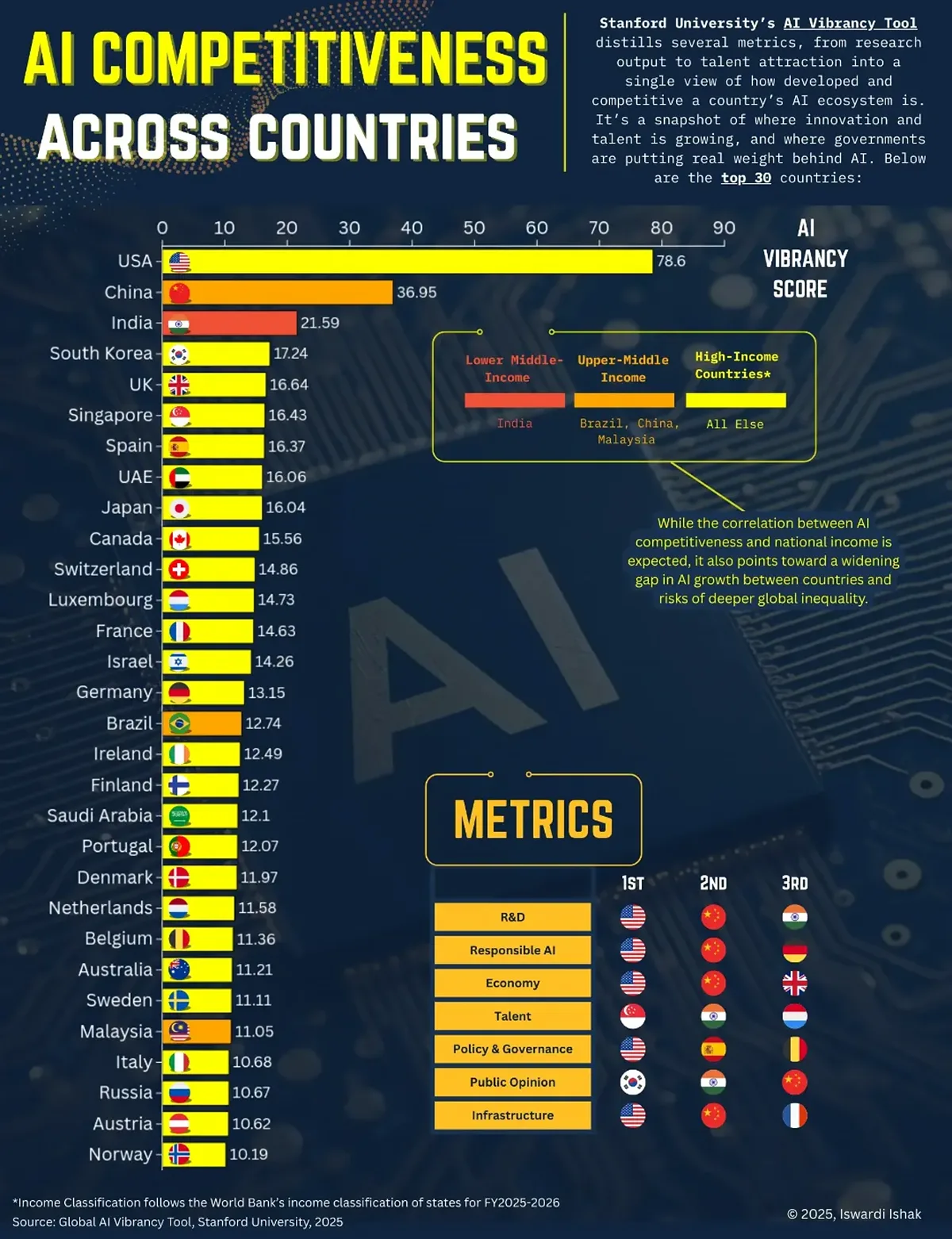
The infographic above, created by Iswardi Ishak, uses data from Stanford University’s Global AI Vibrancy Tool, which aggregates dozens of indicators of national AI performance, from research output and investment to talent attraction and governance frameworks.
Here’s how the world’s most AI‑competitive countries rank:
| Rank | Country | AI Vibrancy Score |
|---|---|---|
| 1 |  United States United States |
78.6 |
| 2 |  China China |
36.95 |
| 3 |  India India |
21.59 |
| 4 |  South Korea South Korea |
17.24 |
| 5 |  United Kingdom United Kingdom |
16.64 |
| 6 |  Singapore Singapore |
16.43 |
| 7 |  Spain Spain |
16.37 |
| 8 |  UAE UAE |
16.06 |
| 9 |  Japan Japan |
16.04 |
| 10 |  Canada Canada |
15.56 |
| 11 |  Switzerland Switzerland |
14.86 |
| 12 |  Luxembourg Luxembourg |
14.73 |
| 13 |  France France |
14.63 |
| 14 |  Israel Israel |
14.26 |
| 15 |  Germany Germany |
13.15 |
| 16 |  Brazil Brazil |
12.74 |
| 17 |  Ireland Ireland |
12.49 |
| 18 |  Finland Finland |
12.27 |
| 19 |  Saudi Arabia Saudi Arabia |
12.1 |
| 20 |  Portugal Portugal |
12.07 |
| 21 |  Denmark Denmark |
11.97 |
| 22 |  Netherlands Netherlands |
11.58 |
| 23 |  Belgium Belgium |
11.36 |
| 24 |  Australia Australia |
11.21 |
| 25 |  Sweden Sweden |
11.11 |
| 26 |  Malaysia Malaysia |
11.05 |
| 27 |  Italy Italy |
10.68 |
| 28 |  Russia Russia |
10.67 |
| 29 |  Austria Austria |
10.62 |
| 30 |  Norway Norway |
10.19 |
At the top of the list is the United States, ahead by a significant margin. China comes in second with strong research and patent activity, while India’s rapidly growing tech ecosystem and large talent pools land it firmly in third place.
Economies like South Korea, the U.K., Singapore, and Spain also score highly, highlighting how a variety of national strategies—such as Singapore’s regulatory sandbox approach or Spain’s public-sector AI adoption—can accelerate AI progress even in smaller economies.
What Is the AI Vibrancy Tool?
Stanford University’s Global AI Vibrancy Tool is a comprehensive dashboard designed to measure and compare how “vibrant” a country’s AI ecosystem is. Rather than focusing on a single metric, the tool uses 42 indicators across 8 pillars including research, economic competitiveness, infrastructure, policy & governance, and public opinion.
This composite score helps show where innovation and talent are concentrated, and where gaps are emerging. The approach is intentionally multidimensional, blending traditional measures such as R&D output with policy engagement and responsible AI adoption.
Why the U.S. and China Lead
The United States tops the ranking thanks to its dominance in private investment, academic research, and AI startup activity. Its homegrown tech giants and prolific research institutions drive a significant share of global AI innovation.
China follows, buoyed by rapid growth in AI publications, patent filings, and large‑scale deployment of AI technologies across industries. Despite trailing the U.S. in some areas, China continues to close the gap in model development and research output.
India’s placement reflects its expanding AI talent base and robust digital ecosystem, although it still faces challenges scaling research infrastructure to match global leaders. External analyses similarly show rising engagement from Indian AI researchers and policymakers.
Emerging and Regional Players
Beyond the top three, many smaller but wealthy countries perform well relative to their size. Nations like Singapore and the U.K. benefit from supportive policy frameworks, strong human capital, and vibrant tech sectors. These factors help them punch above their weight in a landscape increasingly shaped by global competition.