Central Banks Buying and Selling Gold in 2026
See visuals like this from many other data creators on our Voronoi app. Download it for free on iOS or Android and discover data-driven charts from a variety of trusted sources.
Key Takeaways
- Poland is the largest gold buyer in 2026 so far, adding over 20 tonnes.
- Emerging markets are driving most purchases as geopolitical risk rises.
- Russia and Turkey are among the biggest sellers, reflecting fiscal and currency pressures.
Central banks are taking diverging paths on gold in 2026.
While countries like Poland, Uzbekistan, and China are adding to their reserves, others, including Russia and Turkey, are selling to manage economic pressures. The split highlights gold’s dual role as both a geopolitical hedge and a source of liquidity.
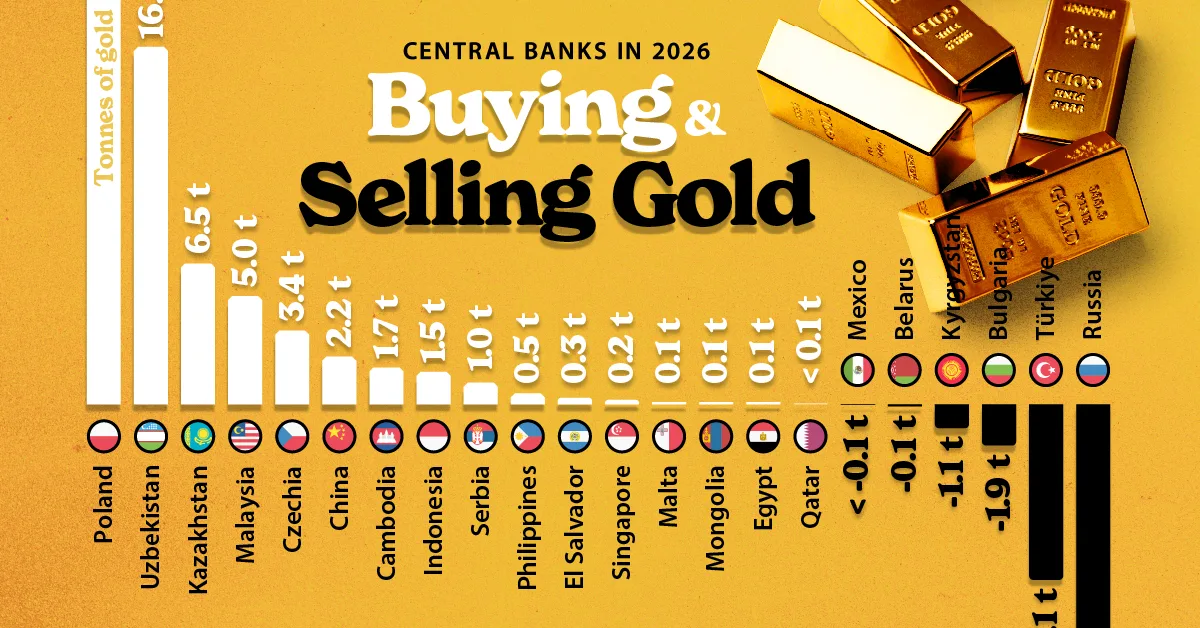
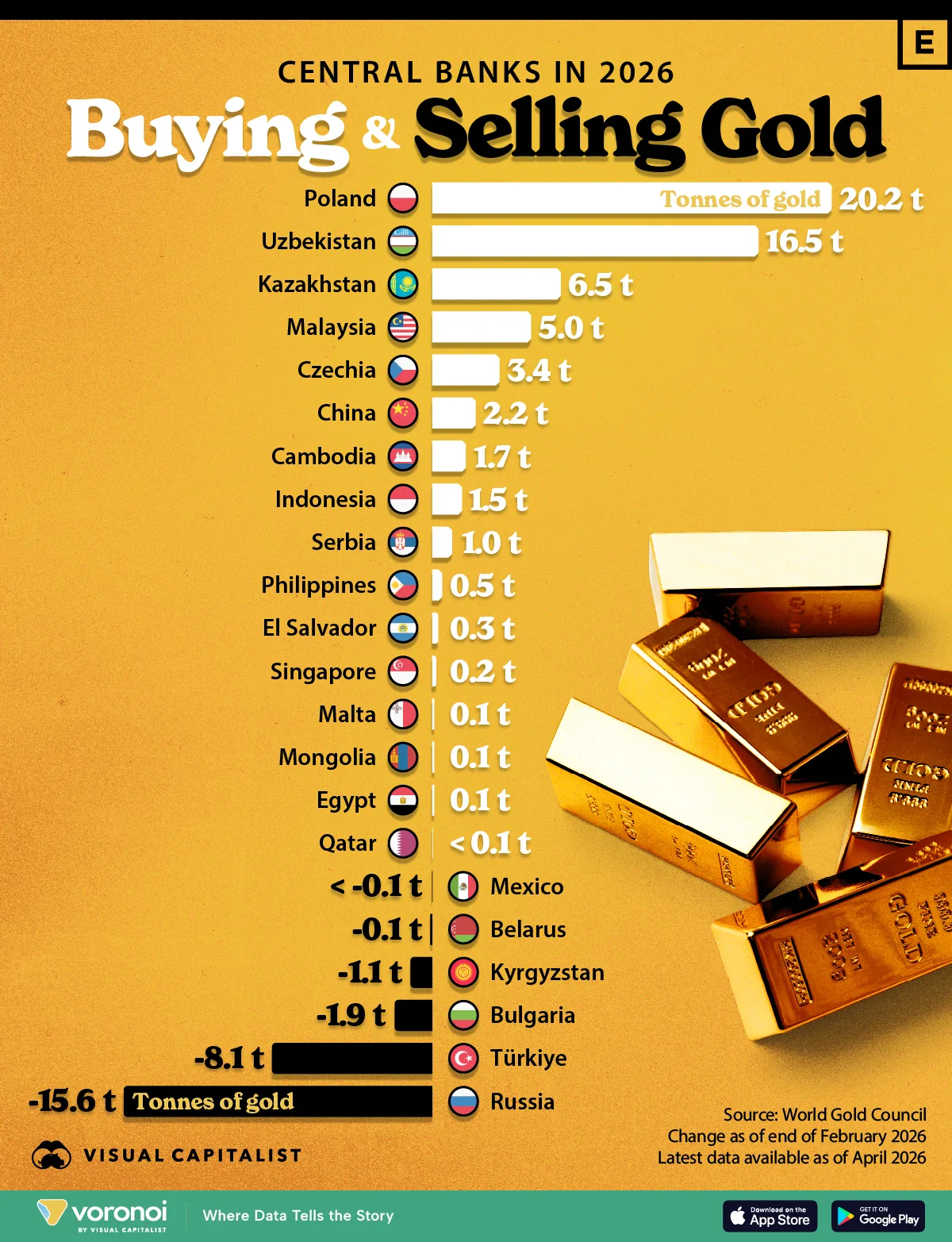
This chart shows net changes in central bank gold reserves by country so far as of end of February, based on data from the World Gold Council.
Poland Leads Global Gold Buying in 2026
Poland is leading global gold accumulation in 2026, adding over 20 tonnes, more than any other central bank so far this year. This purchase is part of a broader multi-year plan to reach 700 tonnes, reflecting heightened security concerns on NATO’s eastern flank.
Uzbekistan and Kazakhstan follow closely behind, continuing a steady trend of gold accumulation among Central Asian economies.
| Country | Net Change in 2026 (Tonnes of Gold) |
|---|---|
 Poland Poland |
20.23 |
 Uzbekistan Uzbekistan |
16.48 |
 Kazakhstan Kazakhstan |
6.51 |
 Malaysia Malaysia |
4.98 |
 Czechia Czechia |
3.36 |
 China China |
2.18 |
 Cambodia Cambodia |
1.69 |
 Indonesia Indonesia |
1.51 |
 Serbia Serbia |
0.99 |
 Philippines Philippines |
0.46 |
 El Salvador El Salvador |
0.29 |
 Singapore Singapore |
0.20 |
 Malta Malta |
0.12 |
 Mongolia Mongolia |
0.08 |
 Egypt Egypt |
0.06 |
 Qatar Qatar |
0.02 |
 Mexico Mexico |
-0.02 |
 Belarus Belarus |
-0.05 |
 Kyrgyzstan Kyrgyzstan |
-1.07 |
 Bulgaria Bulgaria |
-1.88 |
 Turkey Turkey |
-8.08 |
 Russia Russia |
-15.55 |
Diversification Away From Dollar Reserves
The freezing of roughly $300 billion in Russian central bank assets in 2022 marked a turning point for global reserve management.
In response, countries like China and several Central Asian economies have accelerated gold purchases, treating bullion as a reserve asset that sits outside the reach of foreign governments. Unlike foreign currency reserves, gold is not subject to foreign jurisdiction, making it attractive in a fragmented geopolitical landscape. Smaller buyers, such as Cambodia and Serbia, are also gradually increasing their allocations.
Why Russia and Turkey Are Selling Gold
On the other side of the ledger, Russia and Turkey are the largest net sellers of gold in 2026.
Russia’s gold sales point to mounting fiscal strain, as wartime spending and sanctions pressure government finances.
Meanwhile, Turkey’s reduction is driven by domestic policy, including efforts to stabilize the lira and manage local gold demand.
Learn More on the Voronoi App 
If you enjoyed today’s post, check out Mapped: Which Countries Hold the Most Gold Reserves? on Voronoi, the new app from Visual Capitalist.