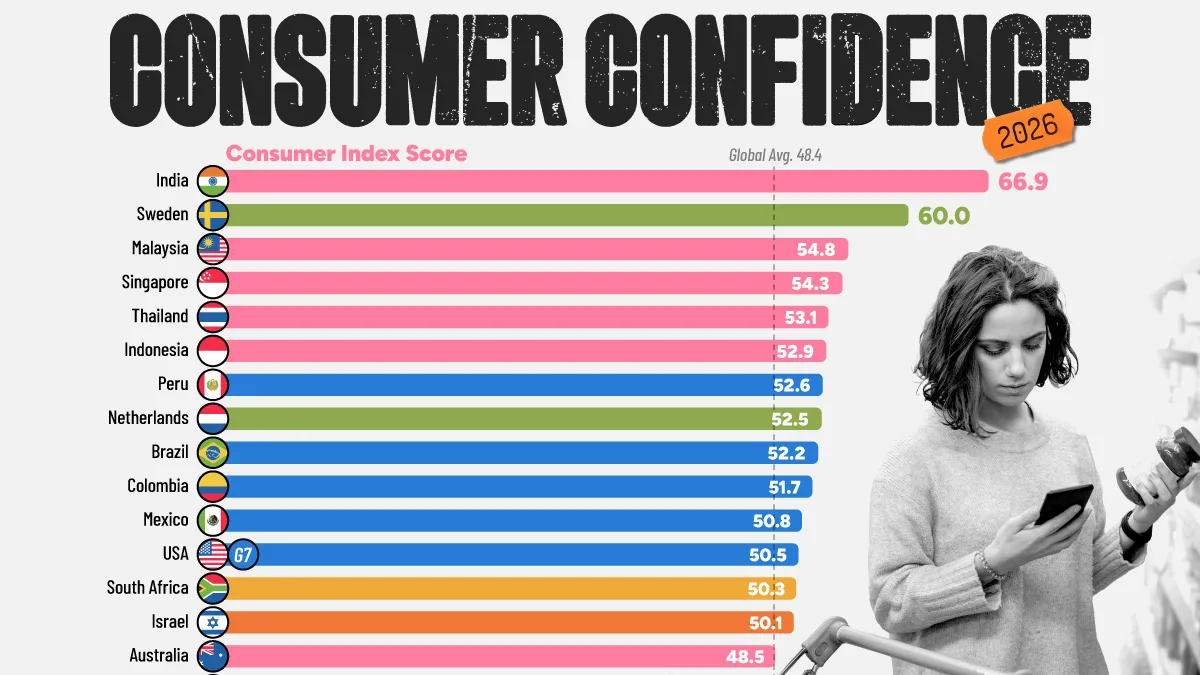
Where Consumer Confidence Is Highest in 2026
Key Takeaways
- India ranks first for consumer confidence at 66.9, followed by Sweden at 60.0.
- India, Malaysia, Thailand, and Indonesia all rank ahead of every G7 economy surveyed.
- The U.S. leads the G7 at 50.5, just above the global average of 48.4.
Consumers in several major emerging markets are more upbeat than those in many of the world’s wealthiest economies.
This graphic compares 30 countries using Ipsos’s September 2026 Global Consumer Confidence Index, based on a survey of more than 21,000 adults. The scores reflect views on personal finances, employment, and the economic outlook, with higher readings indicating greater confidence.
Asian Optimism and the G7
One of the clearest patterns in the ranking is the strength of emerging Asian economies. India leads at 66.9, while Malaysia, Thailand, and Indonesia all rank ahead of every G7 economy surveyed.
The U.S. (50.5) is the G7’s strongest performer but still trails Brazil and Mexico. Japan (39.4) sits near the bottom, in sharp contrast with the optimism seen elsewhere in Asia.
The table below lists the countries surveyed alongside their consumer confidence scores as of September 2026.
| Rank | Country | Index Score |
|---|---|---|
| 1 |  India India |
66.9 |
| 2 |  Sweden Sweden |
60.0 |
| 3 |  Malaysia Malaysia |
54.8 |
| 4 |  Singapore Singapore |
54.3 |
| 5 |  Thailand Thailand |
53.1 |
| 6 |  Indonesia Indonesia |
52.9 |
| 7 |  Peru Peru |
52.6 |
| 8 |  Netherlands Netherlands |
52.5 |
| 9 |  Brazil Brazil |
52.2 |
| 10 |  Colombia Colombia |
51.7 |
| 11 |  Mexico Mexico |
50.8 |
| 12 |  US US |
50.5 |
| 13 |  South Africa South Africa |
50.3 |
| 14 |  Israel Israel |
50.1 |
| 15 |  Australia Australia |
48.5 |
| 16 |  Ireland Ireland |
48.3 |
| 17 |  Great Britain Great Britain |
48.2 |
| 18 |  Hungary Hungary |
48.2 |
| 19 |  Poland Poland |
48.0 |
| 20 |  Canada Canada |
47.3 |
| 21 |  Spain Spain |
46.8 |
| 22 |  South Korea South Korea |
44.3 |
| 23 |  Italy Italy |
43.0 |
| 24 |  Belgium Belgium |
41.6 |
| 25 |  Germany Germany |
41.4 |
| 26 |  France France |
40.6 |
| 27 |  Chile Chile |
40.5 |
| 28 |  Japan Japan |
39.4 |
| 29 |  Argentina Argentina |
37.8 |
| 30 |  Türkiye Türkiye |
35.3 |
| — |  Global Average Global Average |
48.4 |
India’s strong reading coincides with rapid economic expansion. Its economy is growing faster than any other major market in 2026, while household spending is also rising. Growth has extended across both manufacturing and services.
Among surveyed urban Indians, confidence in job security and personal finances strengthened in September. Respondents also became more willing to make major purchases and investment decisions, suggesting that optimism is reaching household spending plans rather than simply reflecting perceptions of national economic growth.
Why U.S. Consumers Still Feel Squeezed
American confidence improved in September but remained below its level a year earlier. Views of current conditions and comfort with major purchases were weaker than in September 2025, even as perceptions of the job market improved.
One main pressure point is the gas pump. Gasoline prices rose by 27.4% over the year to August 2026, far outpacing overall inflation of 3.4%. For drivers, that means a much larger increase in a recurring expense than the headline inflation rate suggests.
Paychecks have offered limited relief. Inflation-adjusted average hourly earnings were 0.3% lower than a year earlier. An average hour’s pay therefore bought slightly less, helping explain how greater confidence in employment can coexist with unease about household finances.
Japan’s Grocery Bills Weigh on Confidence
Japan offers one of the sharpest contrasts with Asia’s more confident markets, with an index score of just 39.4. One factor weighing on households has been the rising cost of everyday essentials. Rice prices doubled from 2024 to 2025, with higher costs also affecting rice-based foods such as boxed lunches and rice balls.
The pressure extends beyond ingredients. Higher transportation and packaging costs add to food producers’ expenses, creating the potential for further price increases even as rice prices begin easing. Higher oil prices can therefore reach households through supermarket purchases as well as fuel bills.
Recent wage gains have begun outpacing inflation, offering some relief. Sustaining that recovery in purchasing power will be important for improving household sentiment.