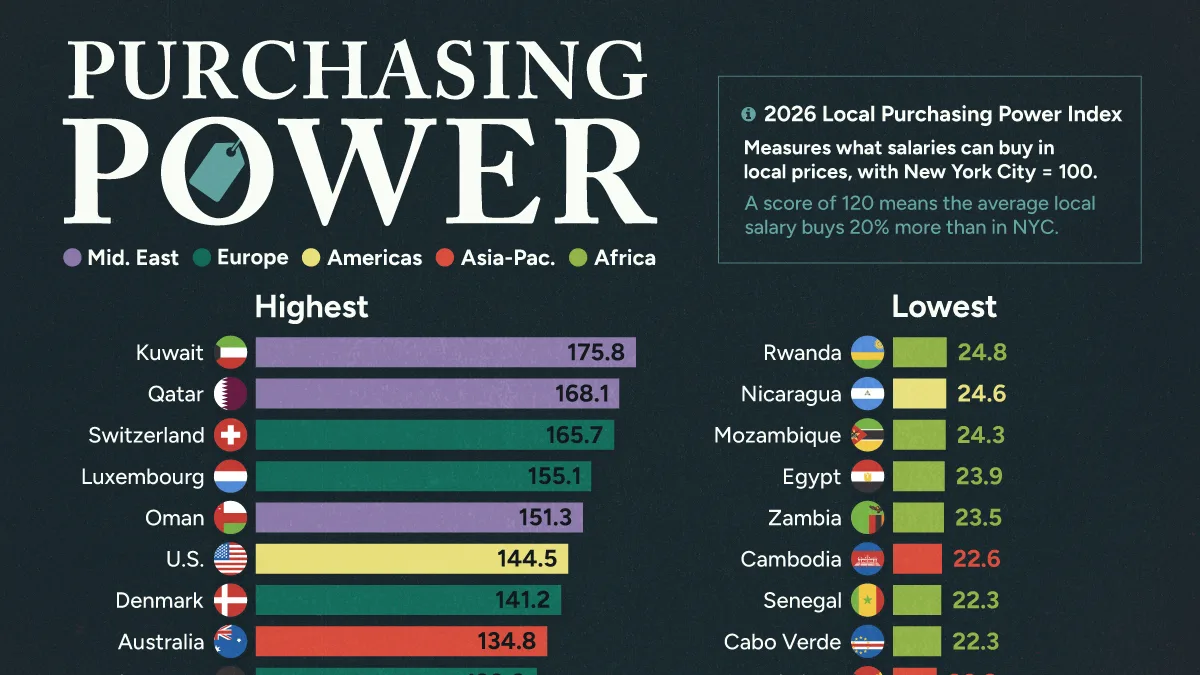
Where Do Salaries Have the Most Purchasing Power?
Key Takeaways
- Kuwait ranks first for salary purchasing power, followed by Qatar and Switzerland.
- Three of the top five countries are Gulf economies, with Oman ranking ahead of the U.S. and Denmark.
- The gap between the extremes is enormous: Kuwait’s index is more than 70 times Cuba’s.
A high salary doesn’t always translate into greater purchasing power. What matters is how much workers earn relative to local living costs, including housing, groceries, and everyday expenses.
This graphic uses Numbeo’s 2026 Local Purchasing Power Index, which compares average net salaries with local prices, including rent. New York City serves as the benchmark at 100, meaning a score of 120 indicates 20% greater local purchasing power than NYC.
The Gulf’s Purchasing Power Advantage
Kuwait leads the ranking with an index of 175.8, followed closely by Qatar (168.1) and Switzerland (165.7).
The Gulf’s strong showing reflects more than high salaries. Energy wealth supports well-paying industries, while low personal income taxes and subsidized essentials such as fuel and utilities can help workers retain more of their earnings.
| Rank | Country | Local Purchasing Power Index (2026) |
|---|---|---|
| 1 |  Kuwait |
175.8 |
| 2 |  Qatar |
168.1 |
| 3 |  Switzerland |
165.7 |
| 4 |  Luxembourg |
155.1 |
| 5 |  Oman |
151.3 |
| 6 |  U.S. |
144.5 |
| 7 |  Denmark |
141.2 |
| 8 |  Australia |
134.8 |
| 9 |  Germany |
130.0 |
| 10 |  Sweden |
128.6 |
| 11 |  Brunei |
128.0 |
| 12 |  Netherlands |
124.3 |
| 13 |  Norway |
123.2 |
| 14 |  Finland |
119.8 |
| 15 |  New Zealand |
119.4 |
| 16 |  UK |
118.2 |
| 17 |  Bahrain |
117.3 |
| 18 |  Belgium |
117.1 |
| 19 |  Saudi Arabia |
115.7 |
| 20 |  Israel |
115.0 |
| 21 |  Canada |
114.8 |
| 22 |  Austria |
114.2 |
| 23 |  Iceland |
113.6 |
| 24 |  UAE |
113.4 |
| 25 |  France |
113.3 |
Oman ranks fifth, ahead of the U.S. and Denmark. Its salary purchasing power is roughly 7% higher than Denmark’s, even though Denmark produces nearly four times as much economic output per person.
The U.S., meanwhile, ranks sixth globally. Despite rising housing, grocery, and other living costs, American salaries still have roughly 11% more purchasing power than those in Germany and 26% more than those in Canada.
A More Than 70-Fold Gap Between the Extremes
At the other end of the ranking, Cuba has an index of just 2.4, followed by Syria at 6.4 and Nigeria at 8.8. These figures highlight how limited local purchasing power can be in economies facing severe economic challenges.
| Rank | Country | Local Purchasing Power Index (2026) |
|---|---|---|
| 142 |  Cuba |
2.4 |
| 141 |  Syria |
6.4 |
| 140 |  Nigeria |
8.8 |
| 139 |  Cameroon |
10.8 |
| 138 |  Côte d’Ivoire |
11.7 |
| 137 |  Ethiopia |
12.5 |
| 136 |  Solomon Islands |
13.2 |
| 135 |  Madagascar |
14.9 |
| 134 |  Yemen |
16.6 |
| 133 |  Venezuela |
16.7 |
| 132 |  Ghana |
18.1 |
| 131 |  Suriname |
18.4 |
| 130 |  Turkmenistan |
18.5 |
| 129 |  Uganda |
18.6 |
| 128 |  Myanmar |
19.5 |
| 127 |  Sri Lanka |
19.7 |
| 126 |  Papua New Guinea |
20.2 |
| 124 |  Senegal |
22.3 |
| 124 |  Cape Verde |
22.3 |
| 123 |  Cambodia |
22.6 |
| 122 |  Zambia |
23.5 |
| 121 |  Egypt |
23.9 |
| 120 |  Mozambique |
24.3 |
| 119 |  Nicaragua |
24.6 |
| 118 |  Rwanda |
24.8 |
Nigeria illustrates the pressure facing households near the bottom of the ranking. Between 2019 and 2024, the cost of a basic food basket increased fivefold as the currency weakened and agricultural disruptions constrained supply. Food accounts for 56% of household income, one of the highest shares globally, leaving less than half for other expenses.
Learn More on the Voronoi App
For another look at global affordability, check out this graphic comparing where eating out costs the most and least worldwide.