Ranked: Countries With the Most College Graduates
See visuals like this from many other data creators on our Voronoi app. Download it for free on iOS or Android and discover incredible data-driven charts from a variety of trusted sources.
Key Takeaways
- Canada leads globally, with 63% of adults holding a tertiary degree.
- Several countries now have more than half their population college-educated.
- Large gaps persist, with some major economies below 20% attainment.
Higher education is becoming the norm in some countries, while remaining out of reach in others.
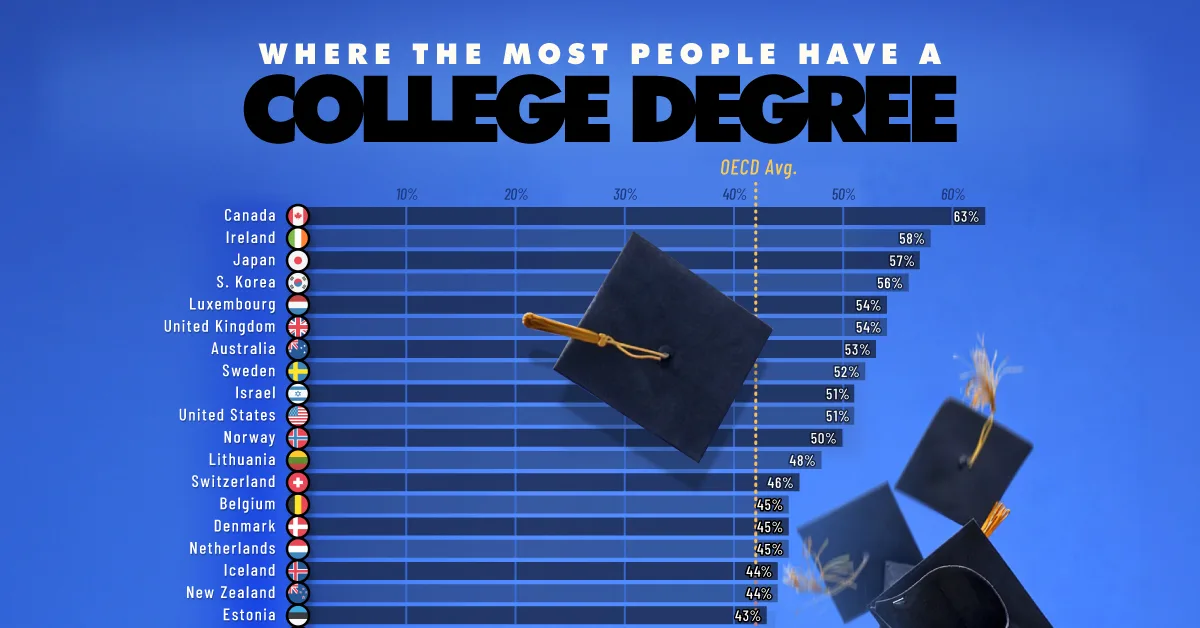
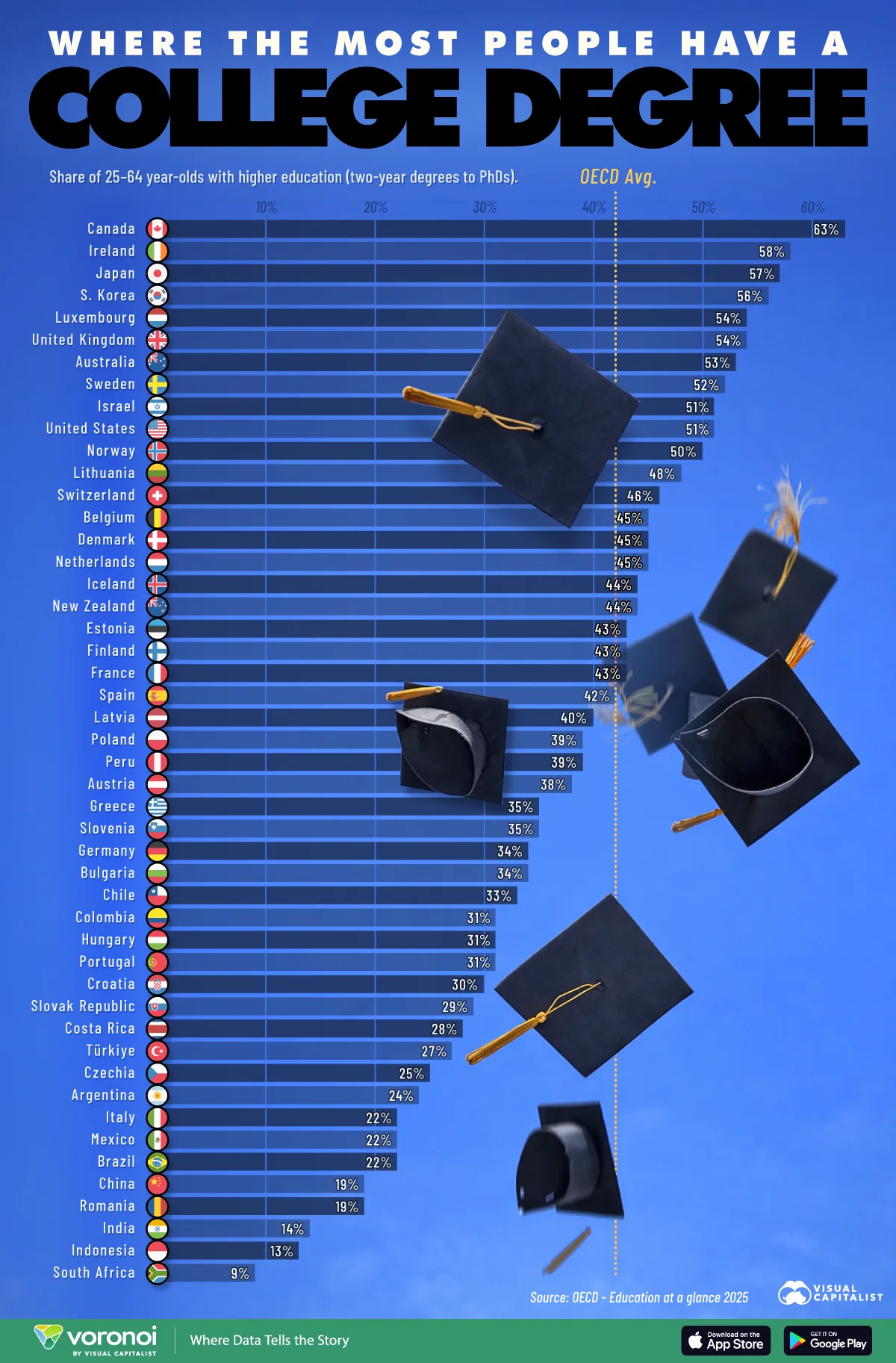
This chart ranks countries by the share of adults aged 25–64 with tertiary education—including college degrees and equivalent programs—based on data from OECD’s Education at a Glance 2025.
Canada leads at 63%, and a number of advanced economies have crossed the 50% threshold, highlighting how college education is becoming more widespread in the global workforce.
Countries like Ireland, Japan, and South Korea are part of this group where a majority of adults now hold a college degree, marking a shift toward higher-skilled labor markets.
Canada Is the Only Country Above 60%
Canada tops the ranking at 63%, making it the only country where nearly two-thirds of adults hold a college degree. The United States is at 51%, just above the OECD average of 42%.
This reflects decades of investment in higher education systems and sustained demand for skilled labor.
| Country | % with higher education |
|---|---|
 Canada Canada |
63 |
 Ireland Ireland |
58 |
 Japan Japan |
57 |
 Korea Korea |
56 |
 Luxembourg Luxembourg |
54 |
 United Kingdom United Kingdom |
54 |
 Australia Australia |
53 |
 Sweden Sweden |
52 |
 Israel Israel |
51 |
 United States United States |
51 |
 Norway Norway |
50 |
 Lithuania Lithuania |
48 |
 Switzerland Switzerland |
46 |
 Belgium Belgium |
45 |
 Denmark Denmark |
45 |
 Netherlands Netherlands |
45 |
 Iceland Iceland |
44 |
 New Zealand New Zealand |
44 |
 Estonia Estonia |
43 |
 Finland Finland |
43 |
 France France |
43 |
 Spain Spain |
42 |
 Latvia Latvia |
40 |
 Poland Poland |
39 |
 Peru Peru |
39 |
 Austria Austria |
38 |
 Greece Greece |
35 |
 Slovenia Slovenia |
35 |
 Germany Germany |
34 |
 Bulgaria Bulgaria |
34 |
 Chile Chile |
33 |
 Colombia Colombia |
31 |
 Hungary Hungary |
31 |
 Portugal Portugal |
31 |
 Croatia Croatia |
30 |
 Slovak Republic Slovak Republic |
29 |
 Costa Rica Costa Rica |
28 |
 Türkiye Türkiye |
27 |
 Czechia Czechia |
25 |
 Argentina Argentina |
24 |
 Italy Italy |
22 |
 Mexico Mexico |
22 |
 Brazil Brazil |
22 |
 China China |
19 |
 Romania Romania |
19 |
 India India |
14 |
 Indonesia Indonesia |
13 |
 South Africa South Africa |
9 |
 OECD average OECD average |
42 |
Europe Spans From 58% to Below 25%
Europe shows one of the widest internal gaps in education attainment.
Ireland ranks among global leaders at 58%, while countries like Italy (22%) fall far behind, highlighting uneven access to higher education across the region.
Major Economies Still Below 20%
Some of the world’s largest economies remain well below OECD levels. China (19%), India (14%), and Indonesia (13%) show how access to higher education is still expanding, with important implications for future workforce development.
As these economies grow, expanding access to higher education will play a critical role in productivity, income growth, and global competitiveness as demand for skilled labor rises.
Learn More on the Voronoi App 
If you enjoyed today’s post, check out The World has Made Substantial Progress in Increasing Basic Levels of Education on Voronoi, the new app from Visual Capitalist.