Which Countries Have the Most Robots per Factory Worker?
Key Takeaways
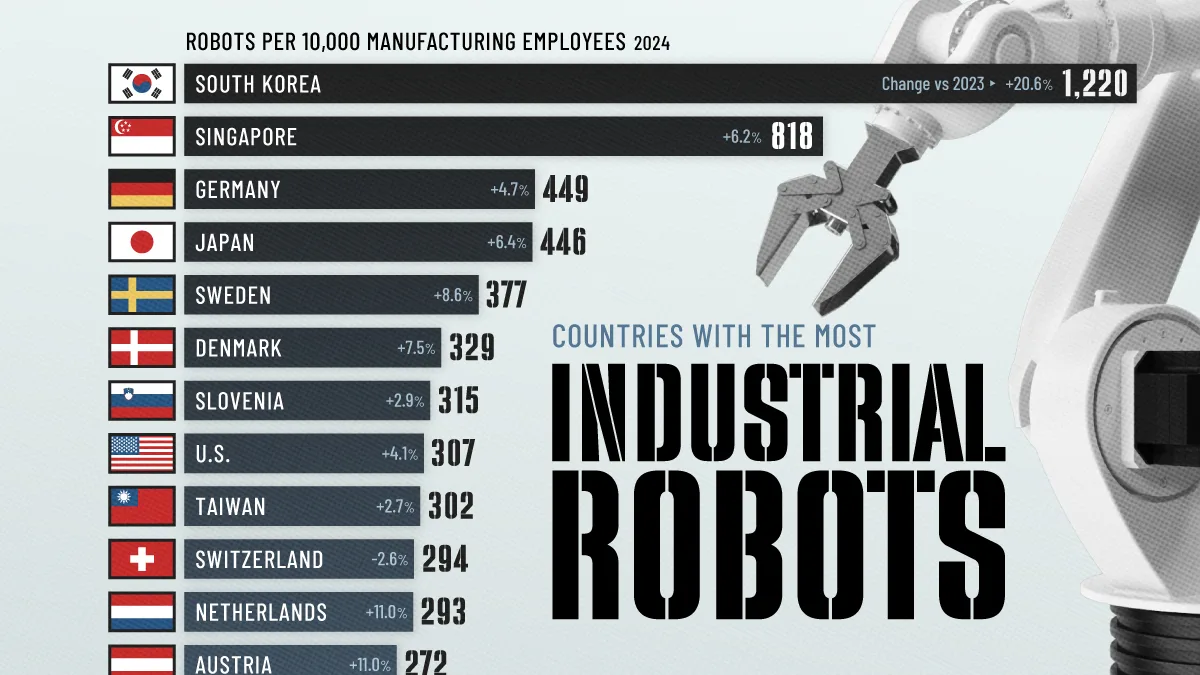
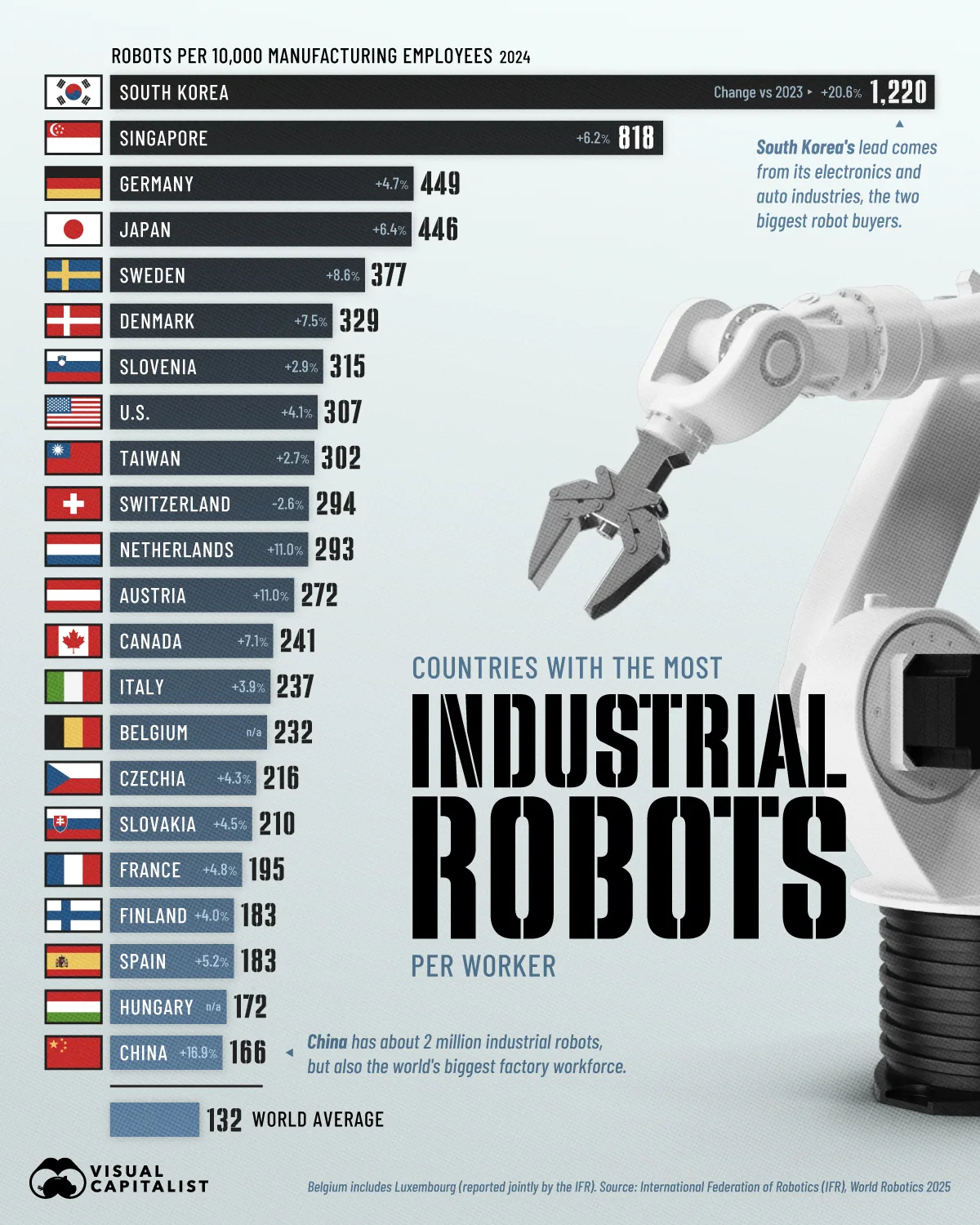
- South Korea led the world with 1,220 industrial robots per 10,000 manufacturing employees in 2024, more than nine times the global average of 132.
- China operates the largest robot fleet, around 2 million units, yet ranks 22nd on a per-worker basis.
- The United States ranked eighth at 307, roughly one robot for every 33 factory workers.
Industrial robots weld car bodies, assemble electronics, and package goods. Yet the country with the most machines doesn’t necessarily have the most robots relative to its factory workforce.
This graphic ranks 22 economies by robot density, the number of industrial robots in operation per 10,000 manufacturing employees in 2024, using data published in April 2026 from the International Federation of Robotics (IFR).
South Korea and Singapore Lead in Robot Density
South Korea and Singapore stand well apart from the rest of the ranking, and both pair heavy automation with small factory workforces.
South Korea’s 1,220 robots per 10,000 manufacturing employees is more than nine times the global average of 132, while Singapore’s 818 is nearly double third-ranked Germany’s 449.
The table below shows robot density in each of the 22 economies in 2024, along with the percentage change from the previous year:
| Rank | Country / Territory | Robots per 10,000 Manufacturing Employees | Annual Change (%) |
|---|---|---|---|
| 1 |  South Korea South Korea |
1220 | 20.6 |
| 2 |  Singapore Singapore |
818 | 6.2 |
| 3 |  Germany Germany |
449 | 4.7 |
| 4 |  Japan Japan |
446 | 6.4 |
| 5 |  Sweden Sweden |
377 | 8.6 |
| 6 |  Denmark Denmark |
329 | 7.5 |
| 7 |  Slovenia Slovenia |
315 | 2.9 |
| 8 |  United States United States |
307 | 4.1 |
| 9 |  Taiwan Taiwan |
302 | 2.7 |
| 10 |  Switzerland Switzerland |
294 | -2.6 |
| 11 |  Netherlands Netherlands |
293 | 11.0 |
| 12 |  Austria Austria |
272 | 11.0 |
| 13 |  Canada Canada |
241 | 7.1 |
| 14 |  Italy Italy |
237 | 3.9 |
| 15 |  Belgium & Belgium &  Luxembourg Luxembourg |
232 | |
| 16 |  Czechia Czechia |
216 | 4.3 |
| 17 |  Slovakia Slovakia |
210 | 4.5 |
| 18 |  France France |
195 | 4.8 |
| 19 |  Finland Finland |
183 | 4.0 |
| 19 |  Spain Spain |
183 | 5.2 |
| 21 |  Hungary Hungary |
172 | |
| 22 |  China China |
166 | 16.9 |
Belgium and Luxembourg are reported jointly by IFR. Blank cells indicate growth rates that are unavailable because 2023 figures are not reported.
South Korea benefits from a globally recognized electronics industry and its large automotive industry. These industries are the two biggest buyers of industrial robots worldwide, together accounting for almost half of new installations in 2024.
Demographics add to the pull of automation: South Korea’s total fertility rate was 0.75 births per woman in 2025, among the lowest birth rates in the world, so manufacturers face a shrinking pool of workers. Singapore is in a similar position, as a small country with few manufacturing employees and a fertility rate also below one (0.96).
China shows the same logic in reverse. It operated about 2 million industrial robots in 2024, roughly 43% of the global fleet, but spread across its huge manufacturing workforce, that works out to 166 per 10,000 employees.
U.S. Industrial Robot Installations Are Climbing
The United States ranked eighth at 307 robots per 10,000 manufacturing workers in 2024, but its position could improve in 2025 and 2026.
America is the world’s second-largest producer of cars and light commercial vehicles after China, and the automotive industry is its largest robot customer, with 13,500 installations in 2025, according to IFR.
Total U.S. installations rose 12% to 38,400 in 2025, overtaking Japan’s 36,200 to make the U.S. the world’s second-largest robot market behind China’s 354,200.
IFR expects installations to keep growing in 2026 as reshoring and labor scarcity create opportunities for robotics.
Auto Industry Drives Europe’s High Robot Density
European countries make up 15 of the 22 countries with the highest industrial robot density, largely driven by their auto industries.
The link is clearest in Central Europe, which has four economies in the top 22: Slovenia (315), Czechia (216), Slovakia (210), and Hungary (172).
Slovakia produced 183 cars per 1,000 inhabitants in 2024, the highest rate in the world and more than three times Germany’s 51, according to OICA. Czechia, home to Škoda Auto and to Hyundai and Toyota plants, produced 134 per 1,000.
Learn More on the Voronoi App
If you enjoyed today’s post, check out 90% of Humanoid Robots Are Shipped by China on Voronoi.
- Source: https://www.visualcapitalist.com/ranked-countries-most-industrial-robots-per-worker-2024-v2/