Which Countries Have the Most Trust in Science?
Key Takeaways:
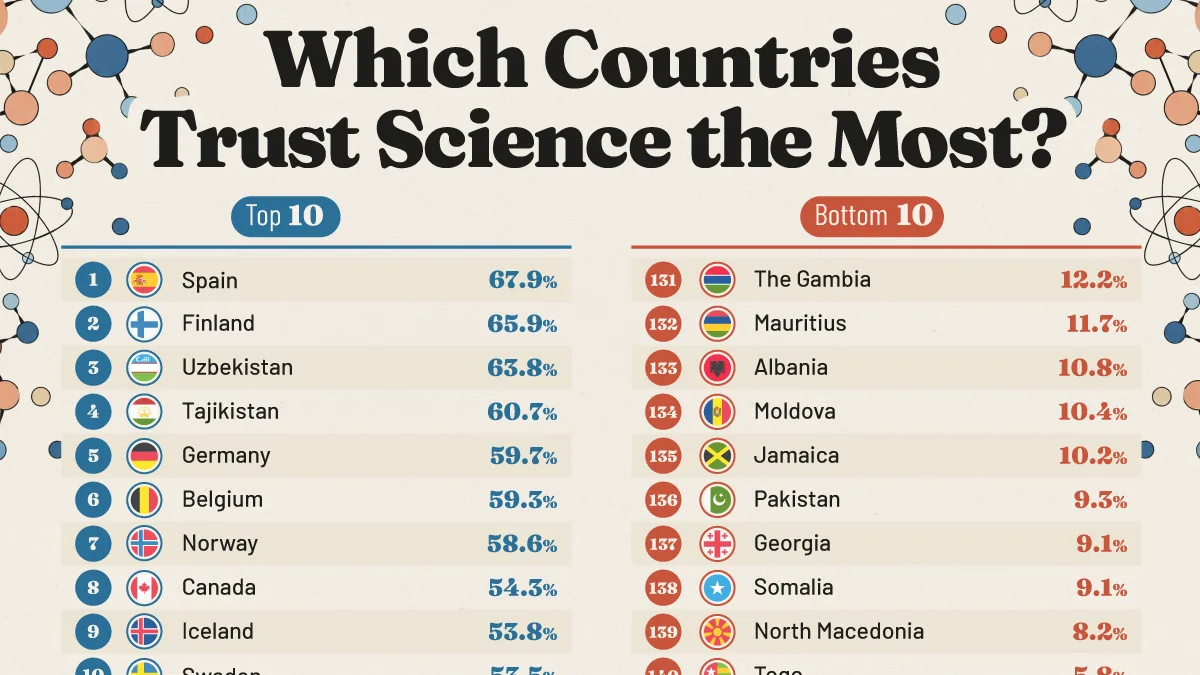
- Spain leads the world in trust in science, with 67.9% of respondents saying they trust science “a lot,” compared with just 5.8% in Togo.
- Europe accounts for 12 of the 16 countries where a majority of respondents express high trust in science.
- The United States ranks 13th globally at 52.5%.
Public trust in science varies dramatically worldwide, with some countries reporting more than 10 times the share of highly trusting respondents as others.
This visualization uses data from the Wellcome Global Monitor 2026, which surveyed more than 140,000 people across 140 countries in 2025.
Ranking 140 Countries on Trust in Science
The following table ranks countries by the share of respondents ages 15 and older who trust science “a lot,” using weighted survey results from Wellcome.
| Rank | Country | Trust in Science “A Lot” (%) |
|---|---|---|
| 1 |  Spain |
67.9 |
| 2 |  Finland |
65.9 |
| 3 |  Uzbekistan |
63.8 |
| 4 |  Tajikistan |
60.7 |
| 5 |  Germany |
59.7 |
| 6 |  Belgium |
59.3 |
| 7 |  Norway |
58.6 |
| 8 |  Canada |
54.3 |
| 9 |  Iceland |
53.8 |
| 10 |  Sweden |
53.5 |
| 11 |  Denmark |
53.4 |
| 12 |  Austria |
52.9 |
| 13 |  United States |
52.5 |
| 14 |  United Kingdom |
51.2 |
| 15 |  Ireland |
50.4 |
| 16 |  France |
50.2 |
| 17 |  Australia |
49.5 |
| 18 |  Switzerland |
49.4 |
| 19 |  Slovenia |
49.4 |
| 20 |  Czech Republic |
49.2 |
| 21 |  Portugal |
48.9 |
| 22 |  Luxembourg |
48.2 |
| 23 |  New Zealand |
46.4 |
| 24 |  Netherlands |
46.4 |
| 25 |  Niger |
45.7 |
| 26 |  Estonia |
43.9 |
| 27 |  Italy |
43.3 |
| 28 |  Mali |
42.7 |
| 29 |  Israel |
40.5 |
| 30 |  Hungary |
40.2 |
| 31 |  Kuwait |
39.4 |
| 32 |  Guinea |
38.7 |
| 33 |  Uruguay |
38.5 |
| 34 |  Argentina |
37.9 |
| 35 |  Philippines |
37.6 |
| 36 |  Algeria |
37.4 |
| 37 |  Greece |
36.2 |
| 38 | Northern Cyprus | 35.2 |
| 39 |  Tanzania |
33.5 |
| 40 |  Bangladesh |
32.5 |
| 41 |  Bahrain |
32.3 |
| 42 |  Singapore |
32.0 |
| 43 |  Vietnam |
31.7 |
| 44 |  United Arab Emirates |
31.4 |
| 45 |  Lebanon |
31.2 |
| 46 |  Malawi |
31.0 |
| 47 |  Azerbaijan |
30.8 |
| 48 |  Brazil |
30.8 |
| 49 |  Mozambique |
30.4 |
| 50 |  Liberia |
29.8 |
| 51 |  Mongolia |
29.8 |
| 52 |  India |
29.8 |
| 53 |  Cyprus |
29.4 |
| 54 |  Lithuania |
29.2 |
| 55 |  Sri Lanka |
29.1 |
| 56 |  Egypt |
28.7 |
| 57 |  South Korea |
28.4 |
| 58 |  Malta |
28.4 |
| 59 |  Myanmar |
28.0 |
| 60 |  Comoros |
27.8 |
| 61 |  Ghana |
27.7 |
| 62 |  Romania |
27.5 |
| 63 |  Venezuela |
25.9 |
| 64 |  Saudi Arabia |
25.9 |
| 65 |  Chile |
25.8 |
| 66 |  Jordan |
25.5 |
| 67 |  Russia |
25.0 |
| 68 |  Zimbabwe |
24.9 |
| 69 |  Uganda |
24.1 |
| 70 |  Kyrgyzstan |
24.1 |
| 71 |  Taiwan |
23.8 |
| 72 |  Mexico |
23.8 |
| 73 |  Benin |
23.7 |
| 74 |  Slovakia |
23.5 |
| 75 |  Zambia |
23.3 |
| 76 |  Tunisia |
22.8 |
| 77 |  Nepal |
22.8 |
| 78 |  Montenegro |
22.7 |
| 79 |  Senegal |
22.1 |
| 80 |  Mauritania |
21.6 |
| 81 |  South Africa |
21.5 |
| 82 |  Iraq |
21.4 |
| 83 |  Bulgaria |
21.4 |
| 84 |  Cameroon |
21.1 |
| 85 |  Costa Rica |
20.7 |
| 86 |  Armenia |
20.4 |
| 87 |  Latvia |
20.4 |
| 88 |  Madagascar |
20.4 |
| 89 |  Indonesia |
20.1 |
| 90 |  Turkiye |
20.0 |
| 91 |  Burkina Faso |
20.0 |
| 92 |  Paraguay |
19.5 |
| 93 |  Dominican Republic |
19.4 |
| 94 |  Ethiopia |
19.3 |
| 95 |  Colombia |
19.3 |
| 96 |  Serbia |
19.1 |
| 97 |  Chad |
19.1 |
| 98 |  Kosovo |
18.9 |
| 99 |  Malaysia |
18.7 |
| 100 |  Bosnia and Herzegovina |
18.7 |
| 101 |  Kenya |
18.6 |
| 102 |  Japan |
18.6 |
| 103 |  El Salvador |
18.5 |
| 104 |  Laos |
18.4 |
| 105 |  Cambodia |
18.4 |
| 106 |  Botswana |
17.9 |
| 107 |  Panama |
17.6 |
| 108 |  Ukraine |
17.2 |
| 109 |  Kazakhstan |
17.0 |
| 110 |  Congo Brazzaville |
16.3 |
| 111 |  Guatemala |
16.3 |
| 112 |  Honduras |
16.2 |
| 113 |  Morocco |
15.4 |
| 114 |  Nigeria |
15.2 |
| 115 |  Peru |
15.2 |
| 116 |  Sierra Leone |
15.1 |
| 117 |  Palestinian Territories |
14.7 |
| 118 |  Bolivia |
14.7 |
| 119 |  Hong Kong |
13.9 |
| 120 |  Libya |
13.8 |
| 121 |  Ecuador |
13.7 |
| 122 |  China |
13.7 |
| 123 |  Poland |
13.5 |
| 124 |  Lesotho |
13.5 |
| 125 |  Namibia |
13.3 |
| 126 |  Thailand |
13.2 |
| 127 |  Ivory Coast |
13.0 |
| 128 |  Congo (Kinshasa) |
12.8 |
| 129 |  Gabon |
12.7 |
| 130 |  Croatia |
12.4 |
| 131 |  The Gambia |
12.2 |
| 132 |  Mauritius |
11.7 |
| 133 |  Albania |
10.8 |
| 134 |  Moldova |
10.4 |
| 135 |  Jamaica |
10.2 |
| 136 |  Pakistan |
9.3 |
| 137 |  Georgia |
9.1 |
| 138 |  Somalia |
9.1 |
| 139 |  North Macedonia |
8.2 |
| 140 |  Togo |
5.8 |
Among the most surprising results are Uzbekistan and Tajikistan, which rank third and fourth globally, ahead of major scientific powers including the United States, United Kingdom, and France.
At the other end of the ranking, several countries report single-digit levels of high trust, highlighting substantial differences in public attitudes toward science worldwide.
Does Education Influence Trust in Science?
Several highly educated and innovative economies rank among the countries with the greatest trust in science. Finland, Germany, and Sweden all make the top 10.
However, Uzbekistan (63.8%) and Tajikistan (60.7%) rank third and fourth globally, ahead of many wealthier nations with more established research institutions. This suggests that educational attainment and economic development alone cannot explain differences in public trust.
Wellcome’s researchers found little convincing evidence of a consistent relationship between trust in science and scientific literacy. They also found no clear country-level association between trust and average scientific literacy or government education spending.
What Role Does Religion Play?
Religious belief does not necessarily translate into skepticism toward science. Muslim-majority Uzbekistan and Tajikistan rank among the world’s most trusting countries, while Pakistan (9.3%) ranks near the bottom, highlighting substantial differences even among countries sharing a predominant religion.
The relationship is similarly complex within scientific communities. Theos Think Tank found that 94% of surveyed scientists in India and 87% in Turkey identified with a religious tradition, compared with 40% in the United States and 36% in the United Kingdom. Separate Pew Research interviews suggest that many Muslims, Hindus, and Buddhists view science and religion as compatible rather than inherently conflicting.
Ultimately, religious identity alone is a poor predictor of scientific trust. Cultural context, institutional confidence, and how religious communities interpret scientific findings can all shape public attitudes.
Global Trust in Science Has Fallen Since 2020
Globally, 72% of respondents reported trusting science “some” or “a lot” in 2025, down from 80% in 2020, according to Wellcome. This represents an eight-percentage-point decline over five years.
A Harvard Global Health Institute discussion highlighted how distrust can reflect structural inequalities, institutional failures, misinformation, and political polarization, particularly among underrepresented populations.
These findings suggest that strengthening scientific trust requires more than scientific advancement. Economic inclusion, reliable institutions, and effective public communication also matter.
Learn More on the Voronoi App
To explore another perspective on global scientific achievement, see Ranked: The Best Countries at Science on Voronoi.