Ranked: Europe’s Most Forested Countries
This was originally posted on our Voronoi app. Download the app for free on iOS or Android and discover incredible data-driven charts from a variety of trusted sources.
Key Takeaways:
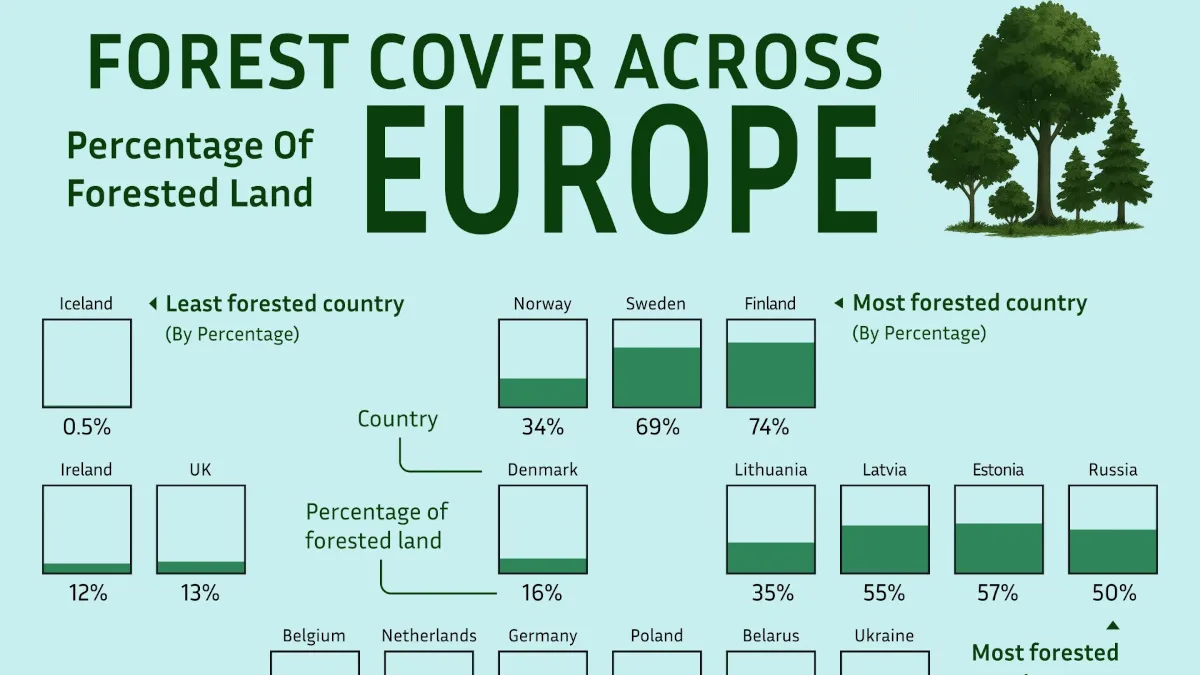
- Finland has the highest forest cover in Europe, with forests covering 74% of its land area, followed by Sweden at 69%.
- Forest cover ranges from 1% to 74% across Europe, reflecting major differences in geography and land use.
- Europe’s total forest area has continued to expand since the 1990s, even as climate change, pests, and wildfires pose growing risks.
Finland is Europe’s most forested country, with nearly three-quarters of its land covered by forests, while countries such as Iceland, Ireland, and the UK have some of the lowest forest shares on the continent.
This visualization, created by Harris Saleem, uses World Bank data to rank European countries by the percentage of land area covered by forests.
The data highlights how geography, climate, and centuries of land use have produced vastly different forest landscapes across Europe.
Which European Countries Have the Most Forest Cover?
The table below shows forest cover as a percentage of total land area across Europe.
| Rank | Country | Percent Forest |
|---|---|---|
| 1 |  Finland Finland |
74% |
| 2 |  Sweden Sweden |
69% |
| 3 |  Montenegro Montenegro |
62% |
| 4 |  Slovenia Slovenia |
61% |
| 5 |  Estonia Estonia |
57% |
| 6 |  Latvia Latvia |
55% |
| 7 |  Russia Russia |
50% |
| 8 |  Austria Austria |
47% |
| 9 |  Belarus Belarus |
43% |
| 10 |  Bosnia & Herzegovina Bosnia & Herzegovina |
43% |
| 11 |  Slovakia Slovakia |
40% |
| 12 |  North Macedonia North Macedonia |
40% |
| 13 |  Spain Spain |
37% |
| 14 |  Bulgaria Bulgaria |
36% |
| 15 |  Portugal Portugal |
36% |
| 16 |  Lithuania Lithuania |
35% |
| 17 |  Croatia Croatia |
35% |
| 18 |  Czechia Czechia |
35% |
| 19 |  Luxembourg Luxembourg |
35% |
| 20 |  Norway Norway |
34% |
| 21 |  Italy Italy |
33% |
| 22 |  Germany Germany |
33% |
| 23 |  France France |
33% |
| 24 |  Serbia Serbia |
32% |
| 25 |  Switzerland Switzerland |
32% |
| 26 |  Poland Poland |
31% |
| 27 |  Greece Greece |
30% |
| 28 |  Romania Romania |
30% |
| 29 |  Türkiye Türkiye |
30% |
| 30 |  Albania Albania |
29% |
| 31 |  Belgium Belgium |
23% |
| 32 |  Hungary Hungary |
22% |
| 33 |  Cyprus Cyprus |
19% |
| 34 |  Ukraine Ukraine |
17% |
| 35 |  Denmark Denmark |
16% |
| 36 |  United Kingdom United Kingdom |
13% |
| 37 |  Moldova Moldova |
12% |
| 38 |  Ireland Ireland |
12% |
| 39 |  Netherlands Netherlands |
11% |
| 40 |  Malta Malta |
1.40% |
| 41 |  Iceland Iceland |
0.50% |
Finland and Sweden lead Europe by a wide margin, with forests covering roughly seven in every 10 hectares of land. Montenegro and Slovenia also rank near the top, while several highly urbanized or agriculture-focused countries have substantially lower forest shares.
Europe’s forest landscapes range from vast northern boreal forests to mixed and broadleaf forests farther south, reflecting the continent’s diverse climates and terrain.
Why Forest Cover Differs Across Europe
Forest cover reflects a combination of geography, climate, land use, and public policy.
Northern Europe’s dominance is closely tied to the boreal forest belt that stretches across Finland, Sweden, and Russia. Colder climates and lower population densities historically limited agricultural expansion, allowing large forest ecosystems to remain intact.
In contrast, fertile lowlands in countries such as Denmark and the Netherlands have long been devoted to farming and settlement. Mountainous regions often tell a different story, as steep terrain is less suitable for intensive agriculture. This helps explain the relatively high forest shares found in countries such as Slovenia, Austria, and parts of the Balkans.
Why Forest Cover Differs Across Europe
Forest cover is shaped not only by geography, but also by policy decisions.
Sustainable forestry practices, conservation programs, and reforestation initiatives have helped maintain or increase forest cover across many European countries. In several cases, forests have expanded over recent decades as marginal agricultural land has been abandoned and allowed to regenerate.
As a result, countries with similar climates can still have noticeably different forest cover depending on how land has been managed over time.
Is Europe Losing or Gaining Forests?
Unlike many regions of the world, Europe has generally expanded its forest area over the last three decades. Reforestation, natural forest regrowth, and sustainable forestry policies have helped increase total forest cover, even as wildfires, droughts, storms, and insect outbreaks become more frequent.
According to the recently released State of Europe’s Forests 2025 report, forest area across the region continues to expand overall, even as forests face growing challenges from natural disasters and pests. Forest area and biodiversity indicators have generally trended upward, although growth rates are slowing in some regions.
That said, expansion in forest area does not necessarily mean forests are free from pressure. Research from the World Resources Institute highlights how logging, natural disturbances, and climate-related impacts increasingly influence forest loss patterns across Europe. The European Environment Agency also notes that forest resilience is becoming a critical policy issue as temperatures rise and extreme weather events become more frequent.
The result is a continent where forests are still growing in total area, but where maintaining healthy and resilient ecosystems is becoming increasingly complex.
Learn More on the Voronoi App 
Europe’s forests may be expanding, but globally the story is often very different. Check out The World Lost a Record Amount of its Tropical Forests in 2024 on the Voronoi app to see how deforestation trends are unfolding across the world’s most important tropical ecosystems.