Which European Countries Have the Most Government Debt?
Key Takeaways
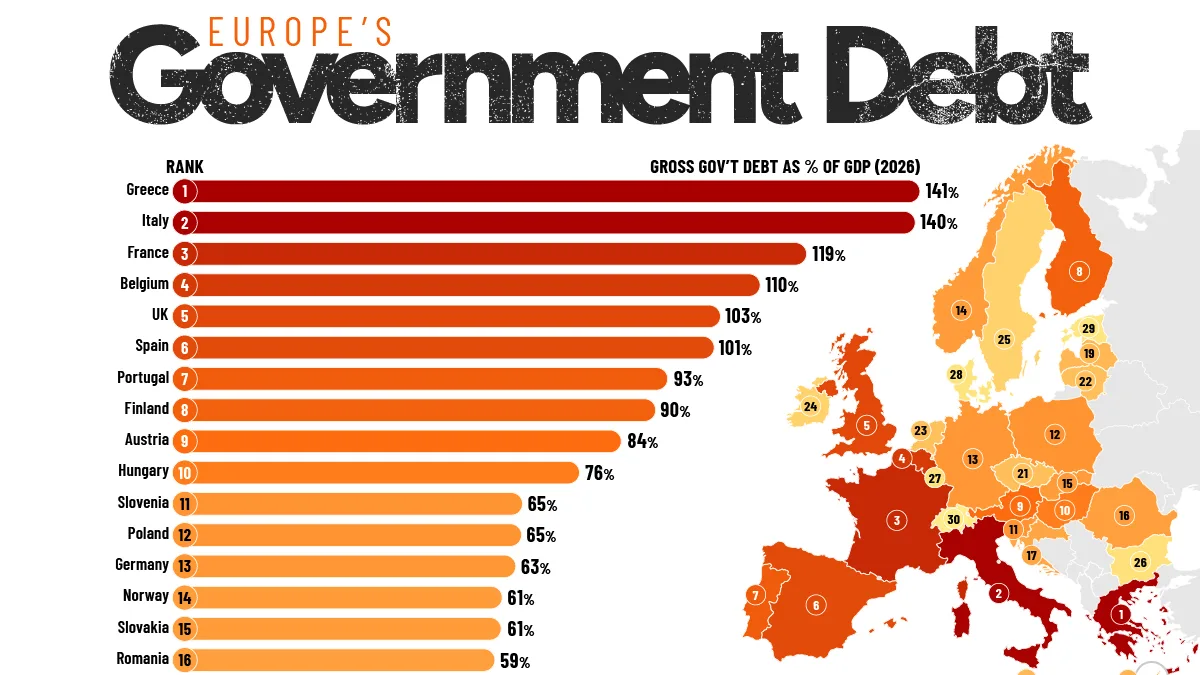
- Greece and Italy have Europe’s highest government debt ratios, at approximately 141% and 140% of GDP, respectively.
- Greece’s debt ratio fell 11.2 percentage points over the past year, while Poland recorded the EU’s largest increase.
- France’s persistent deficits and rising interest costs are putting further pressure on its public finances.
Government debt is rising across Europe, putting greater pressure on public finances as governments contend with slower economic growth and borrowing costs.
This visualization ranks European countries by government debt as a share of gross domestic product (GDP), using Q2 2026 data from Eurostat, the UK’s Office for National Statistics, and the Swiss Federal Finance Administration.
Across the 27-member EU, government debt reached 82.9% of GDP in the second quarter of 2026, up from 81.4% a year earlier.
Europe’s Top Debt Burdens in 2026
Southern Europe dominates the top of the ranking, with Greece and Italy carrying government debt equivalent to 140.8% and 139.9% of GDP, respectively.
France follows at 119.1%, while the UK and Spain also exceed the 100% threshold, meaning their outstanding government debt is larger than their annual economic output.
At the opposite end of the ranking, Switzerland has a government debt ratio of just 23.4% of GDP, roughly one-sixth of Greece’s level. This gives the Swiss government considerably more fiscal flexibility.
The table below ranks European countries by their government debt burdens as of mid-2026.
| Rank | Country | Debt (% of GDP) in 2026 |
|---|---|---|
| 1 |  Greece |
140.8 |
| 2 |  Italy |
139.9 |
| 3 |  France |
119.1 |
| 4 |  Belgium |
110.2 |
| 5 |  United Kingdom |
102.6 |
| 6 |  Spain |
101.4 |
| 7 |  Portugal |
92.5 |
| 8 |  Finland |
90.2 |
| 9 |  Austria |
83.6 |
| 10 |  Hungary |
75.6 |
| 11 |  Slovenia |
64.7 |
| 12 |  Poland |
64.5 |
| 13 |  Germany |
63.4 |
| 14 |  Norway |
60.8 |
| 15 |  Slovakia |
60.6 |
| 16 |  Romania |
59.4 |
| 17 |  Croatia |
56.2 |
| 18 |  Cyprus |
48.5 |
| 19 |  Latvia |
48.1 |
| 20 |  Malta |
47 |
| 21 |  Czechia |
43.8 |
| 22 |  Lithuania |
43.8 |
| 23 |  Netherlands |
43.7 |
| 24 |  Ireland |
35.3 |
| 25 |  Sweden |
35.3 |
| 26 |  Bulgaria |
28.7 |
| 27 |  Luxembourg |
28.2 |
| 28 |  Denmark |
27.1 |
| 29 |  Estonia |
26.1 |
| 30 |  Switzerland |
23.4 |
Beyond Switzerland, several of Europe’s least indebted countries are in Northern Europe.
Denmark, Estonia, and Sweden all have government debt ratios below 40% of GDP, well below major economies like Germany (63.4%) and the United Kingdom (102.6%). Finland (90.2%) is a notable regional outlier.
Why Greece’s Government Debt Is Falling
Despite topping the ranking, Greece has made substantial progress in reducing its government debt burden.
Its debt-to-GDP ratio fell 11.2 percentage points over the past year, the largest decline in Europe, while its outstanding government debt dropped by more than $10 billion. The country’s debt ratio previously peaked above 200% of GDP during the pandemic.
Several factors are driving the improvement, including budget surpluses, rising nominal GDP, and the use of cash reserves to repay debt. For 2026, Greece is forecast to collect more revenue than it spends, even after interest payments, producing a 0.9% overall surplus.
Economic expansion provides additional support. Investment backed by EU funds is helping sustain growth, with real GDP projected to rise 1.8% in 2026, following 2% growth in 2025.
Together, these conditions are expected to push Greece’s debt ratio below Italy’s by the end of 2026.
France’s Rising Interest Bill Adds Pressure
France faces a different trajectory. Europe’s third-largest economy is struggling with persistent deficits and weak growth. The French budget deficit is forecast to exceed 5% of GDP, while real economic growth remains sluggish.
Slow growth limits tax revenue, making it harder to close the spending gap. Meanwhile, rising interest costs compound the problem.
Government interest payments are projected to reach 2.6% of GDP in 2026 and 3% in 2027, as higher rates on newly issued bonds and payments on inflation-linked debt increase financing costs.
That leaves less budget flexibility for public services, investment, and tax relief. Under unchanged policies, France’s debt ratio is projected to exceed 123% by 2028, potentially putting it on a path to becoming Europe’s most indebted country.
Learn More on the Voronoi App
To compare Europe’s largest economies with peers around the world, check out G7 Nations Are Among the Most Debt-Burdened on Voronoi.