 See more visuals like this on the Voronoi app.
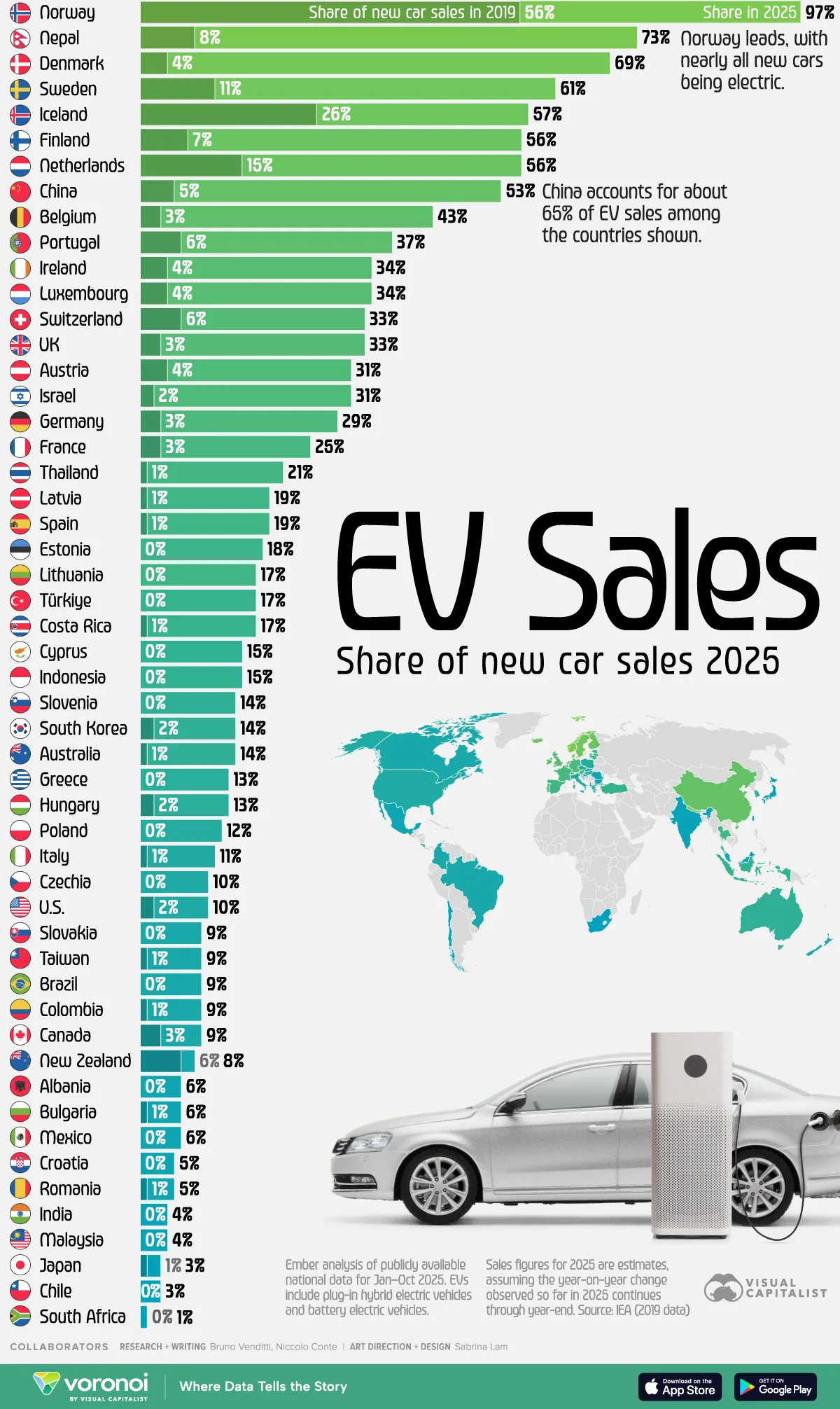
Ranked: EV Share of New Car Sales by Country in 2025
See visuals like this from many other data creators on our Voronoi app. Download it for free on iOS or Android and discover incredible data-driven charts from a variety of trusted sources.
Key Takeaways
- Norway leads the world, with EVs making up an estimated 97% of new car sales in 2025.
- China is the largest EV market by volume, with over 13 million EV sales estimated for 2025.
In 2019, electric vehicles were still a niche purchase in most countries, accounting for single-digit shares of new car sales.
By 2025, EVs had moved from niche to dominant in several markets. In Norway, EVs were estimated to make up 97% of new car sales, meaning nearly every new car sold was electric. Several other countries crossed the 50% threshold, and in China, EVs made up more than half of all new car sales in the world’s largest auto market.
This infographic highlights how EV sales share has evolved between 2019 and 2025. The data for this visualization comes from the International Energy Agency (IEA) and Ember. EVs include both battery electric vehicles (BEVs) and plug-in hybrid electric vehicles (PHEVs). Sales figures for 2025 are estimates.
Taken together, the data shows how quickly EV adoption has moved from early adoption to mainstream across much of the global auto market.
Norway Sets the Global Benchmark
Norway remains the global leader in EV adoption. In 2019, EVs already accounted for 56% of new car sales in the country. By 2025, that share is estimated to reach 97%, meaning nearly every new car sold is electric. This rapid shift has been driven by strong policy incentives, tax exemptions, and widespread charging infrastructure.
Nepal ranks second globally, with EVs estimated to account for 73% of new car sales in 2025 — a striking shift from just 8% in 2019.
| Rank (2025) | Country | 2019 Share | 2025 Share | Change (p.p.) |
|---|---|---|---|---|
| 1 |  Norway Norway |
56% | 97% | +41 |
| 2 |  Nepal Nepal |
8% | 73% | +65 |
| 3 |  Denmark Denmark |
4% | 69% | +65 |
| 4 |  Sweden Sweden |
11% | 61% | +50 |
| 5 |  Iceland Iceland |
26% | 57% | +31 |
| 6 |  Finland Finland |
7% | 56% | +49 |
| 7 |  Netherlands Netherlands |
15% | 56% | +41 |
| 8 |  China China |
5% | 53% | +48 |
| 9 |  Belgium Belgium |
3% | 43% | +40 |
| 10 |  Portugal Portugal |
6% | 37% | +31 |
| 11 |  Ireland Ireland |
4% | 34% | +30 |
| 12 |  Luxembourg Luxembourg |
4% | 34% | +30 |
| 13 |  Switzerland Switzerland |
6% | 33% | +27 |
| 14 |  United Kingdom United Kingdom |
3% | 33% | +30 |
| 15 |  Austria Austria |
4% | 31% | +27 |
| 16 |  Israel Israel |
2% | 31% | +29 |
| 17 |  Germany Germany |
3% | 29% | +26 |
| 18 |  France France |
3% | 25% | +22 |
| 19 |  Thailand Thailand |
1% | 21% | +20 |
| 20 |  Spain Spain |
1% | 19% | +18 |
| 21 |  Latvia Latvia |
1% | 19% | +18 |
| 22 |  Estonia Estonia |
0% | 18% | +18 |
| 23 |  Lithuania Lithuania |
0% | 17% | +17 |
| 24 |  Türkiye Türkiye |
0% | 17% | +17 |
| 25 |  Costa Rica Costa Rica |
1% | 17% | +16 |
| 26 |  Cyprus Cyprus |
0% | 15% | +15 |
| 27 |  Indonesia Indonesia |
0% | 15% | +15 |
| 28 |  Slovenia Slovenia |
0% | 14% | +14 |
| 29 |  South Korea South Korea |
2% | 14% | +12 |
| 30 |  Australia Australia |
1% | 14% | +13 |
| 31 |  Greece Greece |
0% | 13% | +13 |
| 32 |  Hungary Hungary |
2% | 13% | +11 |
| 33 |  Poland Poland |
0% | 12% | +12 |
| 34 |  Italy Italy |
1% | 11% | +10 |
| 35 |  United States United States |
2% | 10% | +8 |
| 36 |  Czechia Czechia |
0% | 10% | +10 |
| 37 |  Brazil Brazil |
0% | 9% | +9 |
| 38 |  Canada Canada |
3% | 9% | +6 |
| 39 |  Taiwan Taiwan |
1% | 9% | +8 |
| 40 |  Colombia Colombia |
1% | 9% | +8 |
| 41 |  New Zealand New Zealand |
6% | 8% | +2 |
| 42 |  Albania Albania |
0% | 6% | +6 |
| 43 |  Bulgaria Bulgaria |
1% | 6% | +5 |
| 44 |  Mexico Mexico |
0% | 6% | +6 |
| 45 |  Croatia Croatia |
0% | 5% | +5 |
| 46 |  Romania Romania |
1% | 5% | +4 |
| 47 |  Malaysia Malaysia |
0% | 4% | +4 |
| 48 |  India India |
0% | 4% | +4 |
| 49 |  Japan Japan |
1% | 3% | +2 |
| 50 |  Chile Chile |
0% | 3% | +3 |
| 51 |  South Africa South Africa |
0% | 1% | +1 |
Other Nordic countries also rank near the top. Sweden is estimated to reach 61% in 2025, while Finland and Denmark both exceed 50%.
China Dominates by Volume
While Norway leads in percentage terms, China dominates in absolute numbers. EV sales in China are estimated to reach over 13.2 million in 2025, accounting for 53% of new car sales. That makes China both the largest EV market by volume and one of the fastest-growing in terms of market share.
In comparison, the United States has a 10% EV sales share in 2025, with roughly 1.6 million EVs sold. Canada trails slightly behind at 9%. Recently, the Canadian government has agreed to remove its 100% blocking tariff from a small annual quota of 49,000 EVs made in China.
Europe’s Broad-Based Acceleration
Europe shows some of the most widespread gains across major economies. Countries like Belgium (43%), the Netherlands (56%), Portugal (37%), and the United Kingdom (33%) have all seen dramatic increases since 2019, when EV shares were mostly below 10%.
Even traditionally slower adopters, such as Italy and Spain, have reached double-digit penetration. Across the region, EV sales have surged not only in share but also in volume—Germany alone is estimated to sell more than 840,000 EVs in 2025.
Emerging Markets Gain Momentum
Adoption is also expanding beyond Europe and China. Nepal stands out with an estimated 73% EV sales share in 2025, albeit from a small base. Thailand (21%) and Indonesia (15%) are emerging as Southeast Asian leaders.
In Latin America, Brazil’s EV share has risen to 9%, while Mexico reaches 6%.
Learn More on the Voronoi App
If you enjoyed today’s post, check out The Most Fuel Efficient Cars From 1975 to Today on Voronoi, the new app from Visual Capitalist. “`