Global Helium Production by Country
See visuals like this from many other data creators on our Voronoi app. Download it for free on iOS or Android and discover incredible data-driven charts from a variety of trusted sources.
Key Takeaways
- The U.S. and Qatar produce over 75% of the world’s helium, making supply highly concentrated.
- Helium is essential for semiconductors, MRI machines, and aerospace systems.
- Supply disruptions—like tensions in the Middle East—can quickly ripple across global tech industries.
Helium is often associated with party balloons, but its importance extends far beyond celebrations.
This rare gas is one of the most strategic gases in the world, and it’s essential for advanced technologies, including semiconductor manufacturing, aerospace systems, and medical imaging.
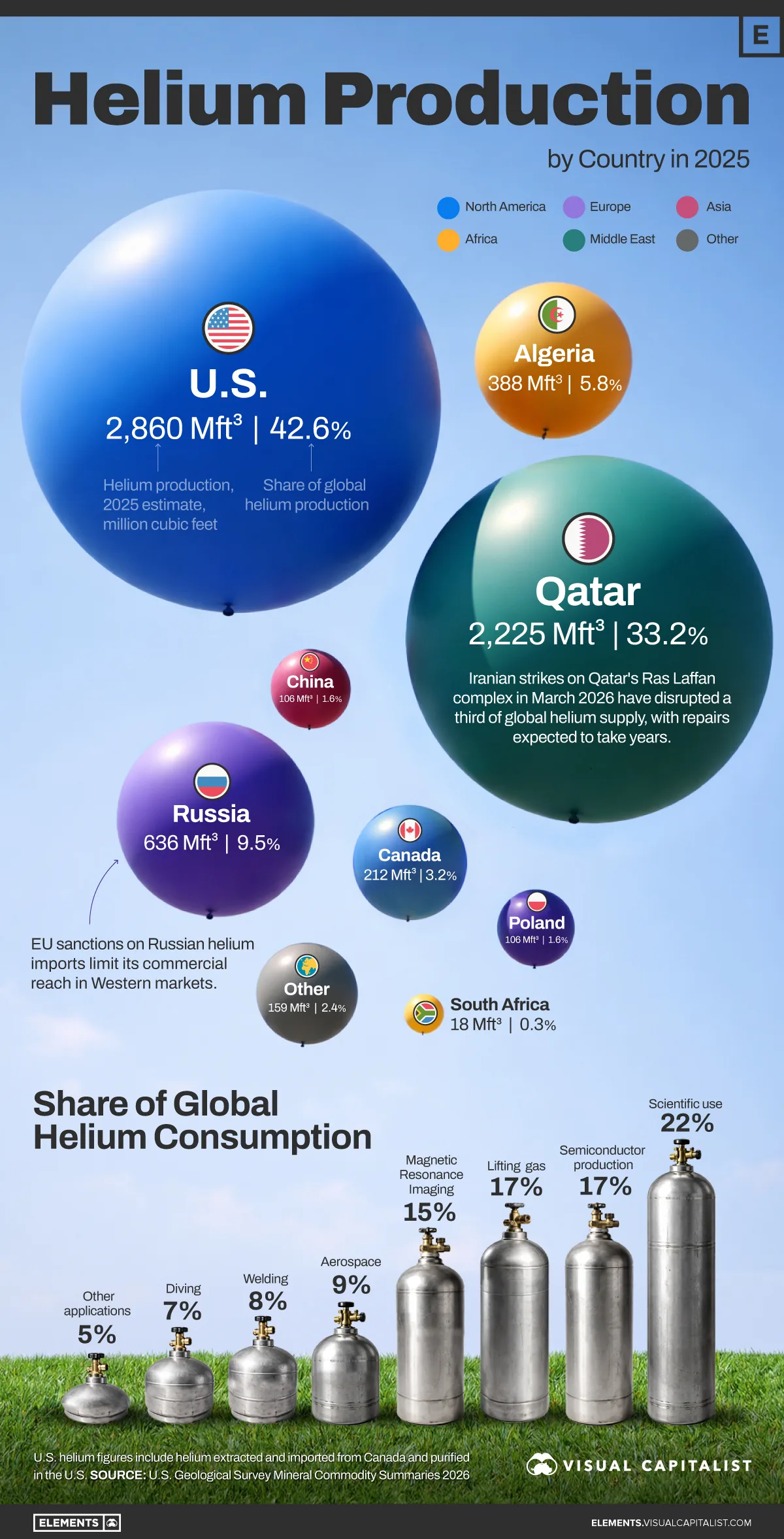
This visual highlights how global helium production is concentrated among a few key countries. The data for this visualization comes from USGS Mineral Commodity Summaries 2026.
A Duopoly Controls Global Helium Supply
The global helium market is unusually concentrated, with just two countries dominating supply. This creates a structural vulnerability: any disruption in either country can have outsized effects on global industries that rely on helium.
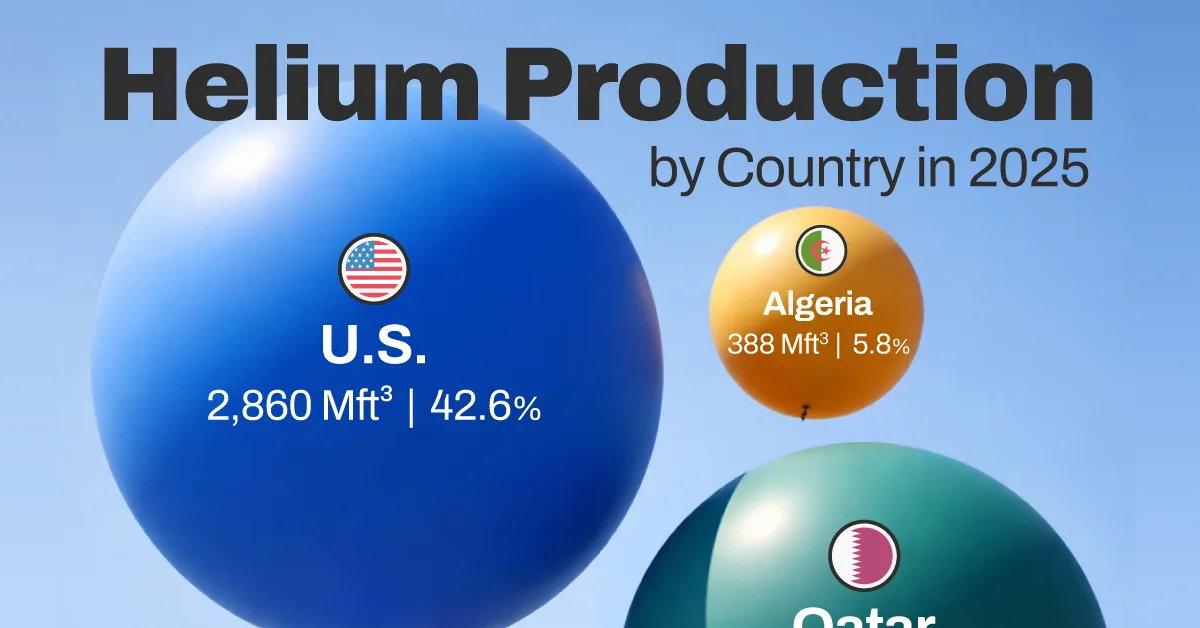
The United States leads global helium production, accounting for 42.6% of output in 2025. This figure includes helium imported from Canada and refined domestically, boosting its share.
Qatar ranks second with 33.2%, meaning the two countries together dominate global supply.
| Country | Production (Cubic Feet) | World Production (%) |
|---|---|---|
 United States United States |
2,860 | 42.6% |
 Qatar Qatar |
2,225 | 33.2% |
 Russia Russia |
636 | 9.5% |
 Algeria Algeria |
388 | 5.8% |
 Canada Canada |
212 | 3.2% |
 China China |
106 | 1.6% |
 Poland Poland |
106 | 1.6% |
 South Africa South Africa |
18 | 0.3% |
 Other Other |
159 | 2.4% |
 World Total World Total |
6,710 | 100.0% |
Recent tensions around the Strait of Hormuz—a critical shipping route for Qatar—highlight how fragile helium supply chains can be. Any disruption to exports from the region can quickly impact countries like South Korea, where semiconductor manufacturing depends on steady helium imports.
Russia’s Output Faces Market Constraints
Russia produces about 9.5% of the world’s helium, placing it third globally. However, its ability to supply Western markets is limited by EU sanctions on Russian helium imports.
Meanwhile, China accounts for a relatively small share of global helium production, contributing about 1.6% in 2025. Despite its limited domestic supply, the country is a major consumer due to its large semiconductor and electronics industries. This imbalance makes China heavily reliant on imports to meet its growing demand.
Helium’s Expanding Industrial Role
Helium demand is tightly linked to high-tech and medical industries, where reliability is critical and substitutes are limited.
Scientific research accounts for 22% of global consumption, followed by semiconductor production and lifting gas applications at 17% each. Medical use, particularly in MRI machines, represents another 15% of demand.
As demand grows across semiconductors, healthcare, and scientific research, helium is becoming less of a niche resource and more of a strategic one. With supply concentrated in just a handful of countries, securing reliable access is emerging as a priority for governments and industries alike.
Learn More on the Voronoi App 
If you enjoyed today’s post, check out Ranked: The Most Consistent U.S. Power Sources on Voronoi, the new app from Visual Capitalist.