Ranked: Military Spending in OECD Countries in 2025
Key Takeaways
- Israel’s military spending as a share of GDP was the highest among OECD countries in 2025, at 7.8%.
- Military spending increased in 28 of the 33 OECD countries shown compared with their 2015–2022 averages.
- Two NATO members have already exceeded the 2035 target of allocating 3.5% of GDP to core defense.
Military spending has risen sharply across many OECD countries since 2022, with defense budgets growing relative to the size of their economies.
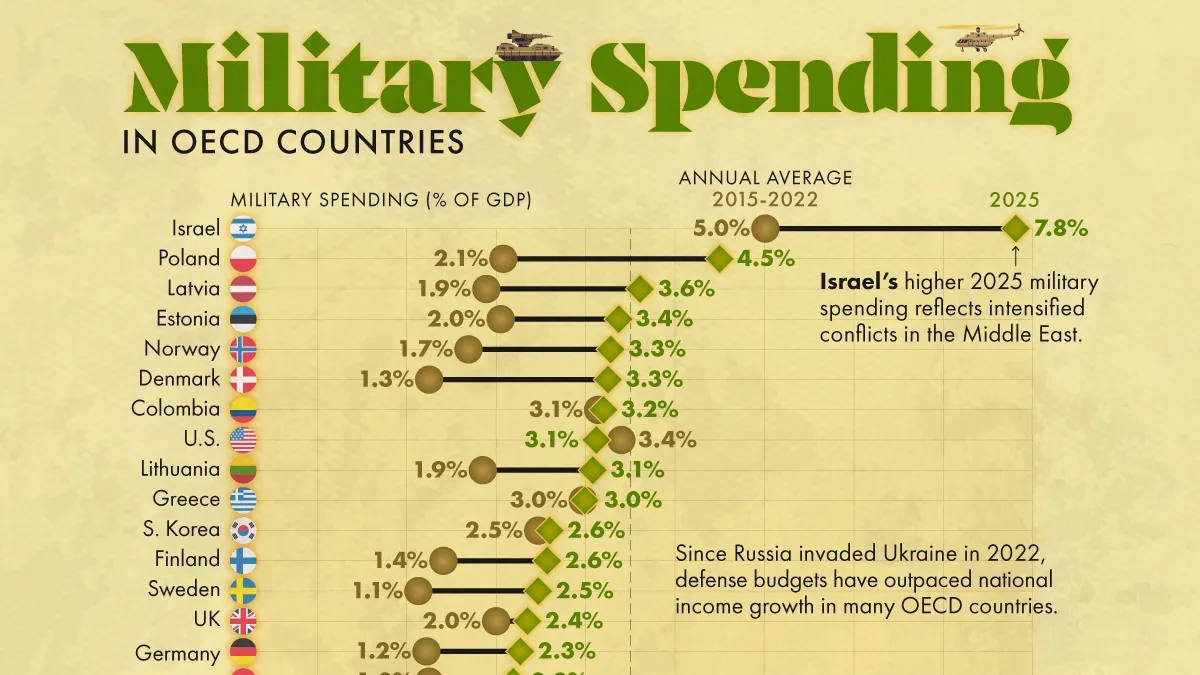
This visualization ranks OECD countries by military spending as a share of GDP in 2025, compared with their 2015–2022 averages, using data from the OECD.
The comparison highlights how defense priorities have shifted amid Russia’s invasion of Ukraine, heightened security concerns in Europe, and mounting U.S. pressure on NATO allies to increase defense spending.
Israel Leads OECD Military Spending Relative to GDP
Measured as a share of GDP, Israel had the highest military spending among OECD countries in 2025, at 7.81%. This was up from an average of 5.01% between 2015 and 2022, marking the largest increase in the dataset at 2.8 percentage points.
Driven in part by its involvement in intensifying, multi-front conflicts in the Middle East, Israel’s spending increase came from an already-high baseline. Even before 2025, its average military spending was higher than that of every other OECD country shown in the dataset.
The following data table ranks OECD countries by military spending as a share of GDP in 2025 compared with their 2015–2022 averages.
| Rank | Country | Military Spending (% of GDP) | |
|---|---|---|---|
| 2015-2022 | 2025 | ||
| 1 |  Israel Israel |
5.01 | 7.81 |
| 2 |  Poland Poland |
2.08 | 4.50 |
| 3 |  Latvia Latvia |
1.89 | 3.61 |
| 4 |  Estonia Estonia |
2.05 | 3.37 |
| 5 |  Norway Norway |
1.69 | 3.28 |
| 6 |  Denmark Denmark |
1.25 | 3.25 |
| 7 |  Colombia Colombia |
3.14 | 3.20 |
| 8 |  United States United States |
3.40 | 3.12 |
| 9 |  Lithuania Lithuania |
1.85 | 3.08 |
| 10 |  Greece Greece |
2.97 | 2.99 |
| 11 |  South Korea South Korea |
2.47 | 2.60 |
| 12 |  Finland Finland |
1.41 | 2.57 |
| 13 |  Sweden Sweden |
1.13 | 2.47 |
| 14 |  United Kingdom United Kingdom |
2.00 | 2.35 |
| 15 |  Germany Germany |
1.22 | 2.27 |
| 16 |  Netherlands Netherlands |
1.25 | 2.19 |
| 17 |  Spain Spain |
1.28 | 2.13 |
| 18 |  Hungary Hungary |
1.29 | 2.04 |
| 19 |  Slovakia Slovakia |
1.44 | 2.03 |
| 20 |  France France |
1.90 | 2.03 |
| 21 |  Belgium Belgium |
0.96 | 2.01 |
| 22 |  Australia Australia |
1.95 | 1.92 |
| 23 |  Türkiye Türkiye |
2.08 | 1.91 |
| 24 |  Italy Italy |
1.40 | 1.89 |
| 25 |  Czechia Czechia |
1.13 | 1.84 |
| 26 |  Portugal Portugal |
1.46 | 1.71 |
| 27 |  Canada Canada |
1.23 | 1.63 |
| 28 |  Slovenia Slovenia |
1.08 | 1.54 |
| 29 |  Chile Chile |
1.85 | 1.52 |
| 30 |  Japan Japan |
0.95 | 1.41 |
| 31 |  New Zealand New Zealand |
1.14 | 1.10 |
| 32 |  Luxembourg Luxembourg |
0.40 | 0.85 |
| 33 |  Mexico Mexico |
0.55 | 0.74 |
When measured in absolute terms, however, Israel’s military spending ranks much lower. In a global ranking of military spending, Israel’s 2025 spending of $48 billion puts the country in 11th place, accounting for 1.67% of total global military expenditure.
Poland and Latvia Clear NATO’s 3.5% Defense Spending Threshold
Members of the North Atlantic Treaty Organization (NATO), 26 of which are also OECD countries, have pledged to spend 5% of GDP on defense and security-related priorities by 2035, including 3.5% on core defense. As of 2025, two NATO members had already exceeded the 3.5% threshold: Poland and Latvia.
Poland, which shares borders with Ukraine, Belarus, and Russia’s Kaliningrad exclave, increased its defense spending from a 2015–2022 average of 2.08% to 4.5% of GDP in 2025 as it strengthened military preparedness and modernization.
That made Poland the second-highest military spender by share of GDP among OECD countries and the highest among NATO members in 2025.
Latvia, which ranked third, also sharply increased its military spending to 3.6% of GDP in 2025, up from a 2015–2022 average of 1.9%. The country, which shares borders with Russia and Belarus, also reinstated conscription in 2023 to address a shortage of military personnel.
Several other members of both NATO and the OECD were close to reaching the 3.5% defense spending goal in 2025. Estonia spent 3.4% of GDP, while Norway and Denmark each spent 3.3%, ranking fourth, fifth, and sixth, respectively.
Defense Spending Decreased in Five OECD Countries
Across the 33 OECD countries in the dataset, the average military spending share rose from 1.7% of GDP in 2015–2022 to 2.5% in 2025.
Despite the broader increase, five countries spent a smaller share of GDP on their militaries in 2025 than their 2015–2022 averages: Chile, the United States, Türkiye, New Zealand, and Australia.
The U.S. stands out because it remained the world’s largest military spender in absolute terms—at $954 billion, or roughly one-third of total global military expenditure that year.
Compared with 2024, U.S. military spending also declined by 7.5% in 2025.
At the bottom of the ranking, Mexico and Luxembourg spent just 0.7% and 0.9% of GDP, respectively. They were the only countries shown that spent less than 1% of GDP on their militaries in 2025.
Overall, the data points to a broad-based rise in military spending across the OECD, with some of the largest increases occurring in countries closest to major security flashpoints.
Learn More on the Voronoi App
If you found today’s post interesting, check out Charted: U.S. Dominates NATO Defense Spending on Voronoi.