Ranked: Refugees Hosted Per Capita by Country
See visuals like this from many other data creators on our Voronoi app. Download it for free on iOS or Android and discover incredible data-driven charts from a variety of trusted sources.
Key Takeaways
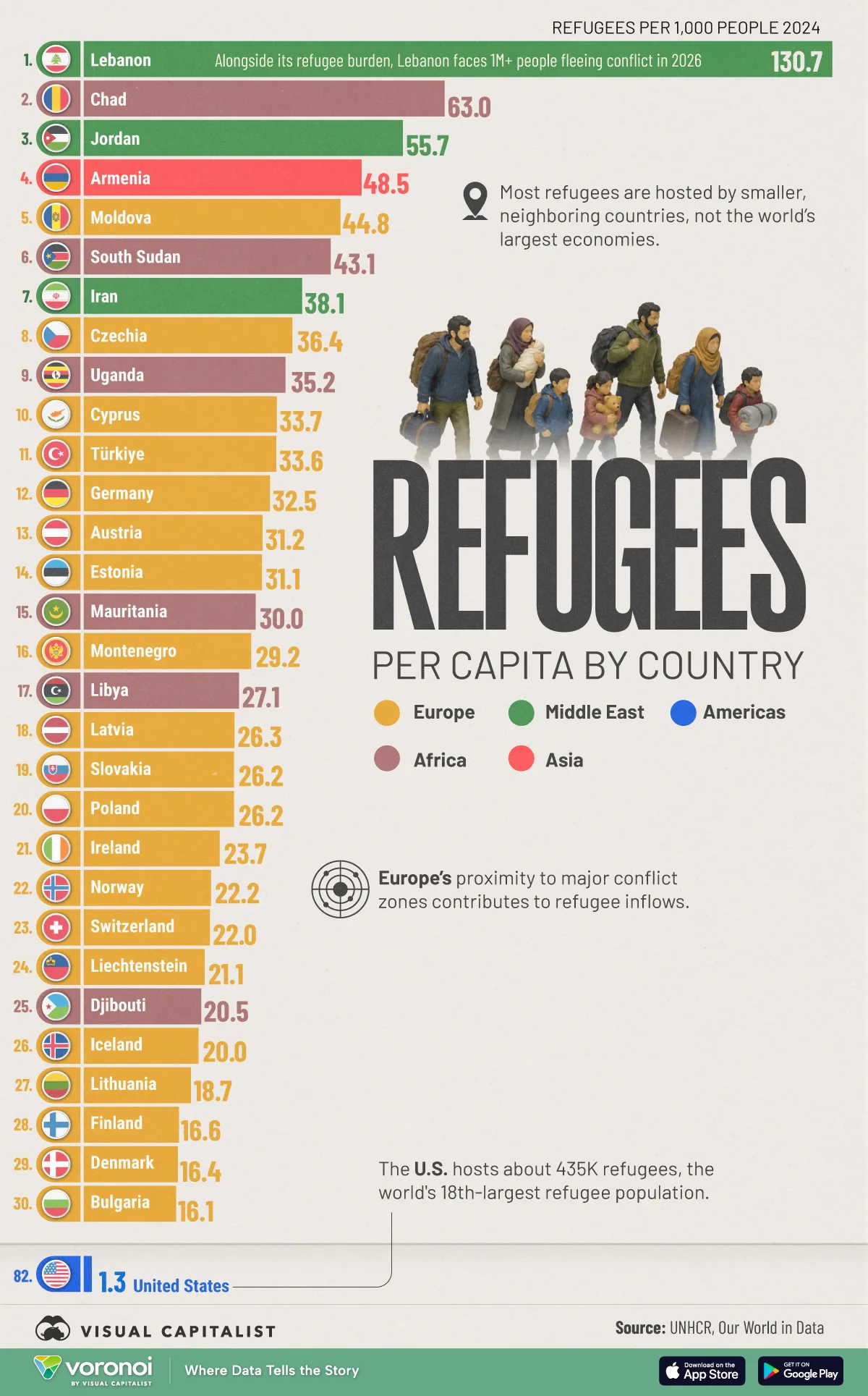
- Lebanon hosts the world’s highest concentration of refugees, with 131 refugees per 1,000 residents.
- Most countries at the top of the ranking border major conflict zones, highlighting how geography shapes refugee flows.
- The U.S. ranks 82nd globally on a per-capita basis despite being among the world’s largest refugee-hosting countries in absolute terms.
The countries carrying the world’s largest refugee burden are often not the ones most people expect.
Using data from the UNHCR via Our World in Data, this graphic ranks countries by the number of refugees hosted per 1,000 residents in 2024.
The results reveal how proximity to conflict frequently matters more than economic size. Many of the countries at the top of the ranking border active war zones and have absorbed large refugee populations relative to their own populations.
Which Countries Carry the Largest Refugee Burden?
Roughly two-thirds of the world’s refugees remain in neighboring countries, helping explain why several relatively small nations rank ahead of much larger economies.
Rather than being distributed across the world’s wealthiest countries, refugee populations are often concentrated in states that share borders with major conflicts. The ranking below shows which countries carry the largest refugee burden relative to their population.
| Rank | Country | Refugees Per 1,000 People 2024 | Region |
|---|---|---|---|
| 1 |  Lebanon Lebanon |
130.7 | Middle East |
| 2 |  Chad Chad |
63.0 | Africa |
| 3 |  Jordan Jordan |
55.7 | Middle East |
| 4 |  Armenia Armenia |
48.5 | Asia |
| 5 |  Moldova Moldova |
44.8 | Europe |
| 6 |  South Sudan South Sudan |
43.1 | Africa |
| 7 |  Iran Iran |
38.1 | Middle East |
| 8 |  Czechia Czechia |
36.4 | Europe |
| 9 |  Uganda Uganda |
35.2 | Africa |
| 10 |  Cyprus Cyprus |
33.7 | Europe |
| 11 |  Türkiye Türkiye |
33.6 | Europe |
| 12 |  Germany Germany |
32.5 | Europe |
| 13 |  Austria Austria |
31.2 | Europe |
| 14 |  Estonia Estonia |
31.1 | Europe |
| 15 |  Mauritania Mauritania |
30.0 | Africa |
| 16 |  Montenegro Montenegro |
29.2 | Europe |
| 17 |  Libya Libya |
27.1 | Africa |
| 18 |  Latvia Latvia |
26.3 | Europe |
| 19 |  Slovakia Slovakia |
26.2 | Europe |
| 20 |  Poland Poland |
26.2 | Europe |
| 21 |  Ireland Ireland |
23.7 | Europe |
| 22 |  Norway Norway |
22.2 | Europe |
| 23 |  Switzerland Switzerland |
22.0 | Europe |
| 24 |  Liechtenstein Liechtenstein |
21.1 | Europe |
| 25 |  Djibouti Djibouti |
20.5 | Africa |
| 26 |  Iceland Iceland |
20.0 | Europe |
| 27 |  Lithuania Lithuania |
18.7 | Europe |
| 28 |  Finland Finland |
16.6 | Europe |
| 29 |  Denmark Denmark |
16.4 | Europe |
| 30 |  Bulgaria Bulgaria |
16.1 | Europe |
| 82 |  United States United States |
1.3 | North America |
Why Does Lebanon Rank So High?
Lebanon tops the ranking by a wide margin, hosting 130.7 refugees per 1,000 residents. Put differently, about one out of every eight people living in the country is a refugee, the highest ratio in the world.
Its position reflects the country’s proximity to Syria, which has produced one of the world’s largest refugee crises since civil war broke out in 2011. Over the past decade, millions of Syrians have sought refuge in neighboring countries, with Lebanon absorbing one of the largest shares relative to its population.
The country has also faced mounting economic and political challenges of its own. More recently, fighting between Israel and Hezbollah displaced more than one million people within Lebanon, adding further strain to public services and infrastructure.
Taken together, these pressures help explain why Lebanon remains one of the countries most affected by displacement anywhere in the world.
Geography Matters More Than Wealth
Many of the countries hosting the largest refugee populations are located near active conflicts or regions experiencing prolonged instability.
Jordan and Lebanon border Syria. Moldova shares a border with Ukraine. Chad hosts refugees from neighboring Sudan, while Uganda has long received people fleeing violence in South Sudan and the Democratic Republic of Congo.
The pattern helps explain why many smaller countries appear near the top of the ranking despite having far fewer economic resources than larger developed nations.
For refugees, crossing a nearby border is often the fastest and safest option. As a result, neighboring countries frequently absorb the largest influxes long before refugees are resettled elsewhere.
Why the U.S. Ranks 82nd
At first glance, America’s ranking may seem surprisingly low.
The United States hosts hundreds of thousands of refugees and remains the world’s 18th-largest refugee destination in absolute terms. However, its population of more than 340 million significantly changes the picture.
When refugee numbers are adjusted for population size, the U.S. hosts roughly 1.3 refugees per 1,000 residents, placing it 82nd globally.
The gap highlights why per-capita measures can reveal a different reality than headline totals. While large countries often host more refugees overall, smaller nations can experience a much greater impact relative to their population size.
Refugee Pressures Are Reaching Record Levels
The number of forcibly displaced people worldwide has surpassed 120 million, nearly double the level seen a decade ago. Conflicts in Ukraine, Sudan, Syria, and other regions continue to drive displacement across borders.
For host countries, the impact extends beyond humanitarian assistance. Large refugee populations can increase demand for housing, healthcare, education, infrastructure, and public services, particularly in smaller countries with limited resources.
The ranking highlights a reality often overlooked in global migration debates: the countries carrying the largest refugee burden are frequently those located closest to conflict, not necessarily those with the largest economies.
Learn More on the Voronoi App 
To learn more about this topic, check out this graphic on the world’s largest migration corridors.