Ranked: The Biggest Arms Importers in 2025
See visuals like this from many other data creators on our Voronoi app. Download it for free on iOS or Android and discover incredible data-driven charts from a variety of trusted sources.
Key Takeaways
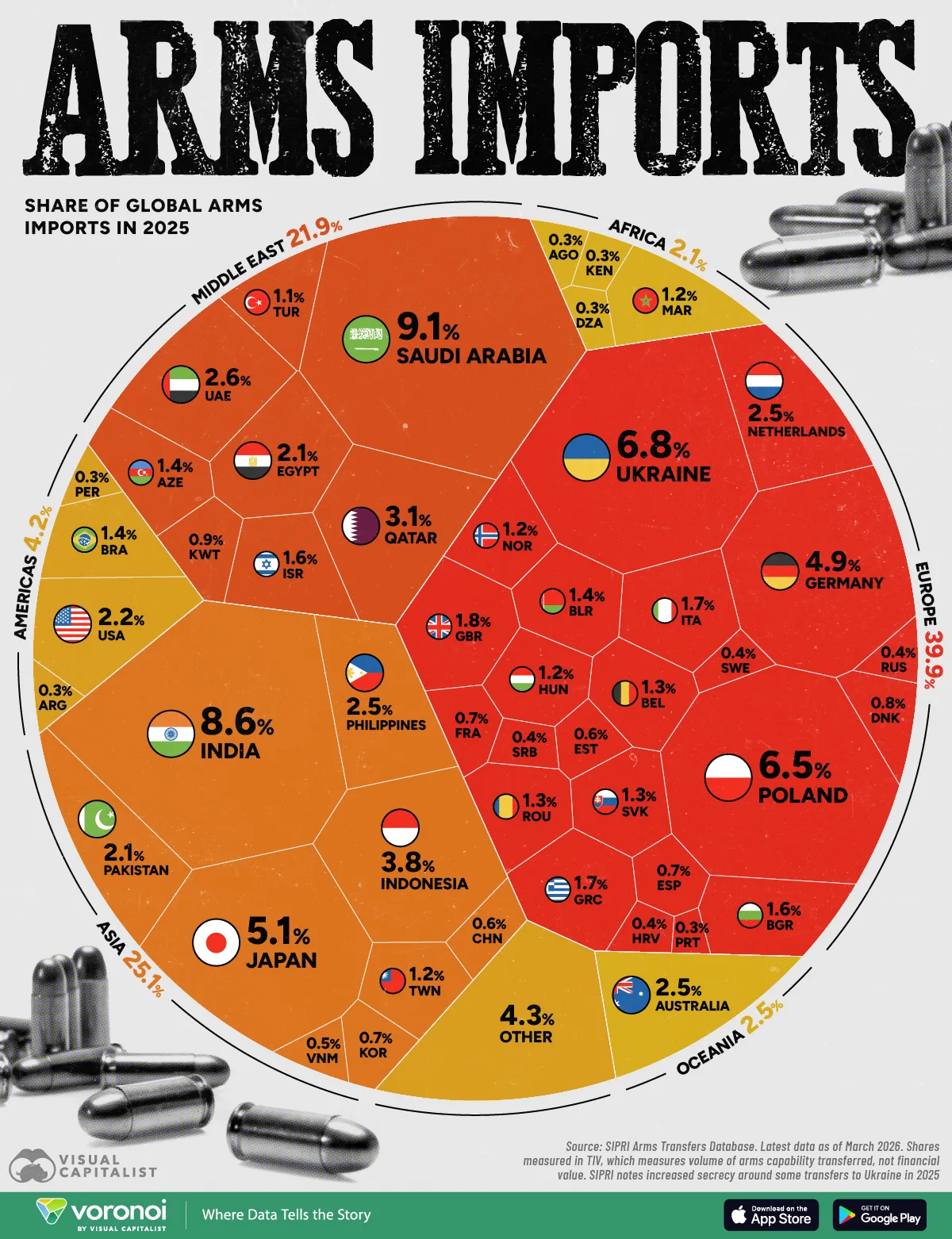
- Saudi Arabia is the world’s largest arms importer, accounting for 9.1% of global demand.
- Europe now makes up nearly 40% of global arms imports amid rising security concerns.
- India, Ukraine, and Poland rank among the top buyers, reflecting ongoing regional tensions.
Global demand for military equipment is rising as countries respond to conflict, uncertainty, and shifting alliances.
This chart ranks the world’s largest arms importers in 2025, based on data from the SIPRI Arms Transfers Database (March 2026). It shows which nations are driving the surge in defense spending and where demand is accelerating fastest.
Middle East and Asia Lead Demand
Saudi Arabia leads global arms imports by a wide margin, accounting for 9.1% of total demand, more than any other country. Its sustained spending highlights a broader trend. Nations are accelerating military upgrades in response to prolonged regional instability.
| Rank | Country | % of Global Arms Imports |
|---|---|---|
| 1 |  Saudi Arabia Saudi Arabia |
9.1% |
| 2 |  India India |
8.6% |
| 3 |  Ukraine Ukraine |
6.8% |
| 4 |  Poland Poland |
6.5% |
| 5 |  Japan Japan |
5.1% |
| 6 |  Germany Germany |
4.9% |
| 7 |  Indonesia Indonesia |
3.8% |
| 8 |  Qatar Qatar |
3.1% |
| 9 |  United Arab Emirates United Arab Emirates |
2.6% |
| 10 |  Philippines Philippines |
2.5% |
| 11 |  Australia Australia |
2.5% |
| 12 |  Netherlands Netherlands |
2.5% |
| 13 |  United States United States |
2.2% |
| 14 |  Pakistan Pakistan |
2.1% |
| 15 |  Egypt Egypt |
2.1% |
| 16 |  United Kingdom United Kingdom |
1.8% |
| 17 |  Greece Greece |
1.7% |
| 18 |  Italy Italy |
1.7% |
| 19 |  Bulgaria Bulgaria |
1.6% |
| 20 |  Israel Israel |
1.6% |
| 21 |  Belarus Belarus |
1.4% |
| 22 |  Azerbaijan Azerbaijan |
1.4% |
| 23 |  Brazil Brazil |
1.4% |
| 24 |  Slovakia Slovakia |
1.3% |
| 25 |  Belgium Belgium |
1.3% |
| 26 |  Romania Romania |
1.3% |
| 27 |  Norway Norway |
1.2% |
| 28 |  Hungary Hungary |
1.2% |
| 29 |  Taiwan Taiwan |
1.2% |
| 30 |  Morocco Morocco |
1.2% |
| 31 |  Turkiye Turkiye |
1.1% |
| 32 |  Kuwait Kuwait |
0.9% |
| 33 |  Denmark Denmark |
0.8% |
| 34 |  Spain Spain |
0.7% |
| 35 |  France France |
0.7% |
| 36 |  South Korea South Korea |
0.7% |
| 37 |  China China |
0.6% |
| 38 |  Estonia Estonia |
0.6% |
| 39 |  Viet Nam Viet Nam |
0.5% |
| 40 |  Sweden Sweden |
0.4% |
| 41 |  Serbia Serbia |
0.4% |
| 42 |  Croatia Croatia |
0.4% |
| 43 |  Russia Russia |
0.4% |
| 44 |  Kenya Kenya |
0.3% |
| 45 |  Algeria Algeria |
0.3% |
| 46 |  Argentina Argentina |
0.3% |
| 47 |  Peru Peru |
0.3% |
| 48 |  Portugal Portugal |
0.3% |
| 49 |  Angola Angola |
0.3% |
| — |  Other Other |
4.3% |
India follows closely at 8.6%, maintaining its position as a top importer due to ongoing regional tensions and the need to upgrade military capabilities. Meanwhile, countries like Qatar and the United Arab Emirates remain major buyers, reinforcing the Middle East’s strong presence in global arms demand.
Europe’s Rapid Expansion
Europe now accounts for 39.9% of global arms imports, the largest regional share by far. This sharp increase reflects a rapid buildup in defense capabilities following the war in Ukraine and a broader shift toward rearmament across the continent.
Ukraine ranks third globally with a 6.8% share, reflecting urgent military needs due to the war with Russia.
Broad Global Participation
While the top importers dominate headlines, arms demand is spread across dozens of countries, underscoring how widespread military investment has become in today’s geopolitical climate.
Nations like Japan, Germany, and Indonesia each hold significant shares. Smaller importers also represent a meaningful portion of the market, with the “Other” category accounting for 4.3% of global imports.
Learn More on the Voronoi App 
If you enjoyed today’s post, check out Where Are the World’s Nuclear Warheads? on Voronoi, the new app from Visual Capitalist.