Ranked: The Biggest Risks Facing the World in 2026
See visuals like this from many other data creators on our Voronoi app. Download it for free on iOS or Android and discover incredible data-driven charts from a variety of trusted sources.
Key Takeaways
- Geoeconomic confrontation is the top global risk in 2026, according to the World Economic Forum’s annual report.
- Fraying transatlantic alliances and a Great-Power competition between the U.S. and China is increasingly undermining global stability.
From rapid advances in AI to shifts in the postwar economic order, multiple forces are reshaping the global system.
As these shifts accelerate, they introduce growing risks. Not only do they raise questions for national competitiveness and security, they stand to disproportionately hit labor markets.
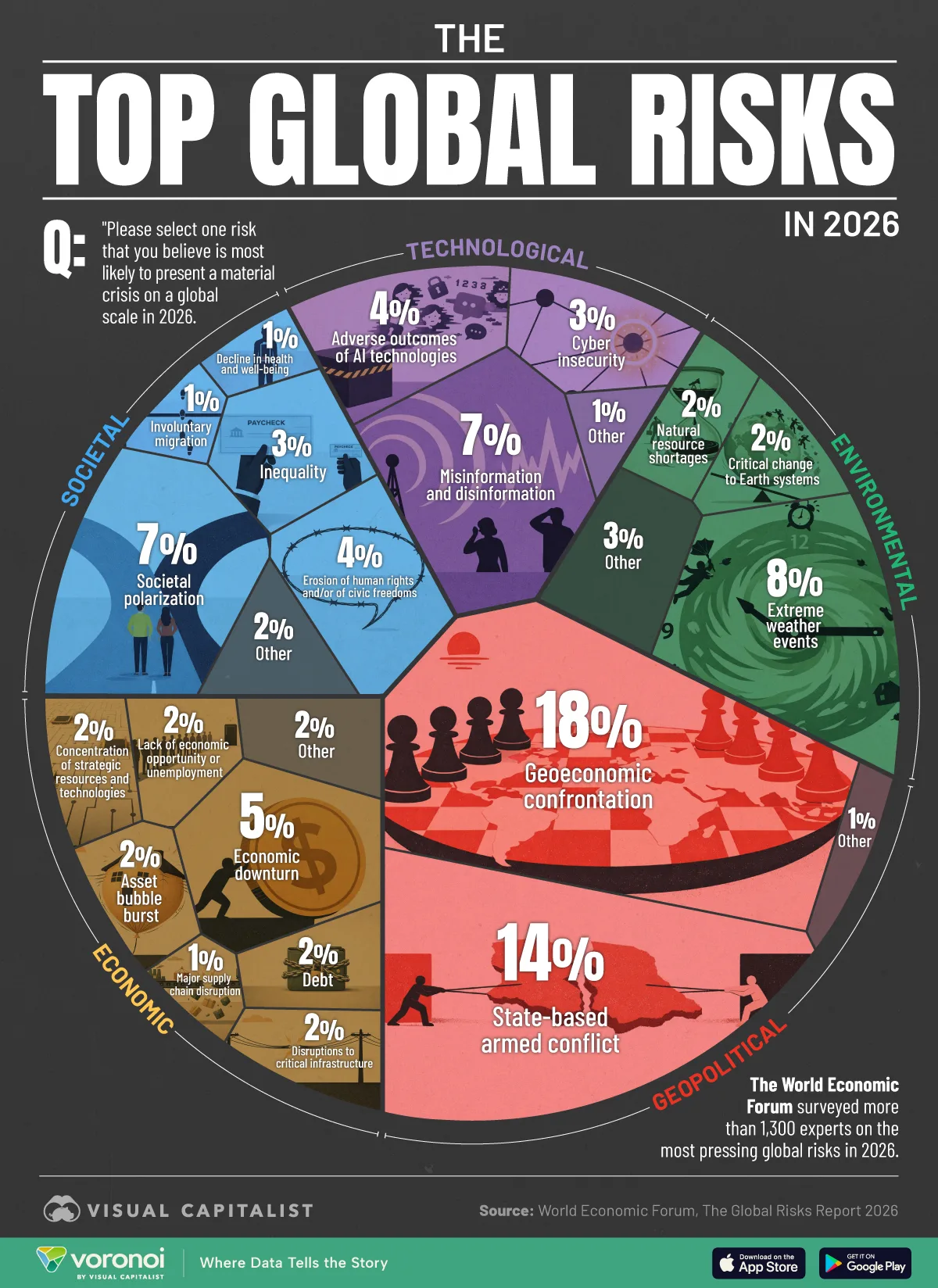
This graphic shows the world’s leading risks in 2026, based on data from the World Economic Forum’s Global Risks Report 2026.
A Closer Look at the Top Global Risks
For the analysis, the World Economic Forum surveyed more than 1,300 experts on the most pressing global risks in 2026.
Here, respondents were asked to answer the following question, “Please select one risk that you believe is most likely to present a material crisis on a global scale in 2026.” Surveys were conducted between August 12 and September 22, 2025:
| Risk | Percentage Selecting as Top Risk |
|---|---|
| Geoeconomic confrontation | 18% |
| State-based armed conflict | 14% |
| Extreme weather events | 8% |
| Societal polarization | 7% |
| Misinformation and disinformation | 7% |
| Economic downturn | 5% |
| Erosion of human rights and/or of civic freedoms | 4% |
| Adverse outcomes of AI technologies | 4% |
| Cyber insecurity | 3% |
| Inequality | 3% |
| Lack of economic opportunity or unemployment | 2% |
| Concentration of strategic resources and technologies | 2% |
| Critical change to Earth systems | 2% |
| Natural resource shortages | 2% |
| Disruptions to critical infrastructure | 2% |
| Asset bubble burst | 2% |
| Debt | 2% |
| Disruptions to a systemically important supply chain | 1% |
| Decline in health and well-being | 1% |
| Involuntary migration or displacement | 1% |
| Biodiversity loss and ecosystem collapse | 1% |
| Biological, chemical or nuclear weapons or hazards | 1% |
| Inflation | 1% |
| Pollution | 1% |
| Insufficient public infrastructure and social protections | 1% |
| Infectious diseases | 1% |
| Non-weather related natural disasters | 1% |
| Censorship and surveillance | 1% |
| Crime and illicit economic activity | 1% |
Geoeconomic confrontation ranks as the top global risk in 2026, selected by 18% of respondents.
Since last year, it has jumped up two spots in the rankings given persisting tensions in the Middle East and Ukraine. More recently, U.S. pressure over Greenland, along with the capture of Venezuela’s Nicolás Maduro, have added further strain.
At the same time, President Trump’s perceived indifference toward defending Taiwan could create a perfect storm, according to experts, for China’s push for “reunification.”
State-based armed conflict ranks second in the WEF report, selected by 14% of respondents. Notably, there are 59 active state-based conflicts worldwide, the highest number since World War II.
Rounding out the top three risks are extreme weather events, selected by 8% respondents overall. From wildfires to droughts, severe weather events are meaningfully contributing to food inflation, displacement, and higher insurance costs. As global temperatures continue to rise, these impacts could intensify in both frequency and severity.
Learn More on the Voronoi App 
To learn more about this topic, check out this graphic on the top 10 global risks from 2020 to 2025.