Ranked: The Countries That Feed the World
See visuals like this from many other data creators on our Voronoi app. Download it for free on iOS or Android and discover incredible data-driven charts from a variety of trusted sources.
Key Takeaways
- Just 10 countries account for nearly half of global food exports.
- The U.S., Brazil, and Canada dominate global agricultural trade.
- China produces huge amounts of food, but consumes most of it domestically.
Food exports have become one of the clearest measures of global economic power.
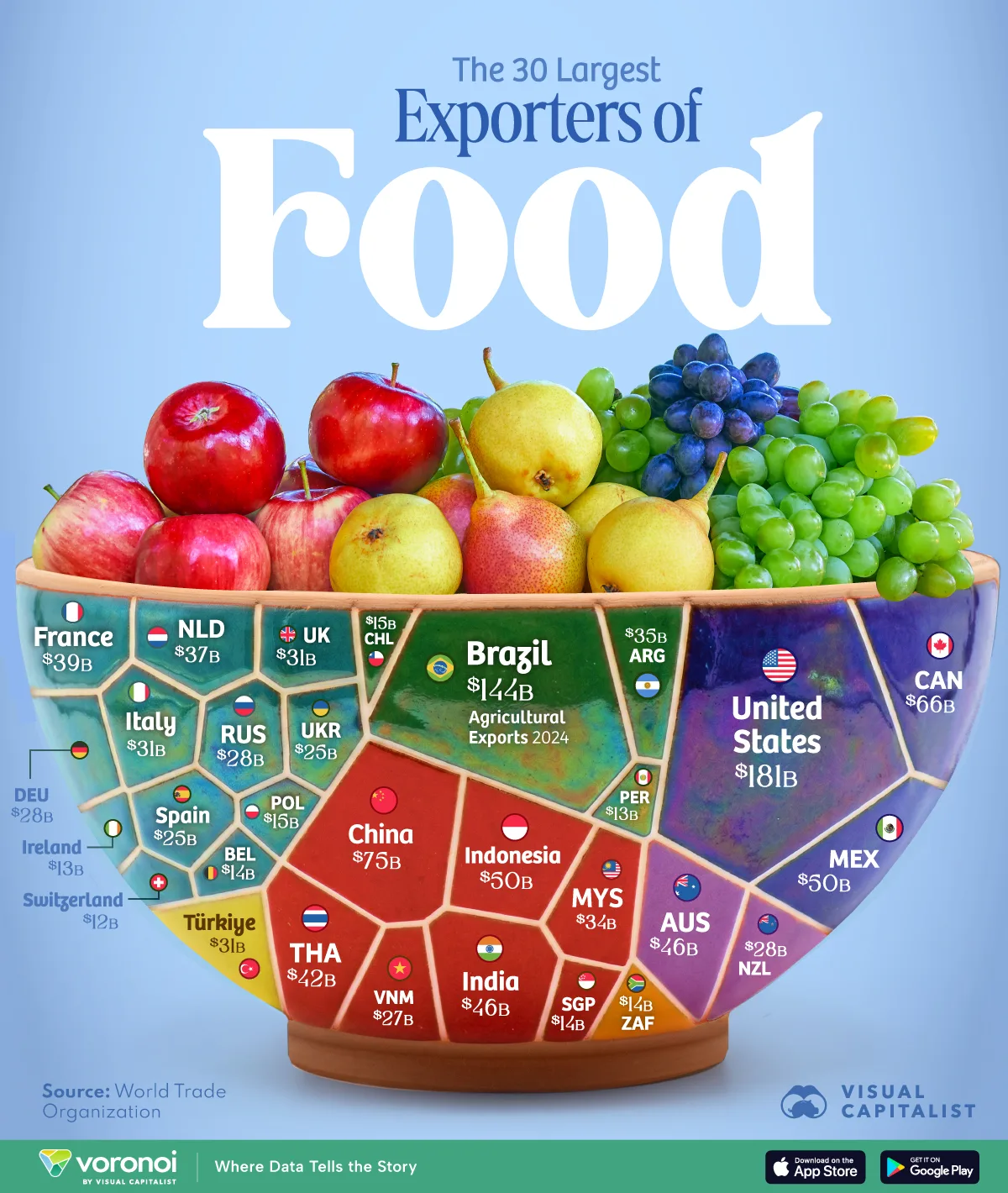
This graphic maps the world’s 30 largest food exporters using World Trade Organization data. Together, these countries account for more than 80% of the $1.5 trillion global agricultural export market.
The data also reveals how concentrated global food supply really is. A relatively small group of countries now plays an outsized role in feeding the world, making agricultural trade increasingly strategic as shipping costs, fertilizer prices, and geopolitical tensions rise.
The Top 30 Exporters of Food
A relatively small group of countries now supplies a huge share of the world’s traded food. The top 10 exporters alone account for nearly half of global agricultural exports, giving a handful of economies enormous influence over global food prices and supply chains.
| Rank | Country | Agricultural Exports (2024) |
Share of Global Total |
Region |
|---|---|---|---|---|
| 1 |  U.S. U.S. |
$181.3B | 12.1% | North America |
| 2 |  Brazil Brazil |
$144.4B | 9.7% | South America |
| 3 |  China China |
$74.8B | 5.0% | Asia |
| 4 |  Canada Canada |
$66.3B | 4.4% | North America |
| 5 |  Mexico Mexico |
$49.9B | 3.3% | North America |
| 6 |  Indonesia Indonesia |
$49.7B | 3.3% | Asia |
| 7 |  Australia Australia |
$45.8B | 3.1% | Oceania |
| 8 |  India India |
$45.5B | 3.0% | Asia |
| 9 |  Thailand Thailand |
$41.8B | 2.8% | Asia |
| 10 |  France France |
$38.7B | 2.6% | Europe |
| 11 |  Netherlands Netherlands |
$37.3B | 2.5% | Europe |
| 12 |  Argentina Argentina |
$34.8B | 2.3% | South America |
| 13 |  Malaysia Malaysia |
$33.5B | 2.2% | Asia |
| 14 |  Türkiye Türkiye |
$31.4B | 2.1% | Middle East |
| 15 |  UK UK |
$30.9B | 2.1% | Europe |
| 16 |  Italy Italy |
$30.7B | 2.1% | Europe |
| 17 |  Russia Russia |
$28.4B | 1.9% | Europe |
| 18 |  New Zealand New Zealand |
$28.3B | 1.9% | Oceania |
| 19 |  Germany Germany |
$28.2B | 1.9% | Europe |
| 20 |  Vietnam Vietnam |
$26.9B | 1.8% | Asia |
| 21 |  Spain Spain |
$25.3B | 1.7% | Europe |
| 22 |  Ukraine Ukraine |
$24.7B | 1.7% | Europe |
| 23 |  Poland Poland |
$15.0B | 1.0% | Europe |
| 24 |  Chile Chile |
$14.9B | 1.0% | South America |
| 25 |  Singapore Singapore |
$14.0B | 0.9% | Asia |
| 26 |  Belgium Belgium |
$13.9B | 0.9% | Europe |
| 27 |  South Africa South Africa |
$13.6B | 0.9% | Africa |
| 28 |  Ireland Ireland |
$13.0B | 0.9% | Europe |
| 29 |  Peru Peru |
$12.6B | 0.8% | South America |
| 30 |  Switzerland Switzerland |
$11.6B | 0.8% | Europe |
The Americas form the core of the global food trade system. The U.S., Brazil, Canada, and Mexico collectively account for nearly 30% of global agricultural exports, spanning everything from grains and meat to processed foods and oilseeds.
Meanwhile, several populous economies rank lower than expected. Despite being the world’s largest agricultural producer, China trails far behind the U.S. and Brazil in export value, reflecting how much of its output is consumed domestically.
Asia-Pacific Economies Play Specialized Roles
While the Americas dominate overall export value, several Asia-Pacific economies play critical roles in specific agricultural supply chains.
Australia ranks among the world’s largest food exporters thanks to its major beef, wheat, and barley exports, making it an important supplier across Asia. Indonesia, meanwhile, is a global powerhouse in palm oil exports, one of the world’s most widely used food ingredients.
Together, these countries highlight how global food trade depends not only on agricultural scale, but also on regional specialization.
Europe Remains a Food Export Powerhouse
Europe’s largest food exporters compete less on scale and more on specialization, efficiency, and high-value agricultural products.
The Netherlands stands out in particular. Despite its small size, it ranks as the world’s 11th-largest food exporter thanks to highly efficient farming, advanced greenhouse agriculture, and its role as a major trade hub for Europe. France and Germany also remain global leaders through exports ranging from grains and dairy to processed foods and beverages.
Together, Europe highlights another side of global food trade: dominance is not only about farmland size, but also logistics, technology, and supply-chain infrastructure.
Why Food Exports Are Becoming More Strategic
Recent shipping disruptions and higher energy costs are increasing pressure across global food supply chains. Because agriculture depends heavily on fuel, fertilizer, and freight networks, geopolitical instability can quickly raise production and transportation costs worldwide.
That dynamic is increasing the strategic importance of major food exporters like the U.S., Brazil, Canada, and Australia, which have the scale and infrastructure to remain reliable suppliers during periods of disruption.
Learn More on the Voronoi App 
To learn more about this topic, check out this graphic on the U.S. states with the most farmland.