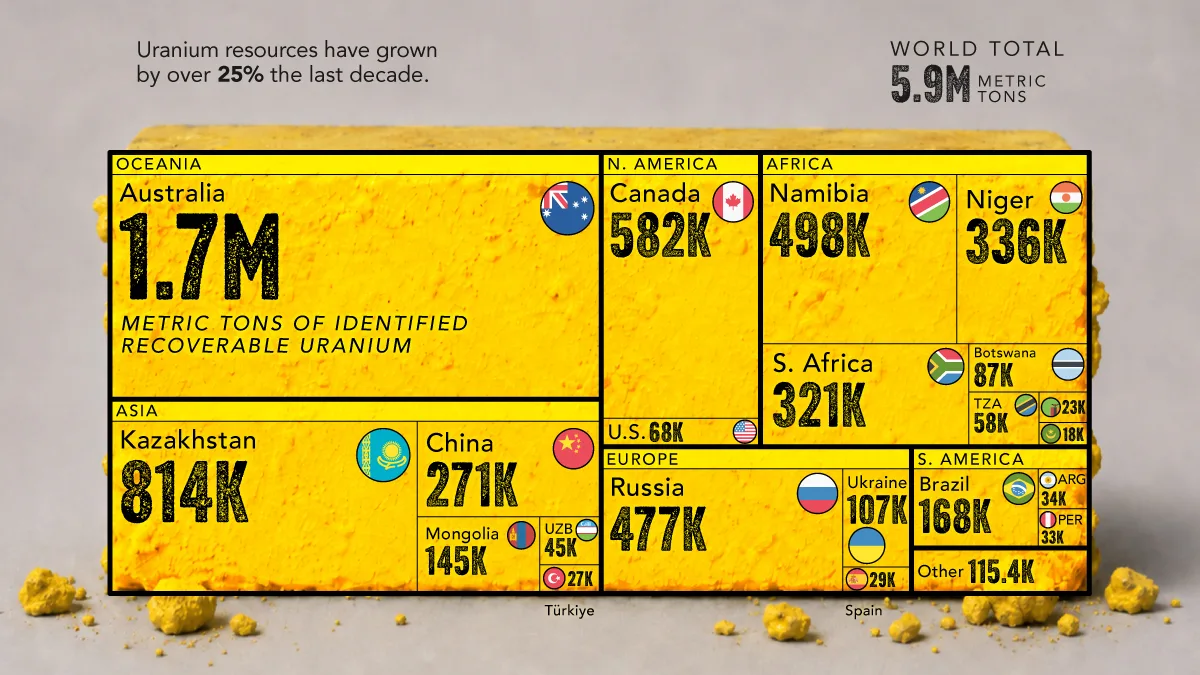
Ranked: The Countries With the Most Uranium
See visuals like this from many other data creators on our Voronoi app. Download it for free on iOS or Android and discover incredible data-driven charts from a variety of trusted sources.
Key Takeaways
- Australia holds 28% of the world’s identified uranium resources, more than double Kazakhstan’s total.
- Australia, Kazakhstan, and Canada account for 52% of global uranium resources.
- Identified uranium resources have increased by more than 25% over the last decade as exploration activity expanded worldwide.
Uranium resources are heavily concentrated in a handful of countries, with Australia alone holding more than a quarter of the world’s known supply.
This graphic ranks countries by identified recoverable uranium resources in 2023. The figures include resources that can be recovered at costs of up to $130 per kilogram of uranium.
The data for this visualization comes from the OECD Nuclear Energy Agency and International Atomic Energy Agency.
Australia Leads by a Wide Margin
Global identified uranium resources totaled 5.9 million tonnes in 2023. More than half of that supply is concentrated in just three countries: Australia, Kazakhstan, and Canada.
Australia has the world’s largest uranium resource base, with 1.7 million tonnes of contained uranium metal.
That equals 28% of the global total, making Australia the clear leader. Its resources are more than double those of Kazakhstan, the second-largest holder.
| Country | Metric tons of identified recoverable uranium (2023) | Percentage of world |
|---|---|---|
 Australia Australia |
1,671,200 | 28% |
 Kazakhstan Kazakhstan |
813,900 | 14% |
 Canada Canada |
582,000 | 10% |
 Namibia Namibia |
497,900 | 8% |
 Russia Russia |
476,600 | 8% |
 Niger Niger |
336,000 | 6% |
 South Africa South Africa |
320,900 | 5% |
 China China |
270,500 | 5% |
 Brazil Brazil |
167,800 | 3% |
 Mongolia Mongolia |
144,600 | 2% |
 Ukraine Ukraine |
106,700 | 2% |
 Botswana Botswana |
87,200 | 1% |
 United States United States |
67,800 | 1% |
 Tanzania Tanzania |
57,700 | 1% |
 Uzbekistan Uzbekistan |
45,000 | 1% |
 Argentina Argentina |
34,300 | 1% |
 Peru Peru |
33,400 | 1% |
 Spain Spain |
28,500 | 1% |
 Türkiye Türkiye |
27,100 | 1% |
 Zambia Zambia |
23,000 | 0% |
 Mauritania Mauritania |
18,200 | 0% |
 Other Other |
115,400 | 2% |
 World total World total |
5,925,700 | 100% |
Having large uranium resources does not necessarily mean producing the most uranium. Resource estimates measure what is known to exist and can potentially be recovered economically, while production depends on mine development, investment, permitting, and government policy.
Despite this large resource base, Australia’s uranium mining industry is smaller than its reserves might suggest, partly due to policy restrictions and project development timelines.
Kazakhstan and Canada Round Out the Top Three
Kazakhstan holds 813,900 tonnes of uranium resources, or 14% of the global total.
Canada follows with 582,000 tonnes, equal to 10% of the world’s resources. Together with Australia, these three countries account for 52% of identified global uranium resources.
Both Kazakhstan and Canada are also major uranium producers, making them central to the global nuclear fuel supply chain.
A Broad Global Resource Base
Beyond the top three, uranium resources are spread across Africa, Asia, Europe, and the Americas.
Namibia and Niger are notable African holders, while Russia, China, Ukraine, and Uzbekistan represent major Eurasian resource bases. Brazil, Argentina, Peru, and the U.S. add to the resource picture in the Americas.
As countries look to expand low-carbon electricity generation, uranium supply has become increasingly important to energy security planning. Continued exploration has helped increase identified global uranium resources by more than 25% over the last decade, expanding the potential fuel base for future nuclear power growth.
Learn More on the Voronoi App 
If you enjoyed today’s post, check out Ranked: The World’s Biggest Electricity Consumers on Voronoi.