Ranked: The Deadliest and Safest Car Models in America
Key Takeaways
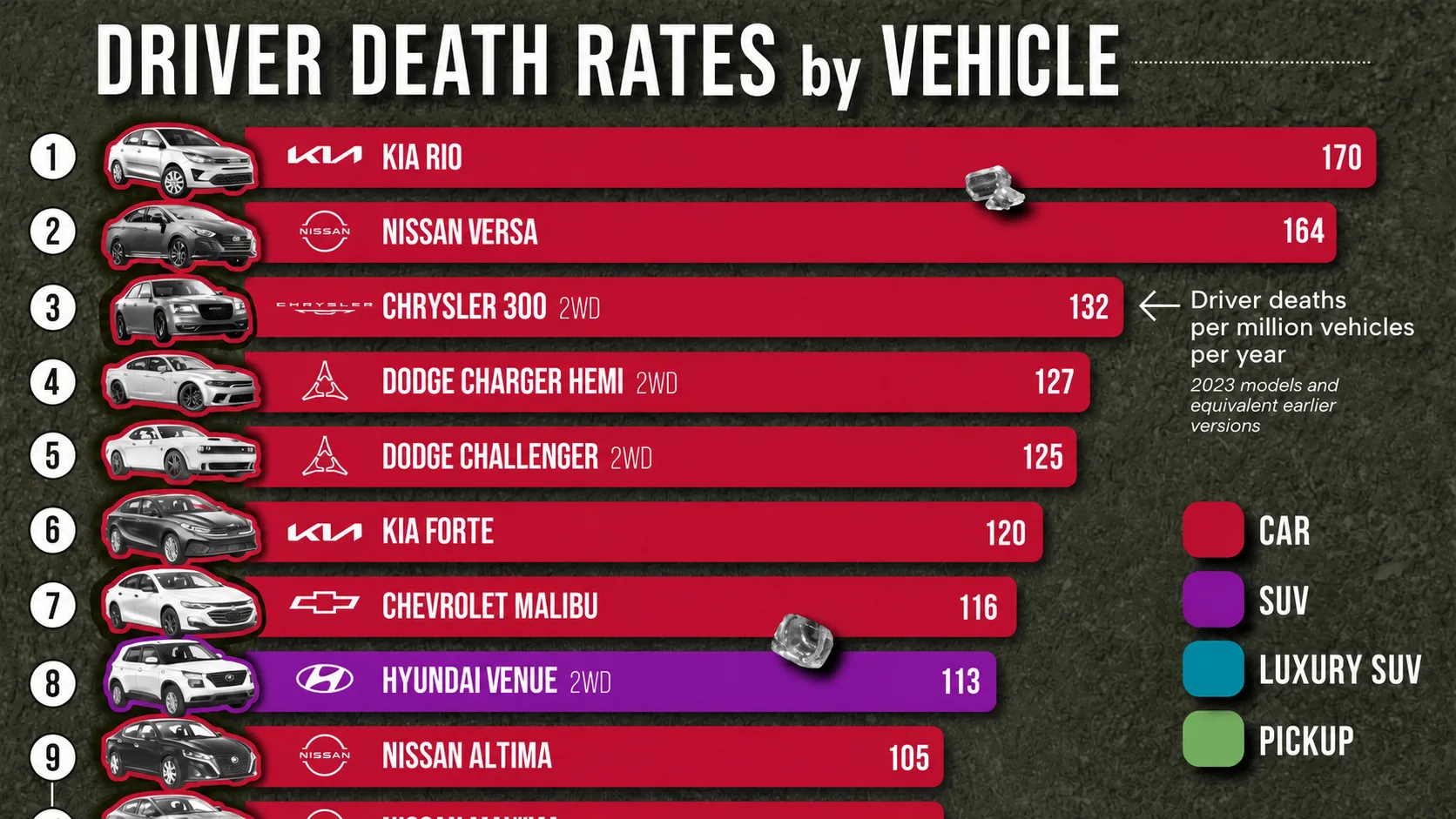
- The Kia Rio has the highest driver death rate at 170 deaths per million registered vehicle-years, followed by the Nissan Versa at 164.
- Nine of the 10 models with the highest driver death rates are passenger cars, while SUVs dominate the lowest-rate rankings.
- Six models recorded zero driver deaths during the study period, including luxury SUVs from BMW, Audi, and Mercedes-Benz.
Which vehicles have the highest and lowest driver death rates in America
This visualization, created by Julie R. Peasley, uses Insurance Institute for Highway Safety (IIHS) data covering 2023 models and equivalent earlier versions during 2021–2024. Rates are adjusted for driver age and sex and measure fatalities per million registered vehicle-years, rather than crash frequency.
Which Car Models Have the Highest Driver Death Rates?
The following table ranks the 10 models with the highest driver death rates, according to the IIHS.
| Vehicle | Driver death rate per million vehicle-years | Vehicle category |
|---|---|---|
| Kia Rio | 170 | Car |
| Nissan Versa | 164 | Car |
| Chrysler 300 2WD | 132 | Car |
| Dodge Charger Hemi 2WD | 127 | Car |
| Dodge Challenger 2WD | 125 | Car |
| Kia Forte | 120 | Car |
| Chevrolet Malibu | 116 | Car |
| Hyundai Venue 2WD | 113 | SUV |
| Nissan Altima | 105 | Car |
| Nissan Maxima | 105 | Car |
The Kia Rio (170) and Nissan Versa (164) lead the ranking, with death rates more than four times the overall average of 37. Nissan appears three times in the top 10, while the Hyundai Venue is the only SUV on the list.
Smaller vehicles generally offer less protection in collisions with heavier vehicles. Meanwhile, powerful models like the Dodge Charger and Challenger illustrate how vehicle performance and driver behavior can also influence fatality rates.
Driver demographics can also influence these rates, making it useful to consider how vehicle preferences vary across generations.
Which Vehicles Have the Lowest Driver Death Rates?
The following table shows the 10 models with the lowest driver death rates, based on IIHS findings.
| Vehicle | Driver death rate per million vehicle-years | Vehicle category |
|---|---|---|
| BMW X5 4WD | 5 | Luxury SUV |
| Volkswagen Atlas 2WD | 5 | SUV |
| Toyota RAV4 Prime Plug-in hybrid 4WD | 5 | SUV |
| Porsche Macan 4WD | 4 | Luxury SUV |
| Audi Q7 4WD | 0 | Luxury SUV |
| BMW X7 4WD | 0 | Luxury SUV |
| Toyota Tundra CrewMax 4WD | 0 | Pickup |
| Chevrolet Tahoe 4WD | 0 | SUV |
| Mercedes-Benz GLE-Class 2WD | 0 | Luxury SUV |
| Mercedes-Benz GLB-Class 4WD | 0 | Luxury SUV |
Six models recorded zero driver deaths during the study period, including the Audi Q7, BMW X7, and Mercedes-Benz GLE-Class. All 10 vehicles are SUVs or pickups, with luxury SUVs accounting for six entries.
Are Luxury SUVs Actually Safer?
Luxury SUVs often combine greater vehicle mass with advanced safety features, including airbags, automatic emergency braking, and electronic stability control. Their size can offer greater protection in collisions with smaller vehicles, while safety technology may help prevent crashes.
However, SUVs aren’t universally safer. Their higher centers of gravity can increase rollover risks, while heavier vehicles can pose greater dangers to occupants of smaller cars.
Luxury branding also doesn’t guarantee superior safety. Individual crash-test results, vehicle design, and driving conditions all matter.
Importantly, zero recorded deaths doesn’t mean zero risk. These figures reflect observed fatality rates over a specific period, not guarantees of safety.
Learn More on the Voronoi App
To explore another perspective on the global automotive market, check out Ranked: EV Share of New Car Sales by Country in 2025 on Voronoi.