Which Everyday Skills Do U.S. Men and Women Say They Have?
Key Takeaways
- Men report greater confidence than women in seven of the 12 everyday skills surveyed, with the largest gaps in mechanics, navigation, and home maintenance.
- Women report higher confidence in five of the 12 tasks, but their advantages are much smaller, ranging from one to four percentage points.
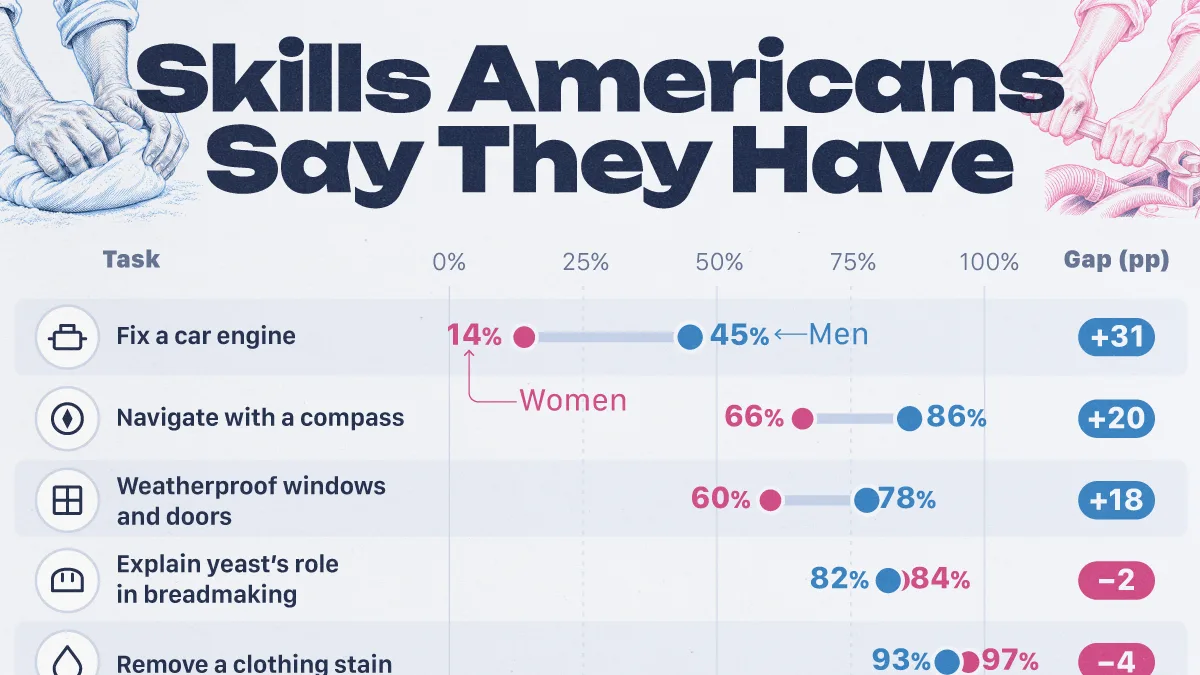
- The largest gender gap is in car repairs: 45% of men say they could fix a car engine, compared with just 14% of women.
From fixing a car engine to removing a clothing stain, which everyday tasks do Americans believe they can handle?
This visualization uses data from a Pew Research Center survey conducted from April 28 to May 4, 2025. It compares the share of U.S. men and women who say they could definitely or probably perform 12 everyday activities, measuring self-reported ability rather than tested skills.
Everyday Skills Americans Say They Have, by Gender
The table below shows the percentage of men and women who say they could perform each task, ranked by the percentage-point difference between their responses.
| Task | Men | Women | Difference (p.p.) |
|---|---|---|---|
| Fix a car engine | 45% | 14% | +31 |
| Navigate with a compass | 86% | 66% | +20 |
| Weatherproof windows and doors | 78% | 60% | +18 |
| Explain high-pressure weather systems | 47% | 30% | +17 |
| Read news charts and tables | 92% | 82% | +10 |
| Calculate a tip mentally | 88% | 84% | +4 |
| Know which cleaners not to mix | 76% | 75% | +1 |
| Read nutrition labels | 87% | 88% | -1 |
| Grow vegetables | 82% | 83% | -1 |
| Clean and care for a wound | 93% | 95% | -1 |
| Explain yeast’s role in breadmaking | 82% | 84% | -2 |
| Remove a clothing stain | 93% | 97% | -4 |
The differences are especially pronounced in technical and mechanical tasks. Men report substantially greater confidence in fixing a car engine, navigating with a compass, and weatherproofing windows and doors.
By contrast, the tasks where women report greater confidence show much narrower gaps. Removing a clothing stain has the largest female advantage, at just four percentage points.
Why Do Men Report More Confidence in Technical Tasks?
One possible explanation is that confidence and actual ability do not always align.
A 2019 study published in the American Economic Review found that gender stereotypes can influence how people assess their own abilities. In laboratory experiments, both men and women tended to overestimate their performance, particularly on difficult tasks, but the extent of overestimation varied by subject.
These findings offer context for Pew’s results, although they do not establish why the gaps in this survey exist. Differences in experience, familiarity with particular tasks, and willingness to express confidence could also play a role.
Education Reveals a Different Pattern
Higher education is associated with greater confidence in some everyday skills, but not all of them.
For example, 97% of postgraduates say they can interpret charts and tables in news articles, compared with 76% of Americans with a high school education or less. A similar pattern appears in calculating tips mentally.
Car repairs tell the opposite story. Among Americans with a high school education or less, 36% say they could fix an engine problem, compared with just 17% of postgraduates.
The contrast highlights how practical experience and formal education may be associated with confidence in different kinds of skills.
How Confidence Changes With Age
Older Americans also report greater confidence in several everyday tasks.
Among adults under 30, 72% say they could grow a vegetable garden, compared with 89% of those ages 50 to 64. Younger adults are also less confident in explaining yeast’s role in breadmaking.
Mental arithmetic shows a similar pattern: 77% of adults under 30 say they could calculate a tip without a calculator, compared with 90% of those ages 65 and older.
For more context on how daily experiences change throughout life, see our visualization of who American men and women spend their time with at different ages.
What the Survey Actually Measures
These findings reflect what respondents believe they can do, not their demonstrated ability. Differences in experience, familiarity, and confidence may all influence how people answer.
The full Pew Research Center survey included 5,085 U.S. adults. The 12 tasks were divided between two randomized survey forms, so each question was answered by approximately half the respondents.
Small differences of one or two percentage points should not be interpreted as meaningful gender differences without additional statistical analysis.
Learn More on the Voronoi App
If you enjoyed this visualization, check out America’s Population by Age and Gender  on the Voronoi app.