Ranked: The Great Lakes by Maximum Depth
See visuals like this from many other data creators on our Voronoi app. Download it for free on iOS or Android and discover incredible data-driven charts from a variety of trusted sources.
Key Takeaways
- Lake Superior is the deepest of the Great Lakes, plunging more than 1,300 feet at its lowest point.
- Lake Erie is by far the shallowest Great Lake, with a maximum depth of just 210 feet.
The Great Lakes are one of North America’s most defining natural features. Together, they hold roughly 20% of the world’s surface fresh water and stretch across more than 94,000 square miles. While they are often discussed as a single system, each lake has a very different underwater landscape.
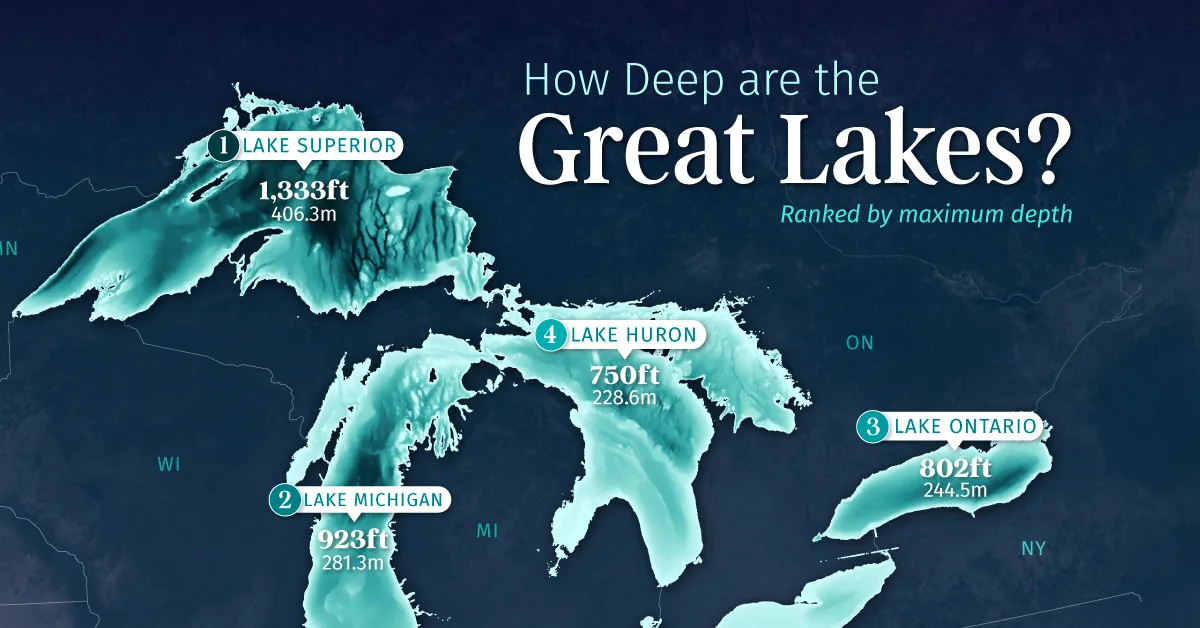
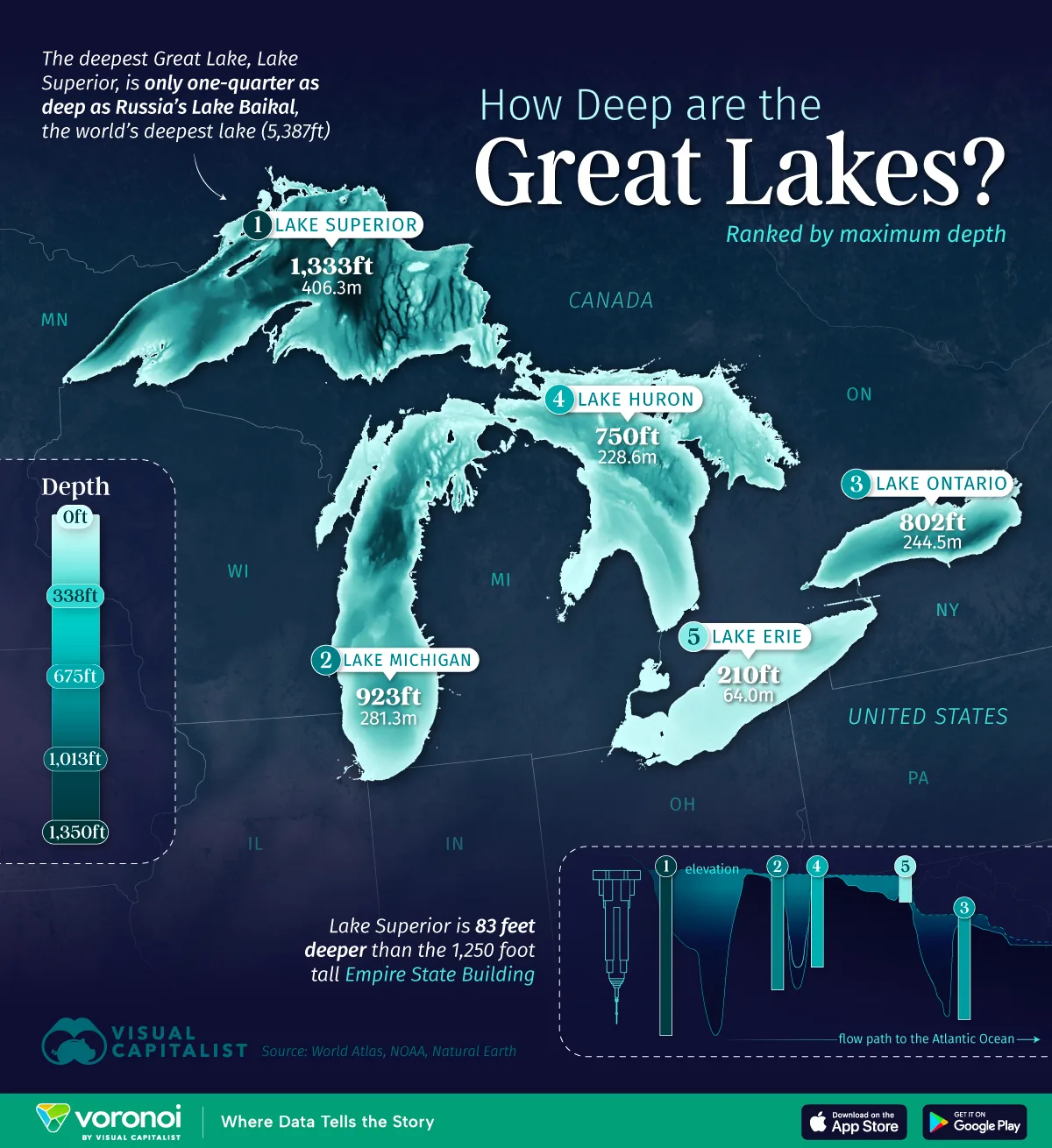
This visualization maps the maximum depth of each Great Lake, highlighting dramatic contrasts shaped by glaciers, geology, and time.
The data for this visualization comes from WorldAtlas, supported by bathymetric data from NOAA and geographic data from Natural Earth.
Lake Superior: The Deepest Freshwater Giant
Lake Superior is the undisputed heavyweight when it comes to depth. At 1,333 feet (406 meters), it is not only the deepest of the Great Lakes, but also the deepest freshwater lake in the United States. Its immense volume means it contains more water than the other four Great Lakes combined.
| Lake | Max Depth (feet) | Max Depth (meters) | U.S. States Bordered |
|---|---|---|---|
| Lake Superior | 1,333 | 406 | Minnesota, Wisconsin, Michigan |
| Lake Michigan | 923 | 281 | Michigan, Wisconsin, Illinois, Indiana |
| Lake Ontario | 802 | 244 | New York |
| Lake Huron | 751 | 229 | Michigan |
| Lake Erie | 210 | 64 | Michigan, Ohio, Pennsylvania, New York |
Why is depth important? Depth plays a critical role in water temperature, circulation, ecosystems, and even shipping routes. Deeper lakes tend to warm more slowly, mix differently, and support distinct aquatic life compared to shallower ones.
Lake Superior’s depth contributes to colder average temperatures and powerful storms, making the lake both ecologically unique and notoriously dangerous for shipping. Its deep basins were carved by glaciers over thousands of years, leaving behind steep underwater cliffs and trenches.
Lakes Michigan, Ontario, and Huron: Deep but Distinct
Lake Michigan ranks second in depth at 923 feet (281 meters). Unlike the others, it is the only Great Lake located entirely within the United States. Its depth supports major commercial shipping lanes and a diverse aquatic ecosystem.
Lake Ontario follows closely with a maximum depth of 802 feet (244 meters), despite being the smallest by surface area. Lake Huron, at 751 feet (229 meters), appears shallower by comparison but still contains enormous volumes of water due to its sprawling size.
Lake Erie stands apart as the shallowest Great Lake, reaching just 210 feet (64 meters) at its deepest point. Its shallow depth allows it to warm quickly in summer and freeze more easily in winter.
Learn More on the Voronoi App 
If you enjoyed today’s post, check out The World’s Forests on Voronoi, the new app from Visual Capitalist.