Ranked: The Most Consistent U.S. Power Sources
Key Takeaways
- Nuclear leads major U.S. power sources with a 91% capacity factor in 2025.
- Geothermal, biomass, and combined cycle natural gas also post strong reliability scores.
- Investor-owned utilities (IOUs) such as Duke Energy and Georgia Power are planning around firm generation as data center demand rises.
Reliable electricity is gaining value as utilities plan for AI-led growth and a more digital economy.
Capacity factor helps compare the fitness of power sources on this topic because it shows which technologies deliver the steadiest output over time.
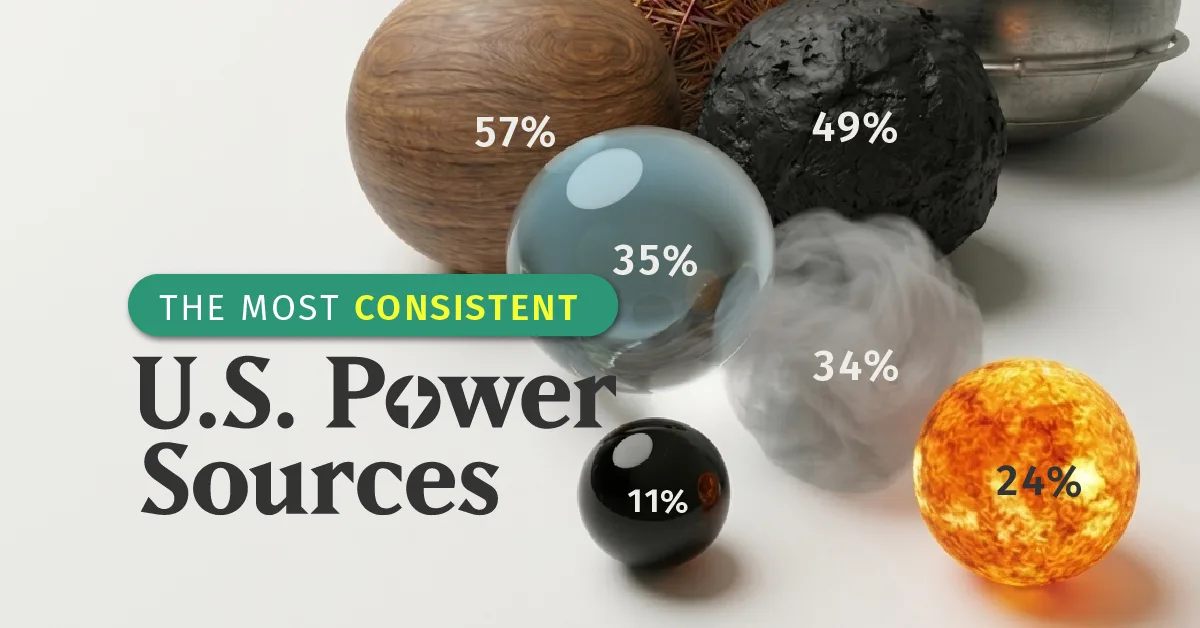

This graphic, in partnership with the National Public Utilities Council, shows the most consistent U.S. power sources using data from the EIA.
Why Capacity Factor Matters
Capacity factor compares actual generation with the maximum possible output over a full year. As a result, it offers a simple way to see which power sources can run hardest when demand rises.
Here is a table that shows U.S. power sources ranked by 2025 capacity factor.
| Energy Source | Capacity Factor (2025) |
|---|---|
| Nuclear | 91% |
| Geothermal | 66% |
| Biomass | 59% |
| Natural Gas (Combined Cycle) | 58% |
| Wood | 57% |
| Coal | 49% |
| Hydroelectric | 35% |
| Wind | 34% |
| Solar (Photovoltaic) | 24% |
| Petroleum (Steam Turbine) | 11% |
Among the major energy sources powering the U.S. today, one standout winner is nuclear.
Nuclear Leads the Ranking
Nuclear posts a 91% capacity factor, far ahead of geothermal at 66% and biomass at 59%. That lead helps explain why firm, emission-free generation remains central as U.S. data center power demand climbs.
The combined cycle variant of natural gas, with its capacity factor of 58%, is the current go-to source in the U.S. for meeting the jump in electricity demand from AI and data centers because utilities can add firm gas-fired generation faster than many other always-available options.
Meanwhile, a low capacity factor is one of the biggest downsides of wind (34%) and solar (24%), as it limits how often they can produce at high levels compared with more consistent sources. Utilities must often pair them with storage, backup generation, or grid upgrades to maintain reliability as demand grows.
How IOUs Are Responding
Several U.S. investor-owned utilities are prioritizing expanding energy capacity for the source with the highest capacity factor.
For example, Duke Energy filed an early site permit application on December 30, 2025, for a potential nuclear site at Belews Creek in North Carolina.
Meanwhile, Georgia Power’s approved 2025 IRP is designed to meet the needs of a growing Georgia, showing how major investor-owned utilities are planning for higher loads with firm generation, grid upgrades, and long-range strategy.
Together, those moves show why capacity factor matters beyond a ranking. It helps utilities identify which power sources can support growth, strengthen resilience, and keep decarbonization plans moving.
-
 AI2 weeks ago
U.S. States Winning and Losing Data Center Market Share
Which U.S. states are winning the data center race? This visualization shows the states gaining and losing data center market share in the next two years.
-

 Environment1 month ago
Mapped: Carbon Offsets by U.S. State
Which states dominate carbon offsets? This U.S. map shows the hotspots as utilities respond to the AI electricity surge.
-
 Energy6 months ago
Ranked: The Top 10 Cleanest Operating Utilities In The U.S.
Just four U.S. utilities operate with over 80% carbon-free generation. This graphic ranks the top 10 cleanest utilities by their fuel mix.
-
 Energy1 year ago
Visualized: Offshore Wind Installations by Region (2023–2033)
This streamgraph shows projected offshore wind capacity by region, according to The Global Wind Energy Council.
-
 Energy1 year ago
Ranked: The Largest Power Outages in the U.S. (2013–2023)
Severe weather caused all ten of the largest U.S. power outages in the past decade, highlighting the importance of grid resiliency.
-
 Batteries1 year ago
Visualized: Countries by Grid Storage Battery Capacity in 2023
This treemap chart uses data from Statistical Review of World Energy to show the top 10 countries with the most battery storage capacity in 2023.
-

 Energy1 year ago
Visualized: Which Countries Capture the Most Carbon?
This voronoi depicts the countries that capture the most carbon globally in 2023, with data from Rystad Energy.
-

 Energy2 years ago
Ranked: Energy Transition Scores by Country in 2024
This bar chart shows the countries’ highest and lowest energy transition index scores determined by the World Economic Forum.
-
 Energy2 years ago
Ranked: America’s Cheapest Sources of Electricity in 2024
This dumbbell plot shows the most and least expensive sources of energy in the U.S., using data from Lazard.
-
 Energy2 years ago
Visualized: Emission Reduction Targets by Country in 2024
This infographic shows the greenhouse gas emissions targets of all countries and their target years with data from Net Zero Tracker.
-
 Green2 years ago
Visualized: The Price of Carbon Around the World in 2024
This bar chart shows the varying prices of carbon across different economies around the globe, using data from the World Bank.
-
 Energy2 years ago
Visualized: Renewable Energy Capacity Through Time (2000–2023)
This streamgraph shows the growth in renewable energy capacity by country and region since 2000.
-

 Environment2 years ago
The Rise in America’s Billion-Dollar Extreme Weather Disasters
From tropical cyclones to severe storms, the number of extreme weather disasters with losses exceeding $1 billion has climbed over time.
-
 Environment2 years ago
The Most Polluted Cities in the U.S.
What are the most polluted cities in the U.S. according to data from the American Lung Association’s 2024 State of the Air Report?
-
 Energy4 years ago
Visualizing U.S. Greenhouse Gas Emissions by Sector
The U.S. emits about 6 billion metric tons of greenhouse gases a year. Here’s how these emissions rank by sector.
-
 Sponsored5 years ago
Road to Decarbonization: The United States Electricity Mix
Can America become carbon-free by 2035? This graphic breaks down the United States’ electricity mix, by state.
-
 Sponsored5 years ago
Road to Decarbonization: U.S. Coal Plant Closures
This infographic highlights announced coal plant closures in the U.S. and how much power will be affected.