Ranked: The Most Powerful Countries, According to Global Opinion
See visuals like this from many other data creators on our Voronoi app. Download it for free on iOS or Android and discover incredible data-driven charts from a variety of trusted sources.
Key Takeaways
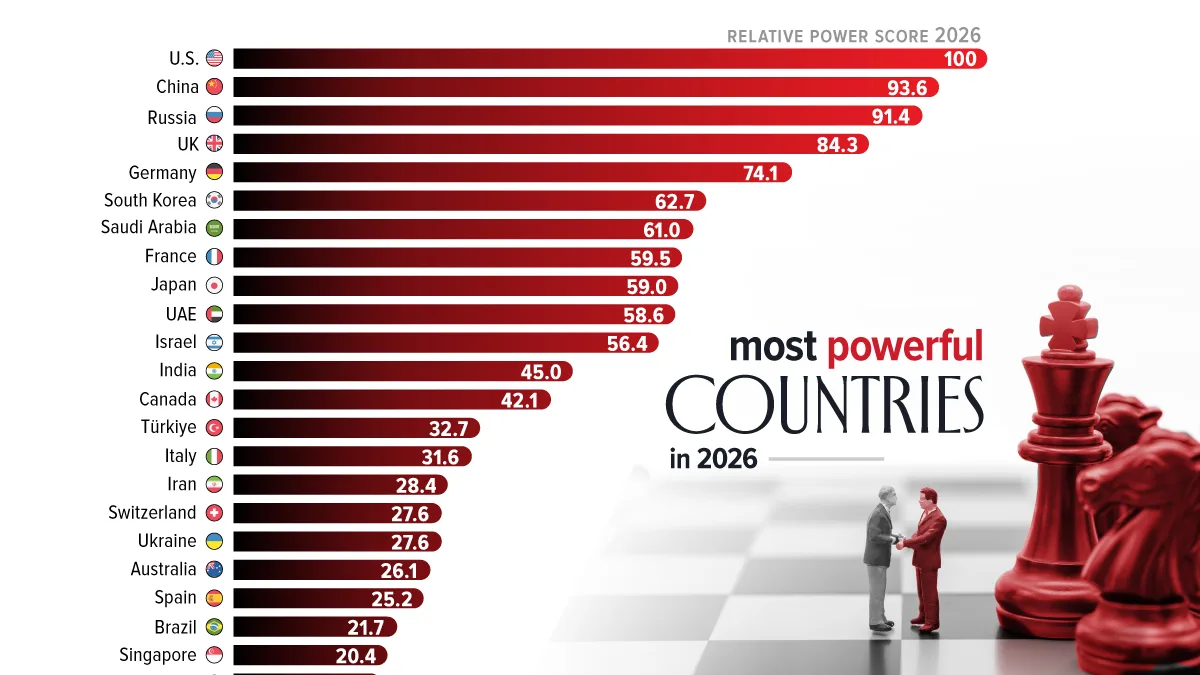
- The U.S., China, and Russia form a distinct top tier in global perceptions of power.
- Russia ranks third despite having a significantly smaller economy than several countries below it.
- South Korea and Saudi Arabia place ahead of traditional powers including France and Japan.
What makes a country powerful?
Military strength remains a defining factor, but global influence is also shaped by economic weight, technological leadership, strategic resources, and diplomatic reach.
This graphic ranks the world’s most powerful countries using data from the University of Pennsylvania Wharton School’s 2026 Best Countries Index, based on a survey of 15,131 adults across 33 countries.
Rather than measuring military or economic strength directly, the rankings reflect how respondents perceive each country’s overall influence.
The World’s Most Powerful Countries in 2026
The table below shows the relative power score for each country across an analysis of 85 nations. The top-ranked country receives a score of 100, with all other scores calculated relative to the leader.
| Rank | Country | Relative Power Score 2026 |
|---|---|---|
| 1 |  U.S. U.S. |
100.0 |
| 2 |  China China |
93.6 |
| 3 |  Russia Russia |
91.4 |
| 4 |  UK UK |
84.3 |
| 5 |  Germany Germany |
74.1 |
| 6 |  South Korea South Korea |
62.7 |
| 7 |  Saudi Arabia Saudi Arabia |
61.0 |
| 8 |  France France |
59.5 |
| 9 |  Japan Japan |
59.0 |
| 10 |  UAE UAE |
58.6 |
| 11 |  Israel Israel |
56.4 |
| 12 |  India India |
45.0 |
| 13 |  Canada Canada |
42.1 |
| 14 |  Türkiye Türkiye |
32.7 |
| 15 |  Italy Italy |
31.6 |
| 16 |  Iran Iran |
28.4 |
| 17 |  Switzerland Switzerland |
27.6 |
| 18 |  Ukraine Ukraine |
27.6 |
| 19 |  Australia Australia |
26.1 |
| 20 |  Spain Spain |
25.2 |
| 21 |  Brazil Brazil |
21.7 |
| 22 |  Singapore Singapore |
20.4 |
| 23 |  Sweden Sweden |
19.5 |
| 24 |  Netherlands Netherlands |
18.6 |
| 25 |  Belgium Belgium |
17.6 |
| 26 |  Kuwait Kuwait |
17.6 |
| 27 |  Denmark Denmark |
16.9 |
| 28 |  Mexico Mexico |
15.4 |
| 29 |  Egypt Egypt |
14.3 |
| 30 |  Vietnam Vietnam |
14.2 |
| 31 |  South Africa South Africa |
13.7 |
| 32 |  Norway Norway |
12.9 |
| 33 |  Indonesia Indonesia |
12.1 |
| 34 |  Poland Poland |
10.8 |
| 35 |  Portugal Portugal |
10.7 |
| 36 |  Belarus Belarus |
10.2 |
| 37 |  Austria Austria |
10.1 |
| 38 |  Argentina Argentina |
9.7 |
| 39 |  Finland Finland |
9.4 |
| 40 |  Bangladesh Bangladesh |
8.9 |
The U.S., China, and Russia Stand Apart
The U.S. remains the world’s most powerful country, sitting at the center of the global economy. However, in the survey’s perception-based ranking, China follows closely behind.
Today’s intensifying great-power competition is shaped by China’s grip on rare earth minerals, expansive trade relationships, and growing military sophistication. China also has the world’s largest active-duty military, with roughly two million personnel.
Global perceptions are shifting as well. A separate survey of 46,667 people across 85 countries found that respondents in every region viewed China more favorably than the United States.
Russia ranks third overall, despite having a much smaller economy than several countries below it. Its position reflects the continued influence of its military capabilities, nuclear arsenal, energy resources, and geopolitical reach.
Power Falls Off Quickly
The U.S., China, and Russia form a clear top tier, with scores falling sharply after the first three positions. The UK ranks fourth with a score of 84.3, followed by Germany at 74.1.
Further down the list, South Korea and Saudi Arabia rank ahead of several long-established Western powers. The UAE also enters the top 10, placing above Israel, India, and Canada.
Iran ranks relatively high despite its smaller economy, reflecting perceptions of its regional military influence, missile capabilities, and network of allied groups across the Middle East.
Despite ongoing attacks by the U.S. and Israel, Iran has maintained significant industrial and military capacity four months into the conflict.
How Perceptions Shape the Rankings
The results show that perceived power does not follow a single formula. Military capabilities remain central, but economic scale, technological leadership, strategic resources, diplomatic influence, and the ability to shape international events also affect how countries are viewed.
This helps explain why some nations rank above larger economies, while others with substantial economic output appear lower on the list.
As competition among major powers intensifies, these perceptions are likely to shift alongside the geopolitical landscape.
Learn More on the Voronoi App 
To learn more about this topic, check out this graphic showing the countries Americans like most and least.