 See more visuals like this on the Voronoi app.
Ranked: The Top Crude Oil Producers in 2025
See visuals like this from many other data creators on our Voronoi app. Download it for free on iOS or Android and discover incredible data-driven charts from a variety of trusted sources.
Key Takeaways
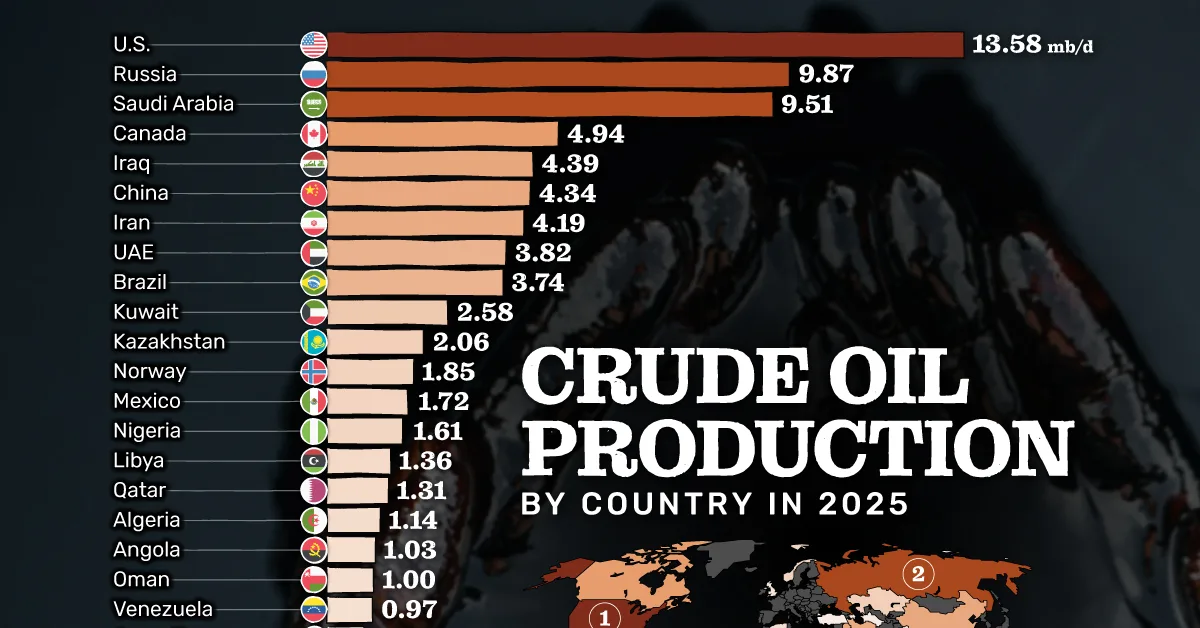
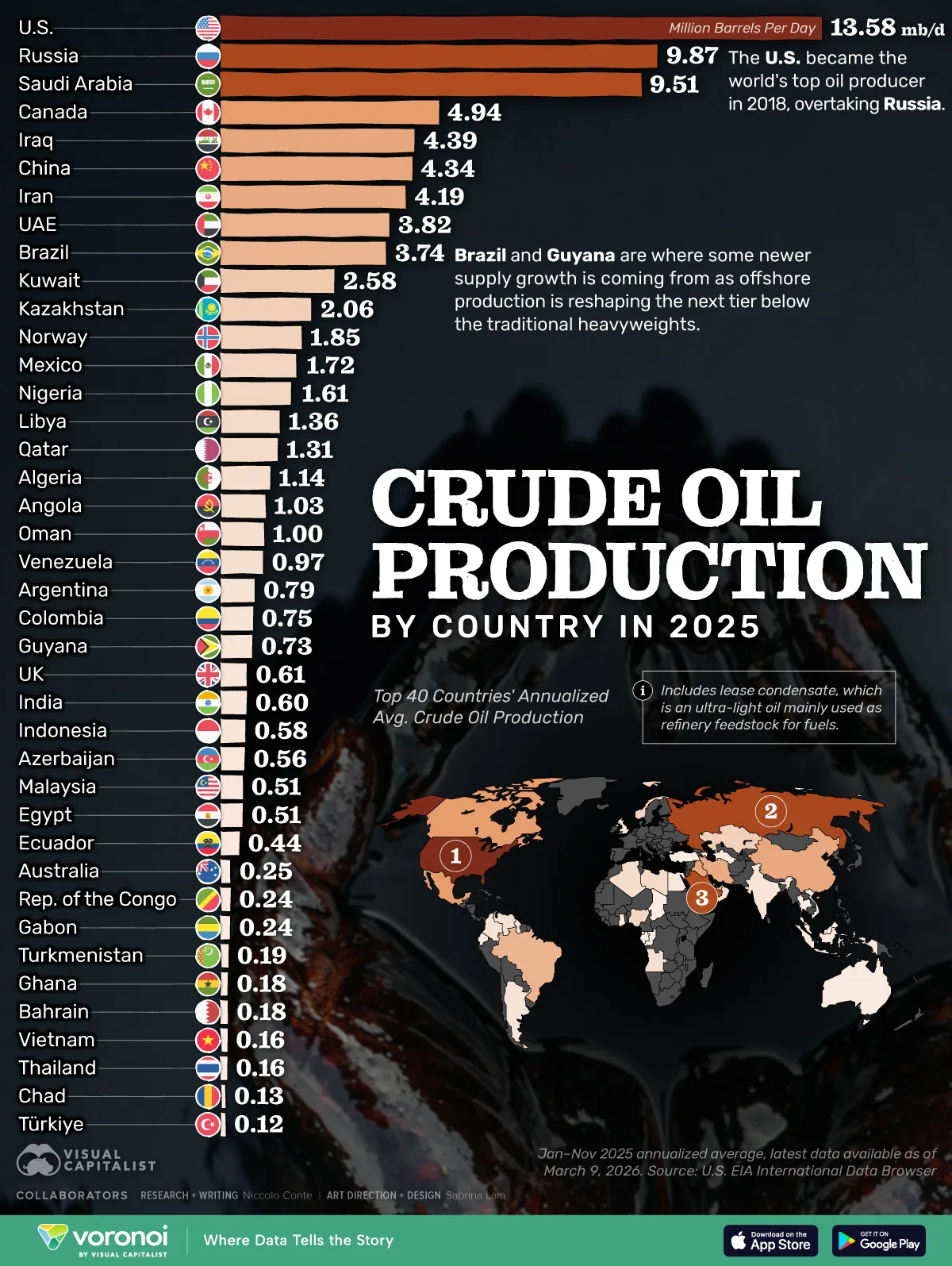
- The U.S. was the world’s largest crude oil producer in 2025, pumping 13.58 million barrels per day.
- Five of the world’s top 10 crude oil producers are in the Middle East.
- Russia and Saudi Arabia ranked second and third globally, each producing more than 9.5 million barrels per day.
The U.S. produced more crude oil than any other country in 2025, by a wide margin.
But while America leads the ranking, the Middle East remains the world’s biggest production hub, with five countries in the global top 10.
This graphic shows crude oil production by country, using 2025 data from the U.S. Energy Information Administration (EIA).
The ranking highlights how oil production is spread across multiple continents, while still concentrated among a small group of leading producers.
America Leads Global Crude Oil Production
The U.S. was the world’s top crude oil producer in 2025, with more than 13.58 million barrels per day (mb/d), representing a 16% share of global production.
The country surpassed Russia in 2018 and in 2023 became the largest producer of crude oil of any country in history.
Here’s how the world’s top producers stack up, based on annualized data from Jan-Nov 2025:
| Rank | Country | Annualized Average Crude Oil production (million barrels per day) |
|---|---|---|
| 1 |  United States United States |
13.577 |
| 2 |  Russia Russia |
9.867 |
| 3 |  Saudi Arabia Saudi Arabia |
9.509 |
| 4 |  Canada Canada |
4.938 |
| 5 |  Iraq Iraq |
4.394 |
| 6 |  China China |
4.337 |
| 7 |  Iran Iran |
4.192 |
| 8 |  United Arab Emirates United Arab Emirates |
3.817 |
| 9 |  Brazil Brazil |
3.745 |
| 10 |  Kuwait Kuwait |
2.575 |
| 11 |  Kazakhstan Kazakhstan |
2.065 |
| 12 |  Norway Norway |
1.846 |
| 13 |  Mexico Mexico |
1.724 |
| 14 |  Nigeria Nigeria |
1.609 |
| 15 |  Libya Libya |
1.357 |
| 16 |  Qatar Qatar |
1.311 |
| 17 |  Algeria Algeria |
1.140 |
| 18 |  Angola Angola |
1.033 |
| 19 |  Oman Oman |
1.000 |
| 20 |  Venezuela Venezuela |
0.974 |
| 21 |  Argentina Argentina |
0.788 |
| 22 |  Colombia Colombia |
0.746 |
| 23 |  Guyana Guyana |
0.733 |
| 24 |  United Kingdom United Kingdom |
0.612 |
| 25 |  India India |
0.602 |
| 26 |  Indonesia Indonesia |
0.582 |
| 27 |  Azerbaijan Azerbaijan |
0.562 |
| 28 |  Malaysia Malaysia |
0.515 |
| 29 |  Egypt Egypt |
0.509 |
| 30 |  Ecuador Ecuador |
0.439 |
| 31 |  Australia Australia |
0.245 |
| 32 |  Congo-Brazzaville Congo-Brazzaville |
0.240 |
| 33 |  Gabon Gabon |
0.238 |
| 34 |  Turkmenistan Turkmenistan |
0.191 |
| 35 |  Ghana Ghana |
0.183 |
| 36 |  Bahrain Bahrain |
0.183 |
| 37 |  Vietnam Vietnam |
0.164 |
| 38 |  Thailand Thailand |
0.160 |
| 39 |  Chad Chad |
0.127 |
| 40 |  Turkiye Turkiye |
0.125 |
| 41 |  South Sudan South Sudan |
0.112 |
| 42 |  Niger Niger |
0.101 |
| 43 |  Brunei Brunei |
0.100 |
| 44 |  Senegal Senegal |
0.100 |
| 45 |  Italy Italy |
0.084 |
| 46 |  Equatorial Guinea Equatorial Guinea |
0.078 |
| 47 |  Syria Syria |
0.073 |
| 48 |  Denmark Denmark |
0.072 |
| 49 |  Cameroon Cameroon |
0.059 |
| 50 |  Pakistan Pakistan |
0.058 |
| 51 |  Cote d’Ivoire Cote d’Ivoire |
0.054 |
| 52 |  Romania Romania |
0.052 |
| 53 |  Trinidad and Tobago Trinidad and Tobago |
0.051 |
| 54 |  Peru Peru |
0.045 |
| 55 |  Germany Germany |
0.032 |
| 56 |  Papua New Guinea Papua New Guinea |
0.032 |
| 57 |  Sudan Sudan |
0.030 |
| 58 |  Uzbekistan Uzbekistan |
0.030 |
| 59 |  Belarus Belarus |
0.026 |
| 60 |  Cuba Cuba |
0.026 |
| 61 |  Tunisia Tunisia |
0.026 |
| 62 |  Hungary Hungary |
0.023 |
| 63 |  Netherlands Netherlands |
0.021 |
| 64 |  Israel Israel |
0.020 |
| 65 |  Bolivia Bolivia |
0.018 |
| 66 |  Poland Poland |
0.016 |
| 67 |  Congo-Kinshasa Congo-Kinshasa |
0.016 |
| 68 |  Yemen Yemen |
0.015 |
| 69 |  Mongolia Mongolia |
0.014 |
| 70 |  Albania Albania |
0.012 |
| 71 |  Suriname Suriname |
0.012 |
| 72 |  Serbia Serbia |
0.012 |
| 73 |  France France |
0.010 |
| 74 |  Croatia Croatia |
0.009 |
| 75 |  Austria Austria |
0.009 |
| 76 |  New Zealand New Zealand |
0.007 |
| 77 |  Burma Burma |
0.006 |
| 78 |  Kyrgyzstan Kyrgyzstan |
0.006 |
| 79 |  Guatemala Guatemala |
0.005 |
| 80 |  Japan Japan |
0.003 |
| 81 |  Bangladesh Bangladesh |
0.003 |
| 82 |  Timor-Leste Timor-Leste |
0.002 |
| 83 |  Chile Chile |
0.002 |
| 84 |  Greece Greece |
0.001 |
| 85 |  Czechia Czechia |
0.001 |
| 86 |  Bulgaria Bulgaria |
0.001 |
| 87 |  Barbados Barbados |
0.001 |
| 88 |  Belize Belize |
0.001 |
| 89 |  Lithuania Lithuania |
0.001 |
| 90 |  Philippines Philippines |
0.001 |
Roughly a quarter of U.S. production comes from the Permian Basin, a sedimentary region spanning western Texas and southeastern New Mexico.
Beyond the Permian and other Texas deposits, the U.S. also has major oil reserves in Alaska and the Gulf of Mexico. In Alaska, oil revenues have supported the Alaska Permanent Fund since the 1970s, a state-owned sovereign wealth fund that pays dividends to residents.
The Middle East Remains the World’s Biggest Oil Hub
Five Middle Eastern countries ranked among the world’s top 10 crude oil producers in 2025: Saudi Arabia (9.51 mb/d), Iraq (4.39), Iran (4.19), the United Arab Emirates (3.82), and Kuwait (2.58).
All five sit along the Persian Gulf, giving the region an outsized role in global energy markets. That also means conflict or disruption around the Strait of Hormuz can have major consequences for global oil supply.
Since the 1960s, each of these countries has also been a core member of the Organization of the Petroleum Exporting Countries (OPEC), which coordinates among major oil producers on output and pricing strategy.
Other Major Oil Producers Outside OPEC
The U.S. is not a member of OPEC. Nor are Canada (4.94 mb/d) and China (4.34), both of which produced more than 4 million barrels per day in 2025 and ranked among the global top 10.
Meanwhile, two other major producers, Russia (9.87) and Brazil (3.74), are part of OPEC+, a looser coalition that works with OPEC members to manage production when interests align.
In recent years, tensions have occasionally emerged between OPEC’s core producers, led by Saudi Arabia, and OPEC+ partners such as Russia over how much oil to pump while trying to support prices.
Learn More on the Voronoi App
If you enjoyed today’s post, check out The U.S. and China Consume 35% of the World’s Oil on Voronoi, the new app from Visual Capitalist.