Ranked: The U.S. Cities With the Most Sunshine
This was originally posted on our Voronoi app. Download the app for free on iOS or Android and discover incredible data-driven charts from a variety of trusted sources.
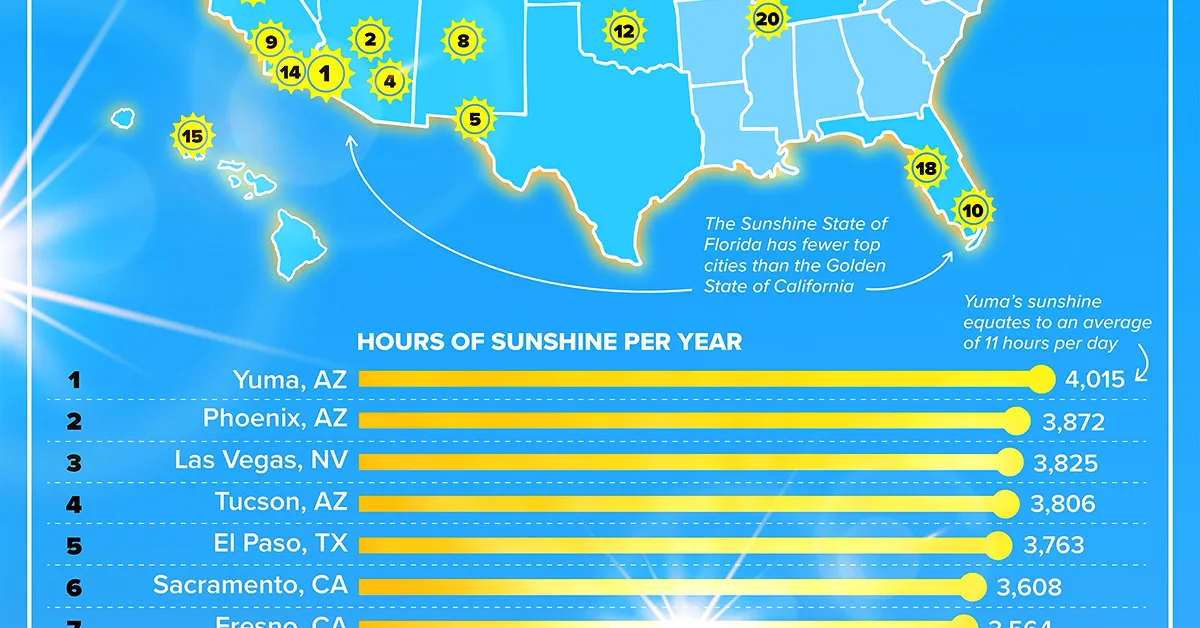
- Yuma, Arizona ranks first with 4,015 hours of sunshine per year, averaging about 11 hours per day.
- Arizona claims three of the top four spots, while California has more top-20 cities than Florida.
- Most of America’s sunniest cities are clustered in the dry, high-pressure climates of the Southwest.
Key Takeaways
Some U.S. cities average nearly 11 hours of sunshine per day—far more than the national norm.
Using NOAA data and visualized by Julie Peasley, this map ranks the 20 sunniest U.S. cities based on annual sunshine hours.
The results highlight a clear geographic divide. Southwestern cities dominate the top of the list, while Florida—despite its nickname—trails California in total entries.
The Sunniest Cities in America
Arizona dominates the very top of the ranking, with Yuma, Phoenix, and Tucson all placing in the top four. But California has the broader showing, with several cities across the state making the top 20.
| Rank | City | State | Yearly Sunshine Hours |
|---|---|---|---|
| 1 | Yuma | AZ | 4,015 |
| 2 | Phoenix | AZ | 3,872 |
| 3 | Las Vegas | NV | 3,825 |
| 4 | Tucson | AZ | 3,806 |
| 5 | El Paso | TX | 3,763 |
| 6 | Sacramento | CA | 3,608 |
| 7 | Fresno | CA | 3,564 |
| 8 | Albuquerque | NM | 3,415 |
| 9 | Los Angeles | CA | 3,254 |
| 10 | Miami | FL | 3,154 |
| 11 | Denver | CO | 3,107 |
| 12 | Oklahoma City | OK | 3,089 |
| 13 | San Francisco | CA | 3,062 |
| 14 | San Diego | CA | 3,055 |
| 15 | Honolulu | HI | 3,036 |
| 16 | Salt Lake City | UT | 3,029 |
| 17 | Boise | ID | 2,993 |
| 18 | Tampa | FL | 2,927 |
| 19 | Wichita | KS | 2,922 |
| 20 | Memphis | TN | 2,888 |
Florida still appears on the list, but its “Sunshine State” reputation does not translate into dominance. Miami and Tampa rank highly, though fewer Florida cities make the cut than California cities.
The Southwest: America’s Sunshine Capital
One pattern stands out immediately: geography drives the rankings. The sunniest cities cluster heavily in the U.S. Southwest, particularly Arizona, Nevada, California, and New Mexico.
Cities like Yuma, Phoenix, and Las Vegas benefit from desert climates where clear skies are the norm. Persistent high-pressure systems suppress cloud formation, while low humidity limits the moisture needed for clouds to develop.
In fact, the Southwest is one of the driest regions in North America. As noted in climate studies, limited precipitation and stable air masses create ideal conditions for near-constant sunshine.
Why So Few Clouds?
The Southwest’s sunshine advantage comes down to a simple recipe: dry air, stable weather patterns, and geography.
- Dry air: Desert regions lack the moisture needed to form clouds.
- High pressure systems: These systems promote sinking air, which inhibits cloud formation.
- Topography: Mountain ranges block moisture from the Pacific Ocean.
Together, these conditions create the clear, sunny skies that define cities like Phoenix, whose climate is comparable to global hotspots like Karachi and Baghdad.
Sunshine Beyond the Desert
While the Southwest leads, other regions still make appearances. Cities like Miami and Tampa benefit from tropical climates with strong seasonal sunshine, while Denver and Boise combine elevation with relatively dry air.
The gap across the ranking is striking. Yuma receives more than 1,000 additional sunshine hours per year than cities at the bottom of the top 20—underscoring how extreme the Southwest’s advantage really is.
Learn More on the Voronoi App 
Explore how climate shapes cities worldwide in World Cities by Climate Type on the Voronoi app.