Ranked: The World’s 20 Most Valuable Oil Companies
See visuals like this from many other data creators on our Voronoi app. Download it for free on iOS or Android and discover incredible data-driven charts from a variety of trusted sources.
Key Takeaways
- Saudi Aramco is the world’s most valuable publicly traded oil company at $1.8 trillion.
- The top 20 listed oil and gas companies are worth a combined $5.1 trillion.
- U.S. firms dominate by number, while Saudi Aramco dominates by scale.
Saudi Aramco towers over every publicly traded oil company in the world.
With a market capitalization of $1.8 trillion, the Saudi state-owned giant is worth more than the next five largest publicly traded oil and gas companies combined, including Exxon Mobil, Chevron, Shell, and PetroChina.
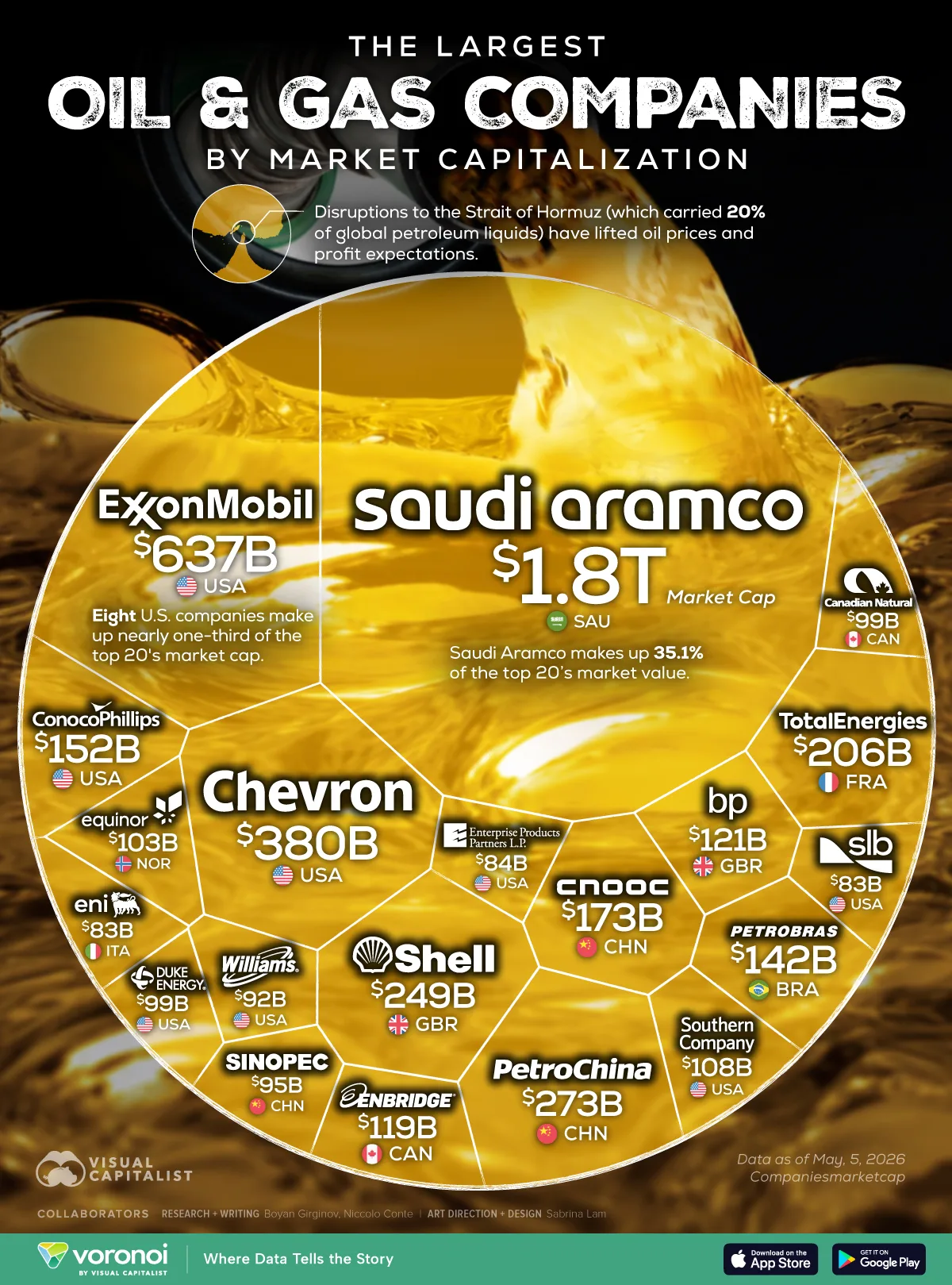
This graphic ranks the world’s 20 most valuable oil and gas companies by market capitalization using data from CompaniesMarketCap as of May 5, 2026.
Saudi Aramco vs. U.S. Energy Giants
The top of the oil and gas industry is shaped by two very different forces: a single state-controlled producer in the Gulf and a fleet of publicly listed major firms in America.
The data table below shows how the top 20 oil and gas companies stack up by market capitalization and country:
| Rank | Company | Market Capitalization (billions, USD) | Country |
|---|---|---|---|
| 1 | Saudi Aramco | $1,800 |  Saudi Arabia Saudi Arabia |
| 2 | Exxon Mobil | $637 |  United States United States |
| 3 | Chevron | $380 | United States |
| 4 | PetroChina | $273 |  China China |
| 5 | Shell | $249 |  United Kingdom United Kingdom |
| 6 | TotalEnergies | $206 |  France France |
| 7 | CNOOC | $173 | China |
| 8 | ConocoPhillips | $152 | United States |
| 9 | Petrobras | $142 |  Brazil Brazil |
| 10 | BP | $121 | United Kingdom |
| 11 | Enbridge | $119 |  Canada Canada |
| 12 | Southern Company | $108 | United States |
| 13 | Equinor | $103 |  Norway Norway |
| 14 | Canadian Natural Resources | $99 | Canada |
| 15 | Duke Energy | $99 | United States |
| 16 | Sinopec | $95 | China |
| 17 | Williams Companies | $92 | United States |
| 18 | Enterprise Products | $84 | United States |
| 19 | SLB (Schlumberger) | $83 | United States |
| 20 | ENI | $83 |  Italy Italy |
At the top sits Saudi Aramco, Saudi Arabia’s state-controlled oil giant, with a $1.8 trillion market cap, accounting for just over one-third of the entire top 20.
That is more than the next five companies combined: Exxon Mobil, Chevron, PetroChina, Shell, and TotalEnergies, which together are worth $1.7 trillion.
Three of the world’s top 10 oil and gas companies are based in the U.S., worth a combined $1.2 trillion and led by Exxon Mobil ($637B) and Chevron ($380B). ConocoPhillips ranks as the eighth largest oil and gas company in the world with a market cap of $152 billion.
The remainder of the top 10 features two Chinese state-owned giants (PetroChina, CNOOC), three European majors (Shell, TotalEnergies, BP), and Brazil’s Petrobras.
For perspective, the combined market value of the world’s 20 largest oil and gas companies exceeds the entire GDP of Japan and is approaching Germany’s economic output. Together, these firms represent one of the world’s largest concentrations of corporate value.
Regional Concentration in Oil and Gas Companies
North America has the broadest presence in the ranking, with 10 companies worth a combined $1.9 trillion, driven by eight U.S. firms and two Canadian names.
The U.S. dominates the list by number of companies, reflecting the scale of North American capital markets and energy infrastructure.
Western Europe also has a wide footprint, with Shell, TotalEnergies, BP, Equinor, and ENI all making the list. However, their combined value of $760.8 billion is still less than half of Saudi Aramco’s market cap.
East Asia is represented entirely by China’s “Big Three” state-owned oil companies: PetroChina, CNOOC, and Sinopec, together worth $541.6 billion.
What Is Driving Oil and Gas Company Valuations?
Oil and gas valuations are being shaped by two powerful forces: supply risk and rising energy demand.
On the supply side, the Strait of Hormuz remains the world’s most important oil chokepoint, with oil flows averaging around 20 million barrels per day, equal to roughly 20% of global petroleum liquids trade.
When that route is threatened, crude prices can move quickly, lifting earnings expectations for major energy firms.
At the same time, booming electricity demand from AI data centers, electrification, and industrial growth is increasing the strategic importance of reliable energy producers worldwide.
Learn More on the Voronoi App 
To learn more about global energy supply, check out this graphic which visualizes how global energy supply evolves from 2024 to 2050.