Ranked: The World’s Deepest Caves
See visuals like this from many other data creators on our Voronoi app. Download it for free on iOS or Android and discover incredible data-driven charts from a variety of trusted sources.
Key Takeaways
- Veryovkina Cave in Abkhazia, Georgia, is the world’s deepest known cave at 7,257 feet (2,212 meters), narrowly edging neighboring Krubera-Voronja by just 42 feet.
- Four of the 10 deepest caves are found in Abkhazia’s Arabika Massif, where soluble karst rock creates ideal conditions for deep cave systems.
- Many caves are still being explored, and a February 2026 expedition is attempting to prove Mexico’s Chevé Cave is the deepest of all.
Scaling the world’s tallest mountains is a well-charted pursuit, but descending into the planet’s deepest caves remains one of exploration’s last frontiers.
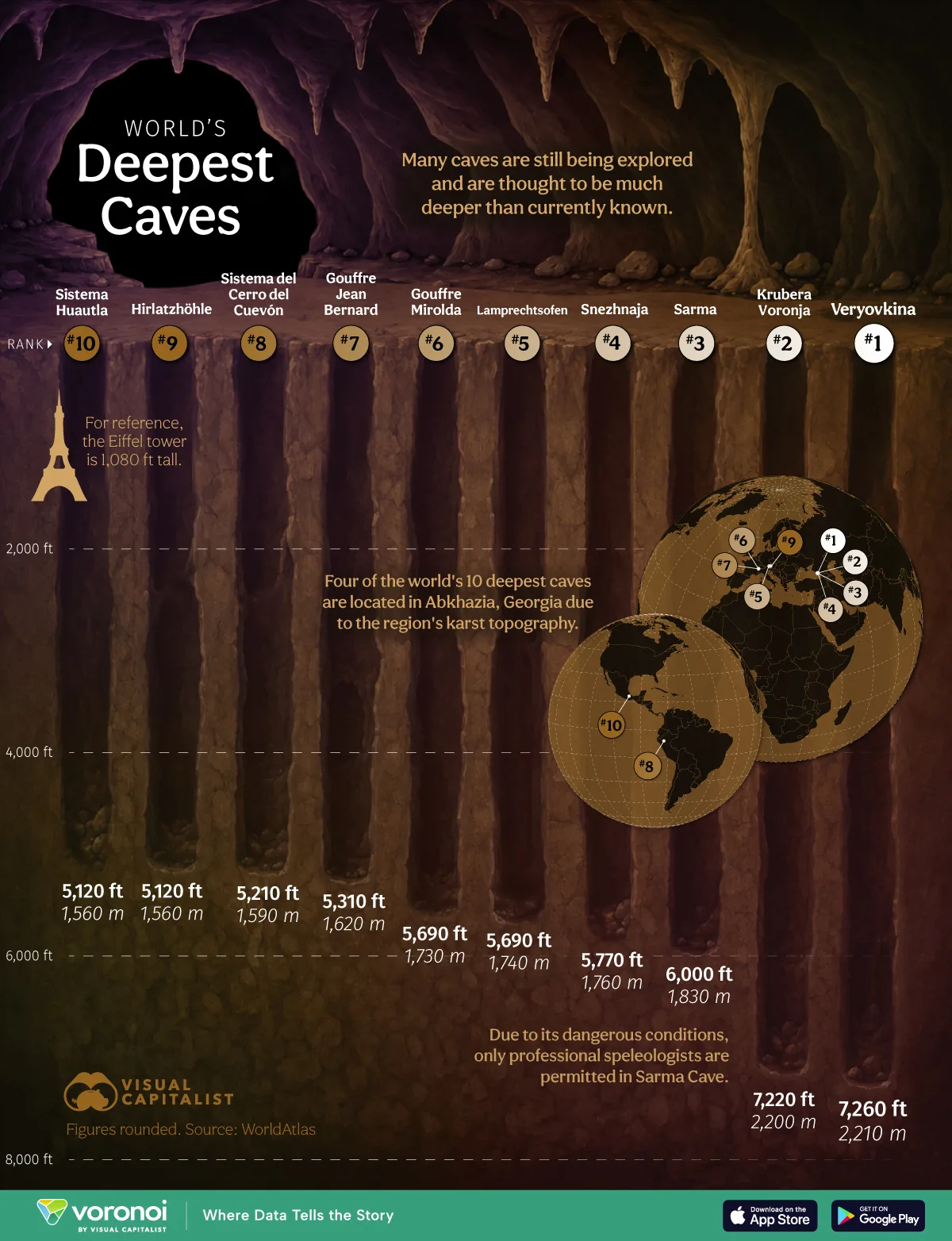
The world’s deepest cave plunges nearly seven times deeper than the Eiffel Tower is tall, descending 7,257 feet (2,212 meters) into the Earth. Seven of the 10 deepest caves reach more than a mile underground, and four of the deepest are clustered in a single karst mountain region in Abkhazia, Georgia.
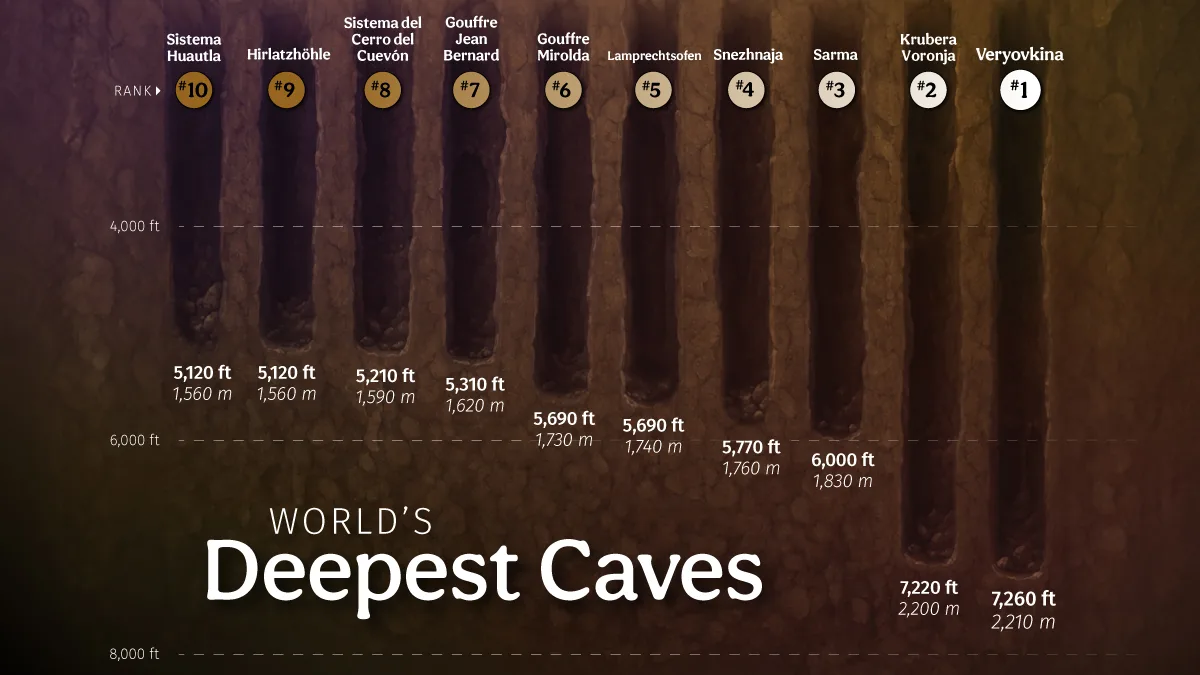
This visualization shows the depth of the 10 deepest caves on Earth, using data from WorldAtlas, which measures their explored vertical depth from the highest entrance down to the lowest point reached.
The 10 Deepest Caves in the World
Veryovkina holds only a slim lead as the deepest cave in the world. At 7,257 feet (2,212 meters), it sits just 42 feet deeper than neighboring Krubera-Voronja, which reaches 7,215 feet (2,199 meters) and held the world record for more than a decade before explorers pushed Veryovkina past it in the same Caucasus massif.
The data table below lists the world’s 10 deepest caves in feet and meters, along with the country where each is located:
| Rank | Cave | Depth (feet) | Depth (meters) | Country |
|---|---|---|---|---|
| 1 | Veryovkina | 7,257 | 2,212 |  Georgia / Abkhazia Georgia / Abkhazia |
| 2 | Krubera-Voronja | 7,215 | 2,199 | Georgia / Abkhazia |
| 3 | Sarma | 6,004 | 1,830 | Georgia / Abkhazia |
| 4 | Snezhnaja | 5,774 | 1,760 | Georgia / Abkhazia |
| 5 | Lamprechtsofen | 5,692 | 1,735 |  Austria Austria |
| 6 | Gouffre Mirolda | 5,686 | 1,733 |  France France |
| 7 | Gouffre Jean-Bernard | 5,305 | 1,617 | France |
| 8 | Sistema del Cerro del Cuevón | 5,213 | 1,589 |  Spain Spain |
| 9 | Hirlatzhöhle | 5,118 | 1,560 | Austria |
| 10 | Sistema Huautla | 5,118 | 1,560 |  Mexico Mexico |
After the top two, the rankings remain tightly packed: eight of the 10 deepest caves fall between roughly 5,100 and 6,000 feet deep. Third-place Sarma reaches 6,004 feet (1,830 meters) and is considered so hazardous that only professional speleologists are permitted to attempt it.
It is followed by Snezhnaja at 5,774 feet (1,760 meters) and Austria’s Lamprechtsofen at 5,692 feet (1,735 meters), rounding out the planet’s five deepest caves.
Why the Deepest Caves Cluster in Abkhazia
The clustering at the top is no accident. Four of the 10 deepest caves, and five of the 20 deepest, lie within Abkhazia’s Arabika Massif, a block of thick, soluble limestone in the Western Caucasus.
Over millions of years, rain and meltwater seep through cracks in this karst rock and slowly dissolve it into vast vertical shafts. Together, high mountains, heavy precipitation, and thick limestone create the conditions for cave systems that can drop thousands of feet underground.
It’s a different mechanism from the one that produces the world’s deepest lakes, which owe their depth to tectonic rift basins rather than dissolving rock, but the result is similarly concentrated geography.
Beyond the Caucasus, the deepest caves sit in the limestone ranges of the Alps and Pyrenees, with entries in Austria, France, Spain, Slovenia, Croatia, and Türkiye. To see how cave depths compare to the oceans and the deepest holes humans have ever drilled, explore this deep dive into Earth’s vertical extremes.
The World’s Deepest Caves Are Still Being Explored
Because a cave’s depth is defined by how far explorers have physically reached, these rankings are always provisional. Many of the listed caves are thought to extend well beyond their currently known floors, and a newly discovered connection between two separate systems can rewrite the order overnight.
The most closely watched contest is in Mexico. In February 2026, a U.S. Deep Caving Team expedition set out to link Chevé Cave with a lower system, a connection that, if confirmed, could make Chevé the deepest cave on Earth and unseat Veryovkina. For now, the title still belongs to the Caucasus.
Learn More on the Voronoi App 
To learn more about our planet, check out this visualization on Voronoi, which breaks down what the Earth is made of.