Ranked: The World’s Hottest Luxury Housing Markets
See visuals like this from many other data creators on our Voronoi app. Download it for free on iOS or Android and discover incredible data-driven charts from a variety of trusted sources.
Key Takeaways
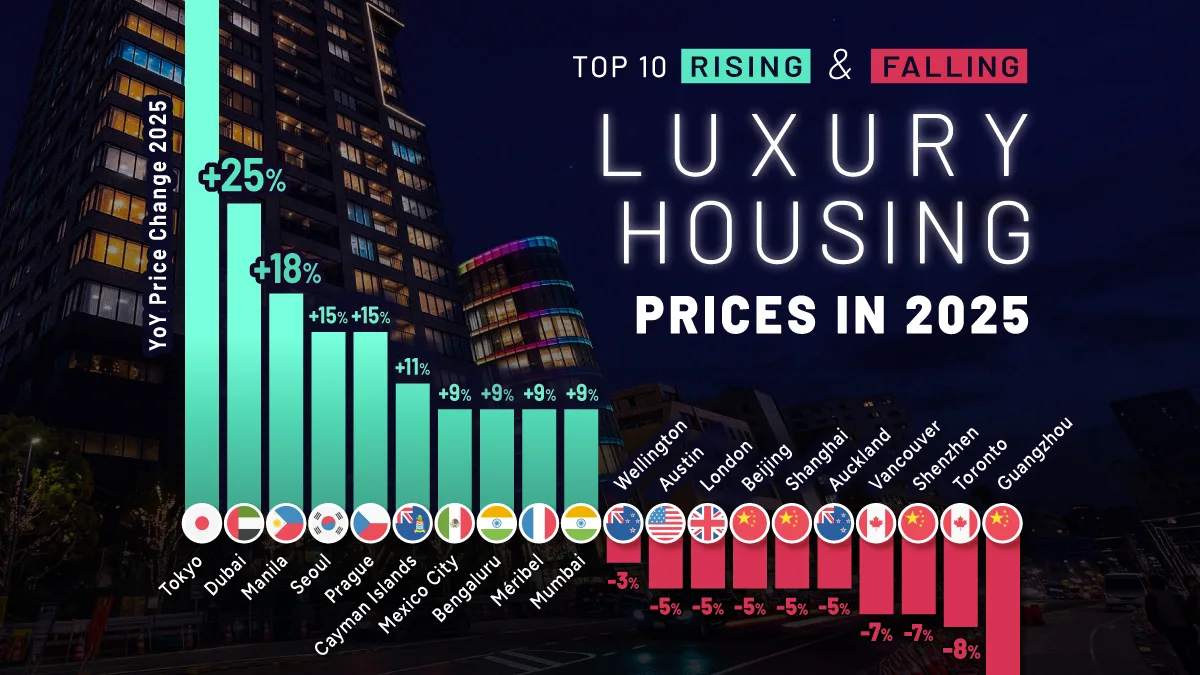
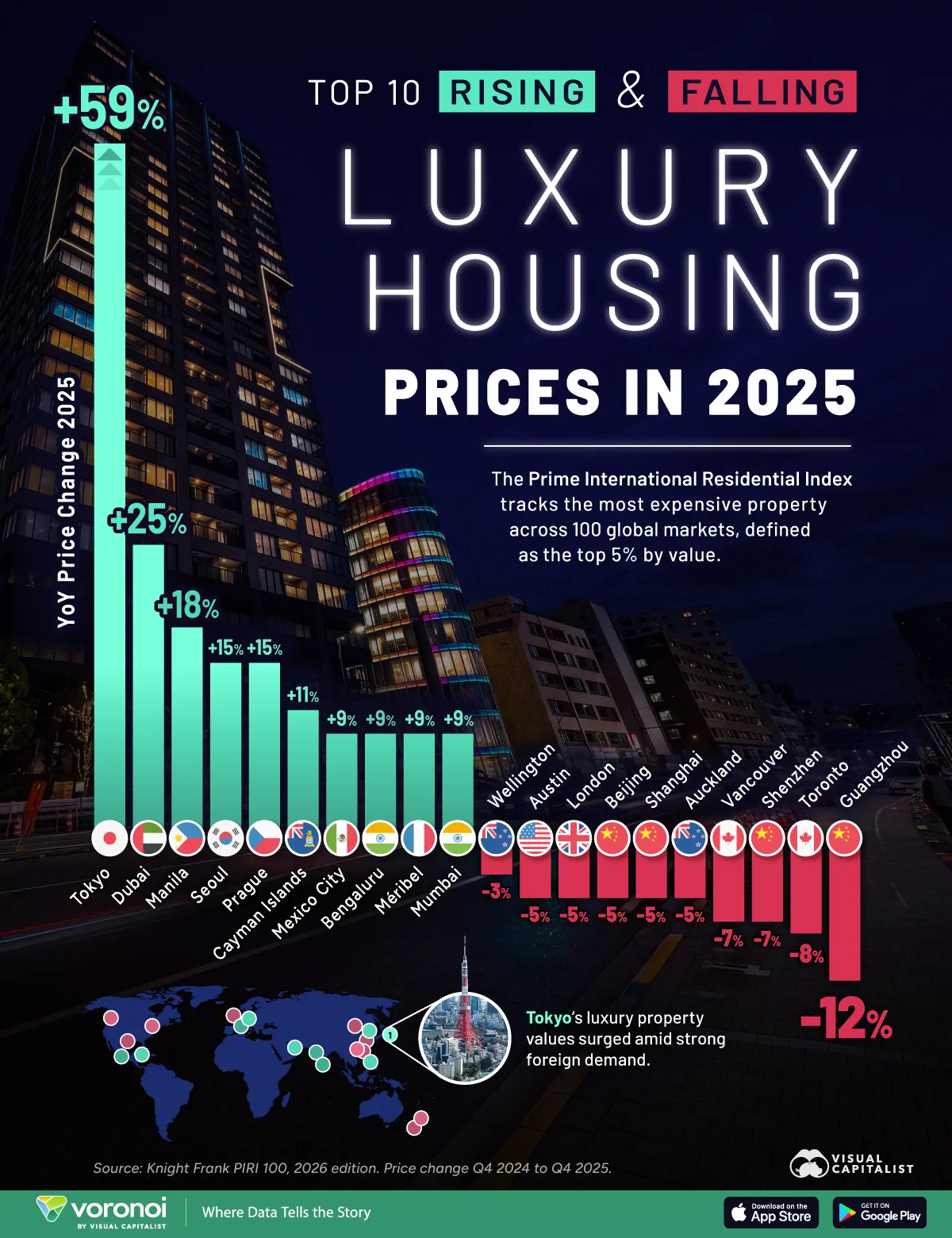
- Tokyo led global luxury housing growth with prices soaring 59% in 2025.
- Dubai, Manila, and Seoul also posted major gains as wealth flows shifted toward Asia.
- China and Canada recorded some of the steepest declines among major luxury markets.
Global luxury housing markets are increasingly moving in opposite directions.
This ranking from Knight Frank’s Wealth Report 2026 shows where luxury home prices surged and where they sharply declined across major global cities in 2025.
Tokyo recorded the strongest growth by far, with luxury housing prices jumping 59% year over year as foreign buyers took advantage of a weaker yen and relatively low borrowing costs. Dubai and Manila also posted double-digit gains, highlighting growing demand across parts of Asia and key global wealth hubs.
Meanwhile, several markets in China and Canada moved lower as higher interest rates, weaker buyer sentiment, and slowing economic growth weighed on luxury real estate demand.
Tokyo’s Luxury Housing Boom
Tokyo’s 59% surge was an outlier even by luxury real estate standards. The jump reflects how quickly global wealth can flow into cities viewed as stable, safe, and relatively affordable for international buyers.
Favorable currency dynamics also made Japanese real estate significantly cheaper for overseas investors, helping fuel a wave of foreign demand.
Low borrowing costs added further momentum. While many countries spent the last two years battling high interest rates, Japan remained one of the few major economies with exceptionally loose monetary conditions.
| Market | Country | Price Change (Q4 2024-25) | Region |
|---|---|---|---|
 Tokyo Tokyo |
Japan | 59% | Asia-Pacific |
 Dubai Dubai |
UAE | 25% | Middle East |
 Manila Manila |
Philippines | 18% | Asia-Pacific |
 Seoul Seoul |
South Korea | 15% | Asia-Pacific |
 Prague Prague |
Czechia | 15% | Europe |
 Cayman Islands Cayman Islands |
Cayman Islands | 11% | Americas |
 Mexico City Mexico City |
Mexico | 9% | Americas |
 Bengaluru Bengaluru |
India | 9% | Asia-Pacific |
 Méribel Méribel |
France | 9% | Europe |
| Mumbai |
India | 9% | Asia-Pacific |
Dubai followed with a 25% increase, while Manila climbed 18%. Together with Tokyo and Seoul, the gains suggest luxury housing demand is increasingly concentrating in Asia and a smaller group of globally connected wealth hubs.
Canada and China See Some of the Sharpest Declines
While parts of Asia surged, several formerly red-hot luxury housing markets moved in the opposite direction.
| Market | Country | Price Change (Q4 2024-25) | Region |
|---|---|---|---|
 Guangzhou Guangzhou |
China | -12% | Asia-Pacific |
 Toronto Toronto |
Canada | -8% | Americas |
| Shenzhen |
China | -7% | Asia-Pacific |
| Vancouver |
Canada | -7% | Americas |
 Auckland Auckland |
New Zealand | -5% | Asia-Pacific |
| Shanghai |
China | -5% | Asia-Pacific |
| Beijing |
China | -5% | Asia-Pacific |
 London London |
UK | -5% | Europe |
 Austin Austin |
U.S. | -5% | Americas |
| Wellington |
New Zealand | -3% | Asia-Pacific |
Guangzhou, a trade and manufacturing hub, recorded the steepest decline in the ranking, with luxury housing prices falling 12% year over year. Shenzhen and Beijing also posted declines, reflecting continued pressure across China’s property sector as economic growth slowed and buyer confidence weakened.
Canada also appeared prominently among the weakest markets. Toronto luxury housing prices fell 8%, while Vancouver dropped 7%. Both cities experienced massive pandemic-era housing booms that pushed prices to record highs, but higher borrowing costs and cooling luxury sales activity have since slowed demand sharply.
What Luxury Housing Reveals About Global Wealth Flows
Luxury housing markets often reflect where high-net-worth investors see opportunity.
Unlike broader housing markets, prime real estate is heavily influenced by international buyers, currency movements, investor sentiment, and cross-border capital flows. As a result, sharp price swings can reveal larger economic and geopolitical shifts happening beneath the surface.
Tokyo’s surge, for example, reflects more than local housing demand. It points to renewed foreign interest in Japan, supply scarcity, and investor appetite for stable global cities.
Meanwhile, weakness across parts of Canada and China suggests wealthy buyers are becoming more selective amid higher interest rates, slower economic growth, and changing market expectations.
The broader takeaway is that luxury real estate is becoming far more selective globally. Instead of rising together, wealth is concentrating in a smaller group of cities offering stability, favorable currency dynamics, and long-term investment appeal.
Learn More on the Voronoi App 
To learn more about this topic, check out this graphic showing what $1 million buys in luxury property markets across major global cities.
- Source: https://www.visualcapitalist.com/ranked-the-luxury-housing-markets-buyers-are-flooding-into/