Ranked: The World’s Inflation Extremes in 2026
See visuals like this from many other data creators on our Voronoi app. Download it for free on iOS or Android and discover incredible data-driven charts from a variety of trusted sources.
Key Takeaways
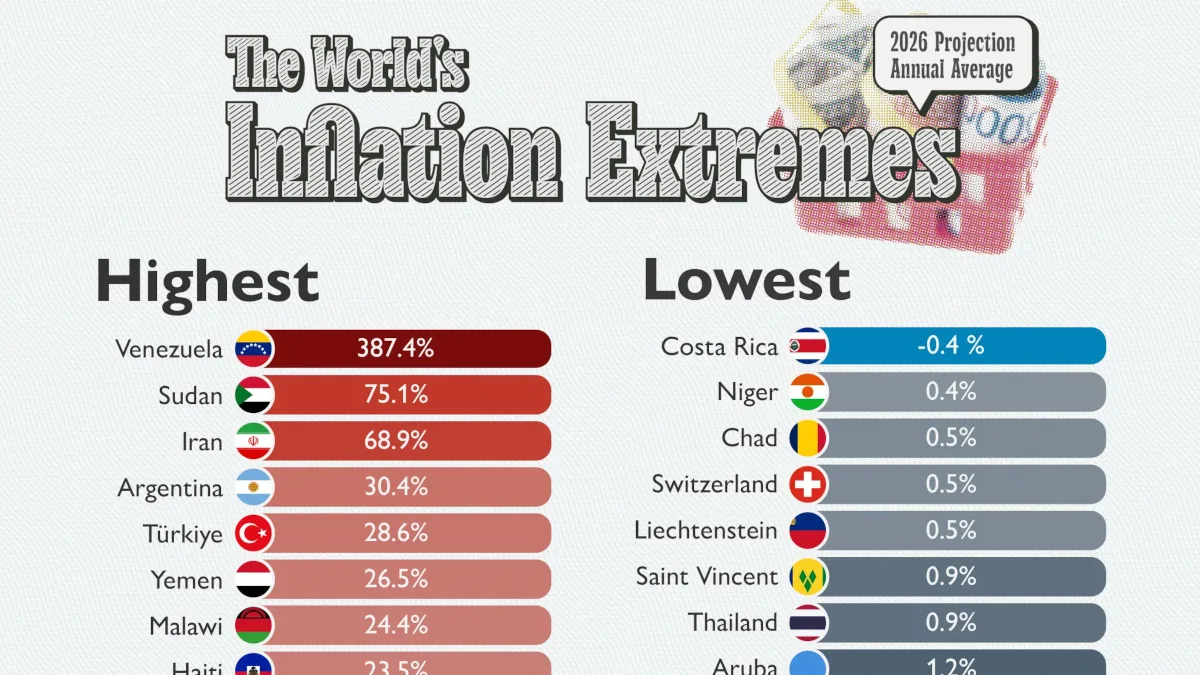
- Venezuela is projected to have the world’s highest inflation rate in 2026, at 387.4%.
- Sudan and Iran follow, with projected annual inflation of 75.1% and 68.9%, respectively.
- Costa Rica is the only country in the dataset projected to see deflation, at -0.4%.
Inflation has cooled in many major economies, but several countries are still facing severe price instability in 2026.
This graphic ranks the countries with the highest and lowest projected annual average inflation rates, based on the International Monetary Fund’s World Economic Outlook (April 2026).
At one extreme, Venezuela’s inflation rate is projected to reach 387.4%. At the other, Costa Rica is expected to be the only country in deflation, with prices falling by 0.4%.
Venezuela’s Inflation Nightmare
Venezuela has the world’s highest inflation rate. Its economy has been battered over the past decade by political instability, policy mismanagement, and an exodus of millions of people.
The country’s economic fortunes have long been tied to petroleum, of which Venezuela has the world’s largest reserves. When oil prices collapsed in 2014, Venezuela’s economy slipped with them. Over a decade later, the country’s inflation remains worse than any other country’s.
The following data table lists the countries with the highest projected inflation rates worldwide.
| Rank | Country | 2026 Inflation (%) |
|---|---|---|
| 1 |  Venezuela Venezuela |
387.4 |
| 2 |  Sudan Sudan |
75.1 |
| 3 |  Iran Iran |
68.9 |
| 4 |  Argentina Argentina |
30.4 |
| 5 |  Türkiye Türkiye |
28.6 |
| 6 |  Yemen Yemen |
26.5 |
| 7 |  Malawi Malawi |
24.4 |
| 8 |  Haiti Haiti |
23.5 |
| 9 |  Bolivia Bolivia |
20.7 |
| 10 |  Myanmar Myanmar |
19.0 |
| 11 |  Nigeria Nigeria |
16.0 |
| 12 |  Burundi Burundi |
14.5 |
| 13 |  South Sudan South Sudan |
14.0 |
| 14 |  Egypt Egypt |
13.2 |
| 15 |  Angola Angola |
12.9 |
| 16 |  Suriname Suriname |
11.8 |
| 17 |  Ethiopia Ethiopia |
11.8 |
| 18 |  Kazakhstan Kazakhstan |
10.7 |
| 19 |  Kyrgyzstan Kyrgyzstan |
10.6 |
| 20 |  Libya Libya |
10.5 |
Given the boom in petroleum prices during the preceding decade, Venezuela’s collapse in the mid-2010s was far from inevitable. However, the channeling of oil profits toward political projects rather than infrastructure modernization has left the country in ruin.
Many other unstable, oil-rich countries also struggle with high inflation, including Iran (68.9%), Libya (10.5%), and Nigeria (16%).
Deflation and Disinflation in the Caribbean
While Venezuela struggles with the world’s worst inflation rate as of 2026, some of its peers in the Caribbean Sea are faring much better.
Aruba, Belize, Grenada, Panama, Saint Vincent and the Grenadines, and the Bahamas are all among the world’s lowest-inflation projection countries, averaging in the low one-percent annual range.
| Rank | Country | 2026 Inflation (%) |
|---|---|---|
| 1 |  Costa Rica Costa Rica |
-0.4 |
| 2 |  Niger Niger |
0.4 |
| 3 |  Chad Chad |
0.5 |
| 4 |  Switzerland Switzerland |
0.5 |
| 5 |  Liechtenstein Liechtenstein |
0.5 |
| 6 |  Saint Vincent and the Grenadines Saint Vincent and the Grenadines |
0.9 |
| 7 |  Thailand Thailand |
0.9 |
| 8 |  Aruba Aruba |
1.2 |
| 9 |  China China |
1.2 |
| 10 |  Morocco Morocco |
1.3 |
| 11 |  Grenada Grenada |
1.3 |
| 12 |  Panama Panama |
1.4 |
| 13 |  Belize Belize |
1.5 |
| 14 |  Taiwan Taiwan |
1.5 |
| 15 |  Sweden Sweden |
1.5 |
| 16 |  Djibouti Djibouti |
1.5 |
| 17 |  Central African Republic Central African Republic |
1.5 |
| 18 |  Burkina Faso Burkina Faso |
1.5 |
| 19 |  Brunei Brunei |
1.6 |
| 20 |  Bahamas Bahamas |
1.6 |
Costa Rica stands out as the only country in the ranking with projected deflation. While falling prices may sound positive for consumers, sustained deflation can weaken demand, reduce business revenues, and put pressure on wages.
The Costa Rican central bank does not project a return to its target inflation range until mid-2027.
Conquering High Inflation in 2026
Given the damaging impact of runaway inflation on households and businesses alike, central banks worldwide are focused on combating inflation, usually through monetary policy such as hiking interest rates.
Governments also have a role to play. President Javier Milei was elected to the Argentine presidency in late 2023 with a mandate to tackle the country’s economic malaise. His government has cut spending and reduced subsidies to help bring down Argentina’s inflation, which is projected to be 30.4% in 2026.
Another, more radical approach that Milei campaigned on involved currency substitution, specifically dollarization. By switching to the U.S. dollar as countries like Ecuador and Panama have done, Milei hoped to avoid the possibility of future governments restarting an inflationary cycle through the overprinting of local currency. As of 2026, however, Argentina continues to use its own currency, the peso.
Learn More on the Voronoi App 
Curious where the U.S. falls in this inflation landscape? Check out Trump Says ‘No Inflation’, Americans Strongly Disagree on Voronoi, the new app from Visual Capitalist.