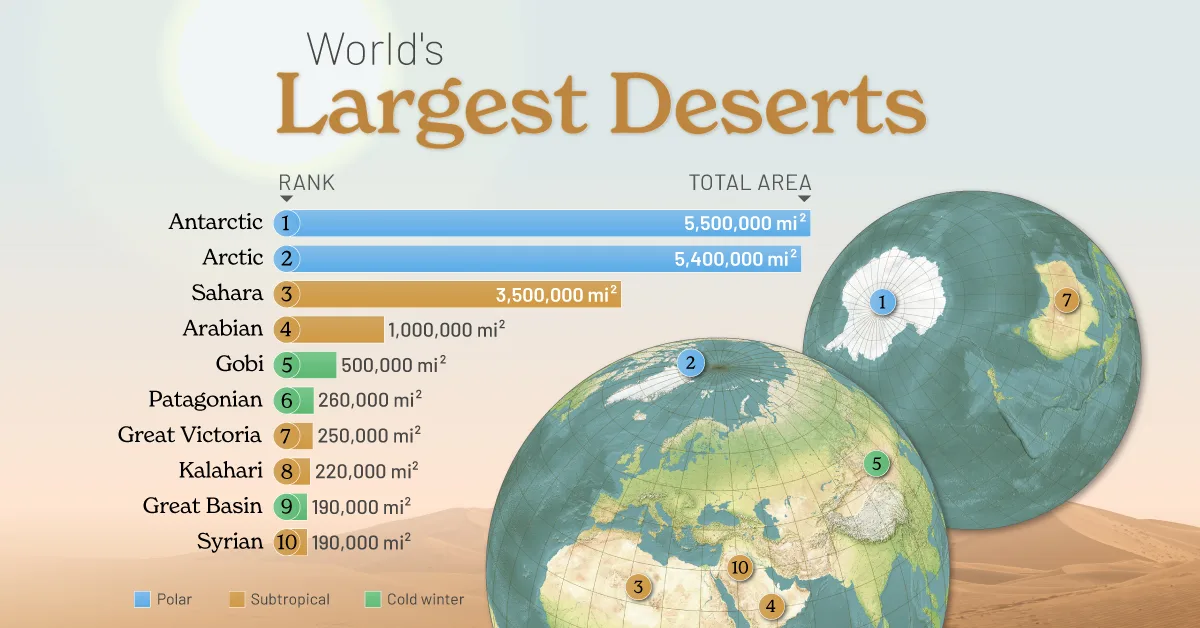
Ranked: The World’s Largest Deserts
See visuals like this from many other data creators on our Voronoi app. Download it for free on iOS or Android and discover incredible data-driven charts from a variety of trusted sources.
Key Takeaways
- The Antarctic and Arctic deserts are the two largest deserts on Earth, each covering more than 5 million square miles.
- The Sahara ranks third overall, but remains the world’s largest hot desert at 3.5 million square miles.
- Deserts can be polar, subtropical, or cold winter regions, with low precipitation being the defining feature.
The world’s two largest deserts aren’t scorching hot landscapes. They’re the frozen polar regions of Antarctica and the Arctic.
Characterized by extremely low precipitation, deserts are found on every continent and cover about one-third of Earth’s land.
This visualization ranks and maps the world’s largest deserts by area, based on data from WorldAtlas, showing how Earth’s biggest dry regions range from ice sheets to subtropical basins.
Antarctica and the Arctic Are Earth’s Largest Deserts
Accounting for all of Antarctica and much of the Arctic region, the Antarctic Desert and Arctic Desert cover 5.5 million and 5.4 million square miles, respectively. They are the world’s only polar deserts.
The data table below shows the world’s 10 largest deserts and their area in square miles and kilometers, along with their desert type and geographic span:
| Desert | Location | Type | Area in sq. miles | Area in sq. kilometers |
|---|---|---|---|---|
| Antarctic |  Antarctica Antarctica |
Polar | 5,500,000 | 14,200,000 |
| Arctic |  Canada Canada Greenland Greenland Iceland Iceland Norway Norway Sweden Sweden Finland Finland Russia Russia |
Polar | 5,400,000 | 13,900,000 |
| Sahara |  Western Sahara Western Sahara Algeria Algeria Libya Libya Egypt Egypt Mauritania Mauritania Mali Mali Niger Niger Chad Chad Sudan Sudan |
Subtropical | 3,500,000 | 9,000,000 |
| Arabian |  Jordan Jordan Iraq Iraq Saudi Arabia Saudi Arabia UAE UAE Oman Oman Yemen Yemen |
Subtropical | 1,000,000 | 2,600,000 |
| Gobi |  China China Mongolia Mongolia |
Cold winter | 500,000 | 1,300,000 |
| Patagonian |  Argentina Argentina |
Cold winter | 260,000 | 670,000 |
| Great Victoria |  Australia Australia |
Subtropical | 250,000 | 650,000 |
| Kalahari |  Namibia Namibia Botswana Botswana South Africa South Africa |
Subtropical | 220,000 | 560,000 |
| Great Basin |  U.S. U.S. |
Cold winter | 190,000 | 490,000 |
| Syrian |  Syria Jordan Saudi Arabia Iraq Syria Jordan Saudi Arabia Iraq |
Subtropical | 190,000 | 490,000 |
With an average of just 0.39 inches (10 millimeters) of annual precipitation, the Antarctic Desert is one of the driest places on Earth. Although it is covered by ice, its extremely low precipitation makes it a desert by definition.
Spanning several northern countries including Canada, Greenland, and Russia, the Arctic Desert receives more precipitation than Antarctica at roughly 6–10 inches annually. However, Arctic air is too cold to retain much moisture.
The Sahara Is Still the Largest Hot Desert
The Sahara Desert ranks third overall, but it is the largest hot desert in the world.
Covering 3.5 million square miles (nine million square kilometers), an area comparable to China, it is by far the largest non-polar desert. The Sahara stretches across parts of Western Sahara, Algeria, Libya, Egypt, Mauritania, Morocco, Niger, Chad, Eritrea, Sudan, Tunisia, and Mali.
Its scale is also changing. Climate change, human activity, and natural climate cycles have contributed to the expansion of many dry regions, and the Sahara’s area has increased by more than 10% since 1920.
Subtropical and Cold Winter Deserts Round Out the Ranking
After the Sahara, the Arabian Desert ranks fourth at one million square miles, making it the second-largest subtropical desert in the dataset.
The Gobi Desert follows at 500,000 square miles and is classified as a cold winter desert spanning China and Mongolia. Further down the ranking, the Patagonian Desert in Argentina covers 260,000 square miles, while Australia’s Great Victoria Desert covers 250,000 square miles.
The two smallest deserts in the top 10 are the Great Basin Desert and Syrian Desert, each covering about 190,000 square miles. Even at the bottom of this ranking, these regions remain enormous landscapes shaped by limited rainfall and extreme environmental conditions.
Learn More on the Voronoi App 
If you enjoyed today’s post, check out Which Countries Have the Largest Forests? on Voronoi.Use This Visualization