The World’s Most Educated Populations, Across 45 Countries
This was originally posted on our Voronoi app. Download the app for free on iOS or Android and discover incredible data-driven charts from a variety of trusted sources.
Key Takeaways
- Advanced economies such as Canada, Ireland, and South Korea have some of the highest shares of tertiary-educated adults (55–65%).
- Germany is a wealthy economy with relatively fewer university graduates, reflecting its strong apprenticeship system that provides high-skill jobs without degrees.
Which countries have the most educated populations?
Higher levels of tertiary education among a populace generally indicate greater potential for innovation and economic growth, but this isn’t always the case.
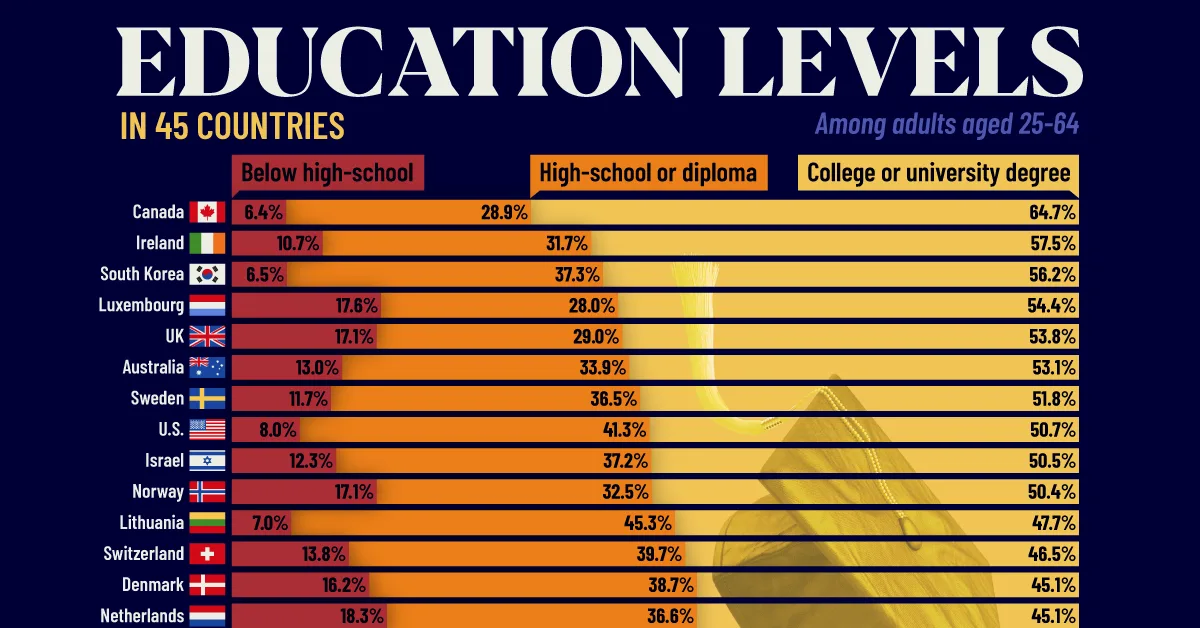
In this graphic, we visualize educational attainment by country, breaking things down into three categories: below high-school, high-school or diploma, and college or university degree.
Data & Discussion
This data comes from the OECD’s Education at a Glance 2025 report. It compares educational attainment among working-age adults across 45 countries as of 2024.
| Country | Below high-school (%) |
High-school or diploma (%) |
College or university degree (%) |
|---|---|---|---|
 Canada Canada |
6.4 | 28.9 | 64.7 |
 Ireland Ireland |
10.7 | 31.7 | 57.5 |
 South Korea South Korea |
6.5 | 37.3 | 56.2 |
 Luxembourg Luxembourg |
17.6 | 28.0 | 54.4 |
 UK UK |
17.1 | 29.0 | 53.8 |
 Australia Australia |
13.0 | 33.9 | 53.1 |
 Sweden Sweden |
11.7 | 36.5 | 51.8 |
 U.S. U.S. |
8.0 | 41.3 | 50.7 |
 Israel Israel |
12.3 | 37.2 | 50.5 |
 Norway Norway |
17.1 | 32.5 | 50.4 |
 Lithuania Lithuania |
7.0 | 45.3 | 47.7 |
 Switzerland Switzerland |
13.8 | 39.7 | 46.5 |
 Denmark Denmark |
16.2 | 38.7 | 45.1 |
 Netherlands Netherlands |
18.3 | 36.6 | 45.1 |
 Belgium Belgium |
17.2 | 37.8 | 45.0 |
 Iceland Iceland |
20.4 | 35.1 | 44.5 |
 New Zealand New Zealand |
16.9 | 39.2 | 44.0 |
 France France |
16.1 | 40.6 | 43.4 |
 Finland Finland |
10.9 | 46.4 | 42.7 |
 Estonia Estonia |
9.5 | 47.9 | 42.5 |
 Spain Spain |
34.7 | 23.0 | 42.3 |
 Latvia Latvia |
10.7 | 48.9 | 40.5 |
 Poland Poland |
5.2 | 55.4 | 39.5 |
 Austria Austria |
13.1 | 49.2 | 37.7 |
 Greece Greece |
18.1 | 46.7 | 35.3 |
 Slovenia Slovenia |
11.0 | 54.4 | 34.6 |
 Germany Germany |
15.9 | 49.9 | 34.3 |
 Bulgaria Bulgaria |
13.1 | 53.1 | 33.8 |
 Chile Chile |
25.0 | 42.1 | 32.9 |
 Portugal Portugal |
38.5 | 30.1 | 31.4 |
 Hungary Hungary |
11.9 | 57.0 | 31.1 |
 Colombia Colombia |
32.7 | 36.8 | 30.6 |
 Croatia Croatia |
9.7 | 59.9 | 30.4 |
 Slovak Republic Slovak Republic |
6.3 | 64.7 | 29.0 |
 Costa Rica Costa Rica |
51.7 | 20.5 | 27.8 |
 Czechia Czechia |
5.7 | 66.8 | 27.5 |
 Türkiye Türkiye |
49.9 | 23.1 | 26.9 |
 Argentina Argentina |
32.2 | 43.6 | 23.7 |
 Italy Italy |
33.3 | 44.4 | 22.3 |
 Mexico Mexico |
54.4 | 23.7 | 21.9 |
 Brazil Brazil |
39.9 | 38.6 | 21.5 |
 Romania Romania |
24.6 | 56.2 | 19.2 |
 India India |
75.2 | 10.5 | 14.2 |
 Indonesia Indonesia |
57.3 | 29.7 | 13.1 |
 South Africa South Africa |
49.3 | 41.7 | 9.0 |
Leaders in Higher Education
Canada tops the list with nearly 65% of adults holding a college or university degree, followed closely by Ireland and South Korea.
These nations have invested heavily in expanding access to higher education, driven by knowledge-based economies that reward advanced qualifications.
According to other OECD data, higher levels of education bring significant earnings advantages.
For instance, across OECD nations, tertiary graduates typically earn double the income of individuals who have not completed secondary education (high school).
Balanced Education Models in Europe
Countries like Austria and Germany demonstrate a more balanced split between tertiary and vocational education (education related to a specific job or trade).
For example, Germany ranks 19th in the world in terms of GDP per capita, despite only 34% of its adults having a university degree.
The country has a strong apprenticeship system where students combine hands-on training with theoretical learning, resulting in a high rate of employment upon graduation.
Learn More on the Voronoi App 
If you enjoyed today’s post, check out The Universities Producing the Most Billionaires on Voronoi, the new app from Visual Capitalist.