Ranked: Where Wages Go Furthest Around the World
See visuals like this from many other data creators on our Voronoi app. Download it for free on iOS or Android and discover incredible data-driven charts from a variety of trusted sources.
Key Takeaways
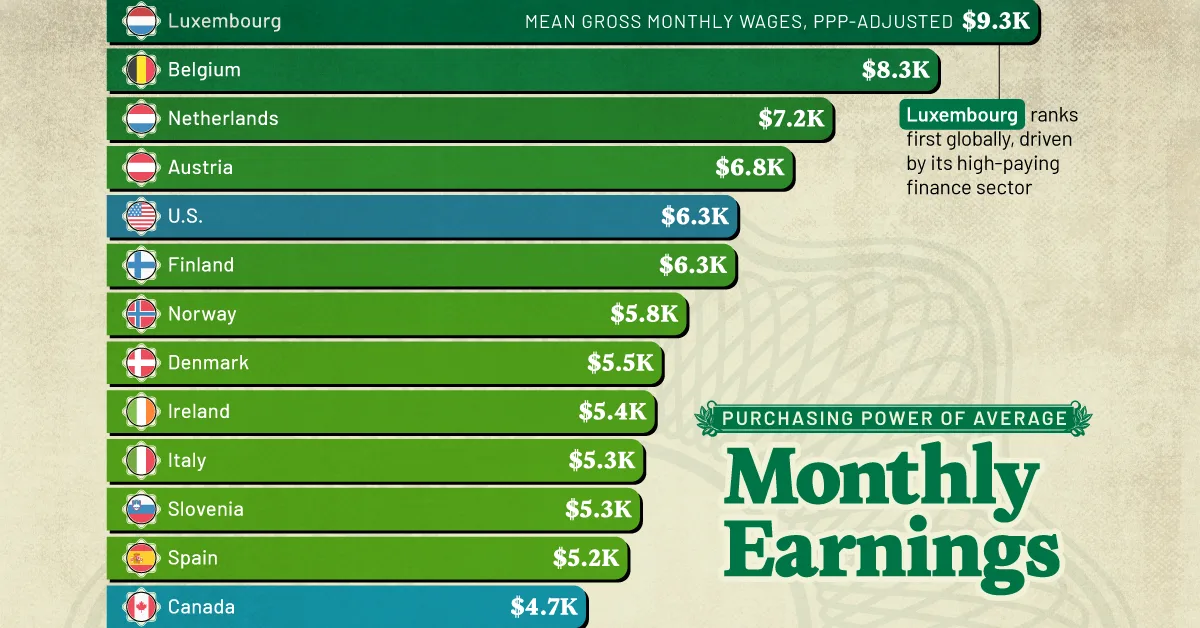
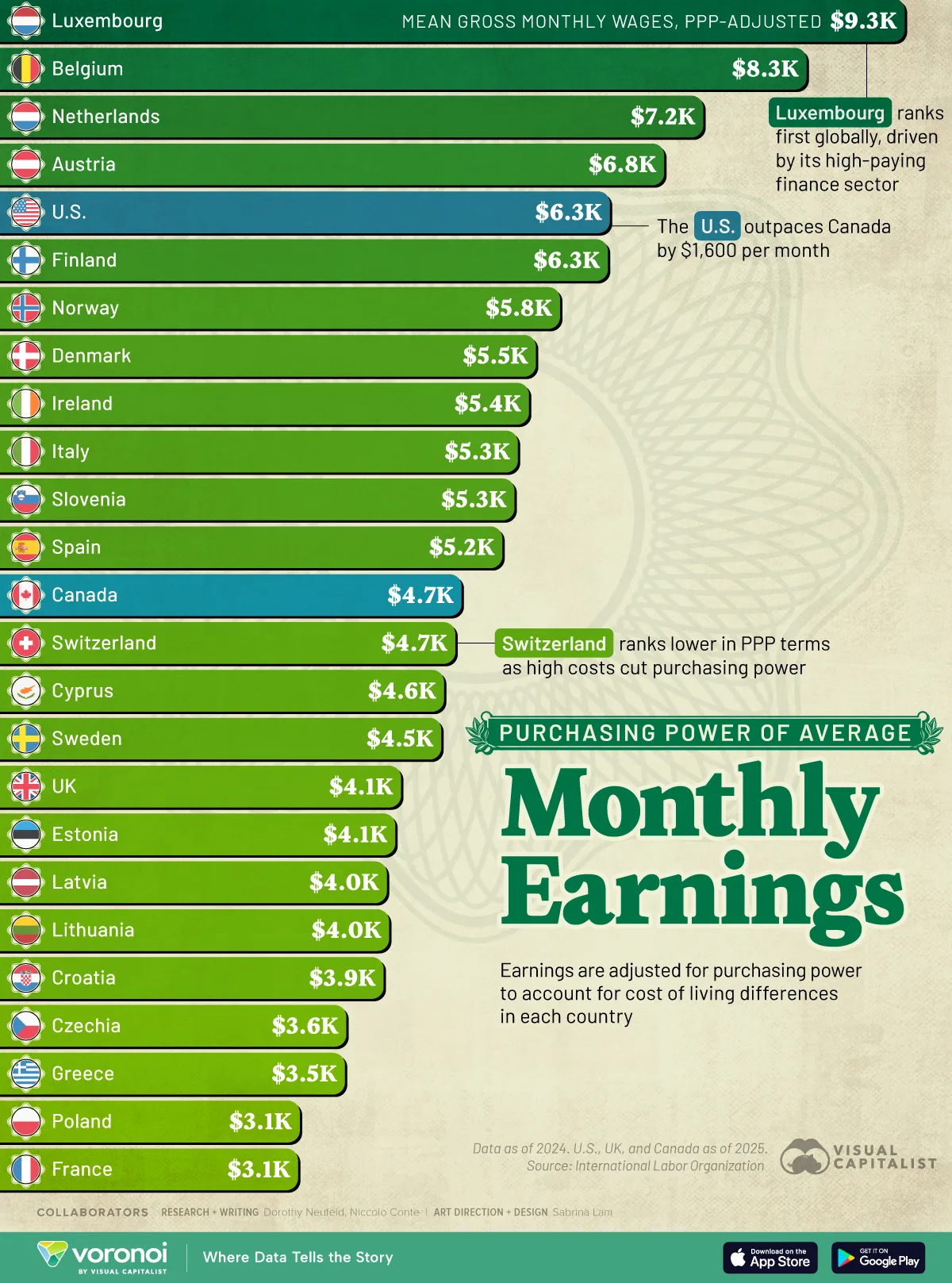
- Luxembourg ranks first globally, with average monthly purchasing power above $9,300.
- The U.S. places fifth worldwide, ahead of Finland and Norway after adjusting for local prices.
- Switzerland falls behind Canada and Spain once cost of living is factored in.
Where does a paycheck actually stretch the furthest?
This graphic ranks countries by average monthly earnings adjusted for purchasing power parity (PPP), using data from the International Labor Organization. Rather than comparing salaries on paper, the ranking measures how much goods and services workers can actually afford after accounting for local prices.
The results show that high nominal wages do not always translate into stronger purchasing power. In some countries, expensive housing and consumer costs significantly reduce how far incomes go, while others combine relatively high wages with lower living costs.
Where Monthly Wages Go Furthest by Country
Luxembourg ranks first globally, with purchasing-power-adjusted monthly earnings exceeding $9,300. That gives workers nearly 50% more spending power than the average American.
Belgium ($8,297) and the Netherlands ($7,234) follow, forming a cluster of high-income European economies where salaries retain strong purchasing power.
This ranking is based on mean gross monthly wages adjusted for local prices and cost of living in 2024. The U.S., UK, and Canada data is for 2025.
| Rank | Country | Mean Gross Monthly Wages, PPP-Adjusted 2024 |
|---|---|---|
| 1 |  Luxembourg Luxembourg |
$9,307 |
| 2 |  Belgium Belgium |
$8,297 |
| 3 |  Netherlands Netherlands |
$7,234 |
| 4 |  Austria Austria |
$6,832 |
| 5 |  U.S. U.S. |
$6,273 |
| 6 |  Finland Finland |
$6,253 |
| 7 |  Norway Norway |
$5,760 |
| 8 |  Denmark Denmark |
$5,512 |
| 9 |  Ireland Ireland |
$5,441 |
| 10 |  Italy Italy |
$5,326 |
| 11 |  Slovenia Slovenia |
$5,291 |
| 12 |  Spain Spain |
$5,166 |
| 13 |  Canada Canada |
$4,747 |
| 14 |  Switzerland Switzerland |
$4,683 |
| 15 |  Cyprus Cyprus |
$4,566 |
| 16 |  Sweden Sweden |
$4,538 |
| 17 |  UK UK |
$4,124 |
| 18 |  Estonia Estonia |
$4,065 |
| 19 |  Latvia Latvia |
$4,011 |
| 20 |  Lithuania Lithuania |
$4,001 |
| 21 |  Croatia Croatia |
$3,945 |
| 22 |  Czechia Czechia |
$3,561 |
| 23 |  Greece Greece |
$3,546 |
| 24 |  Poland Poland |
$3,082 |
| 25 |  France France |
$3,064 |
The U.S. ranks fifth globally, with PPP-adjusted earnings of roughly $6,300 per month, placing it ahead of Northern European countries like Finland and Norway.
One of the biggest surprises in the ranking is Switzerland ($4,683). Despite having some of the world’s highest salaries on paper, the country falls behind both Canada and Spain after adjusting for local costs. Extremely expensive housing, services, and consumer prices significantly reduce real purchasing power.
Countries with similar PPP-adjusted earnings can still have very different underlying dynamics. For example, Canada and Switzerland show comparable levels, but for opposite reasons: moderate wages and costs in Canada versus very high wages offset by very high costs in Switzerland.
A Wide Gap Between Top and Bottom Earners
Even after accounting for cost of living, large gaps in living standards remain across advanced economies.
Workers in the highest-ranked countries earn nearly three times more per month than those near the bottom of the dataset, including Greece ($3,546) and France ($3,064). This gap highlights persistent differences in productivity, industry mix, and economic structure across countries.
In practice, two workers earning similar salaries can experience very different standards of living depending on where they live. Ultimately, where you live can matter just as much as how much you earn.
Learn More on the Voronoi App 
To learn more about this topic, check out this graphic on average full-time salaries in Europe.