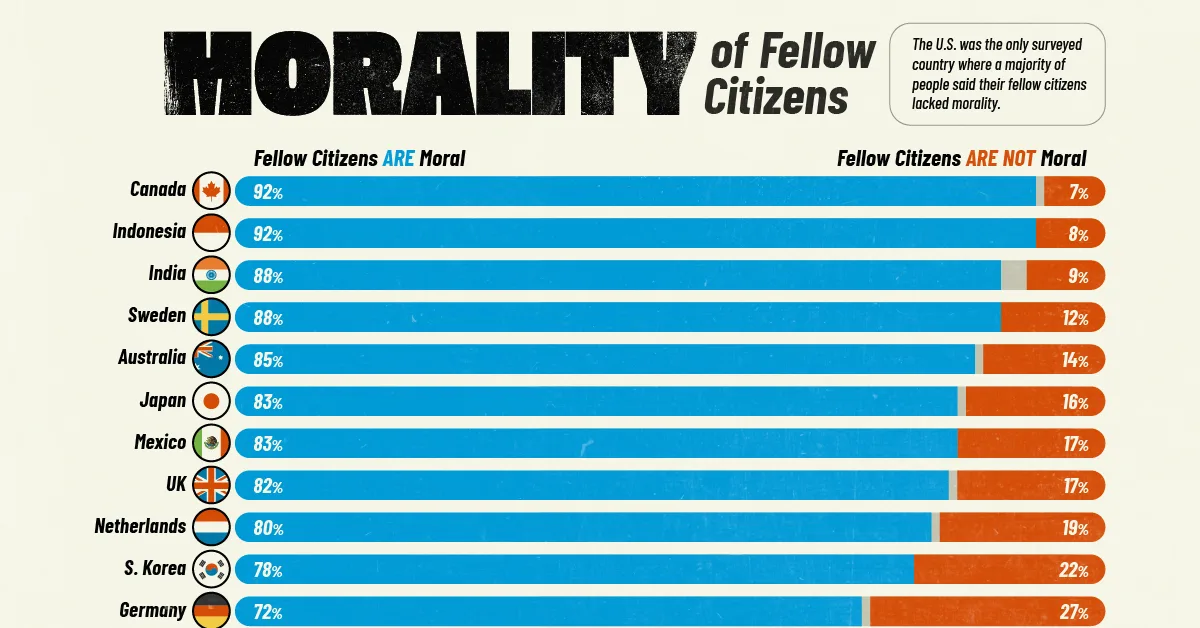
 See more visuals like this on the Voronoi app.
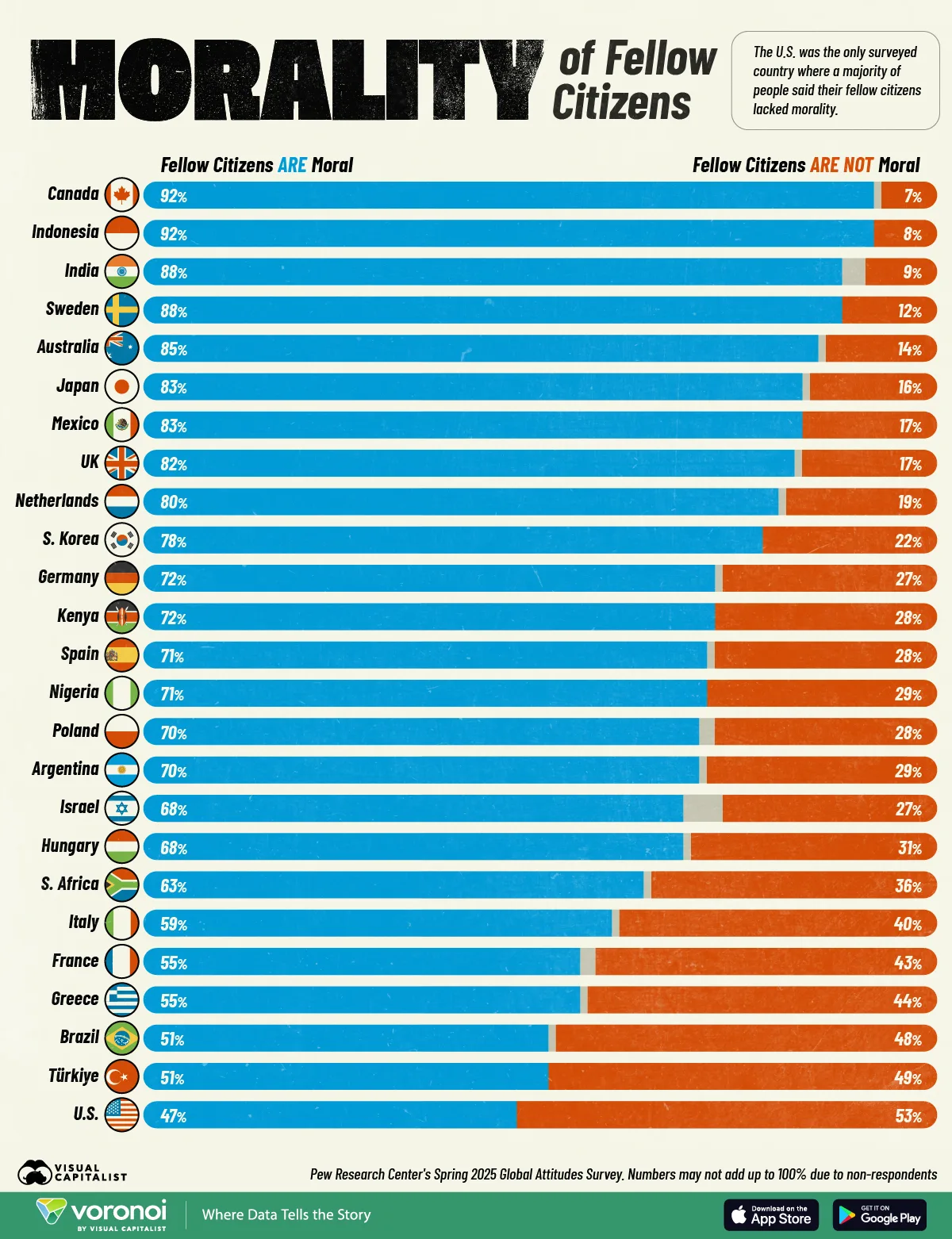
Ranked: Which Countries See Their People as Most Moral
See visuals like this from many other data creators on our Voronoi app. Download it for free on iOS or Android and discover incredible data-driven charts from a variety of trusted sources.
Key Takeaways
- In most surveyed countries, a majority of people say their fellow citizens are moral.
- The U.S. is the only country where most respondents say their compatriots are not moral.
- Canada and Indonesia top the ranking, with 92% of respondents in each country viewing their fellow citizens positively.
People in most countries tend to see their fellow citizens as moral. But one country stands apart: the United States is the only place in Pew’s 2025 survey where a majority of respondents said their compatriots are not moral.
This graphic ranks 25 countries by the share of respondents who said people in their country are moral, based on Pew Research Center’s Spring 2025 Global Attitudes Survey.
The Most Moral Countries Worldwide
Canada and Indonesia lead among surveyed countries, with 92% of respondents in both countries generally believing in their fellow citizens’ morality.
Canada edges slightly ahead, with 7% of respondents saying their compatriots are immoral, compared to 8% in Indonesia.
The following table reflects the percentage of respondents who answered that people in their country were either moral or immoral.
| Country | Fellow Citizens are Moral | Fellow Citizens are Not Moral |
|---|---|---|
 Indonesia Indonesia |
92 | 8 |
 Canada Canada |
92 | 7 |
 Sweden Sweden |
88 | 12 |
 India India |
88 | 9 |
 Australia Australia |
85 | 14 |
 Mexico Mexico |
83 | 17 |
 Japan Japan |
83 | 16 |
 UK UK |
82 | 17 |
 Netherlands Netherlands |
80 | 19 |
 South Korea South Korea |
78 | 22 |
 Kenya Kenya |
72 | 28 |
 Germany Germany |
72 | 27 |
 Nigeria Nigeria |
71 | 29 |
 Spain Spain |
71 | 28 |
 Argentina Argentina |
70 | 29 |
 Poland Poland |
70 | 28 |
 Hungary Hungary |
68 | 31 |
 Israel Israel |
68 | 27 |
 South Africa South Africa |
63 | 36 |
 Italy Italy |
59 | 40 |
 Greece Greece |
55 | 44 |
 France France |
55 | 43 |
 Türkiye Türkiye |
51 | 49 |
 Brazil Brazil |
51 | 48 |
 U.S. U.S. |
47 | 53 |
The mix of countries at the top challenges common assumptions about what drives these perceptions. Indonesia and India (88%) are highly diverse societies, yet they rank alongside more homogeneous countries like Japan (83%) and Hungary (68%).
Meanwhile, the relatively equal responses between countries like Canada and Indonesia, or India and Sweden (both 88%), also dispel notions about the distinguishing factor being tied to the economic development level of the country.
The Sole Outlier
One country does emerge as a clear outlier in this ranking.
In contrast to their northern neighbors in Canada, a whopping 53% of respondents in the U.S. answered that they believe their fellow citizens are immoral. This is the only country where a positive social opinion was the minority.
A few factors may help explain the unique responses by American respondents, including deep political polarization and worsening tribalism across the country, as well as long-running national debates surrounding religion and gun violence.
Notably, while rising numbers of members of both mainstream political parties believe their opponents to be immoral, in this survey Democrats and Democrat-leaning independents were far likelier than their Republican counterparts to answer negatively.
American Peers Around the World
While the U.S. is the only country where most respondents declared their fellow citizens immoral, other countries do also reflect relatively divided views of their national citizenry.
This trend can be found not only in large developing countries like Brazil and Türkiye (both 51%) but also established Western European democracies like France (55%) and Italy (59%).
Learn More on the Voronoi App
If you enjoyed today’s post, check out Survey: The Countries Most Optimistic About 2025 on Voronoi, the new app from Visual Capitalist.