
Beyond the over-the-top family drama that keeps us watching, Landman’s second season showcased many unfortunate and harsh realities of the oil and gas industry.
For those yet to watch, Billy Bob Thornton stars as “Tommy,” a veteran landman — a one-man oil and gas field fixer — turned president of M-Tex, a fictional, independent West Texas oil company. As the second season progresses, we witness Tommy tiring of the high stakes, risky oil business he’s worked in for decades. Tommy cynically observes that “greed has dug a million wells.” Scathing aside, at his core, Tommy is a lifelong oil man. And Season 2 ends with Tommy forming CTT Oil Exploration and Cattle, a new “wildcatting” oil and gas venture drilling on a hunch with a handful of lowly-production wells — and branded with his own initials and those of his son, Cooper, and father, Thomas, plus some cows tossed in.
Despite the whimsical name of Tommy’s new company, the gamut of safety, environmental, economic, and geopolitical risks his industry faces is no laughing matter. These risks keep arising because they are ever-present. As a chemical engineer who once worked in the oil and gas industry, here’s a recap with my reactions.
Season 2, Episode 1 opens with a serious oil and gas health hazard. Toxic hydrogen sulfide (H2S) gas leaks at dangerous levels from M-Tex’s oil and gas equipment. A hunting party in the vicinity encounters animal carcasses strewn in a nearby field before perishing themselves. Tommy’s crew, despite wearing mandatory H2S monitors to alert them, cannot retreat fast enough. With H2S entering their bloodstreams, they become violently ill, and one worker loses his eyesight.
Reaction: Oil and gas are chemical concoctions that contain methane and other volatile compounds, including toxins like H2S and carcinogens like benzene. Although oil and gas are advertised as simple, “standard” commodities, they are very complex. Their makeups vary widely, but their compositions are not publicly disclosed. Greater transparency detailing what’s in oil and gas is needed to safeguard people and property.


Safety risks are a continuing theme in Landman. In episode 4, an oil field truck plows into a parked pickup in distress, resulting in a fireball with no survivors.
Reaction: Road accidents are common in West Texas’ oil patch due to long shifts, high speeds, rural (often unpaved) roads, and big rigs transporting heavy equipment. Studies find that the leading causes of oil and gas deaths, beyond dangerous field conditions, are road fatalities.

Physical risks are confronted in episode 6. One of M-Tex’s offshore rigs is damaged beyond repair in a hurricane, and insurance fraud surfaces. Money is paid out, but no reconstruction takes place.
Reaction: Oil and gas infrastructure is capital intensive and requires insurance (and often re-insurance) to operate. Yet much of the oil and gas industry’s operations — platforms, refineries, LNG terminals, ports, tankers, and pipelines — are in harm’s way in or near waterways and the methane leaking from oil and gas is superheating the planet. The changing climate is increasing the frequency, speed, and severity of superstorms, tornadoes, hurricanes, sea level rise, and flash floods that present physical and financial risks that the industry has not weathered in the past. At least one insurance company, Chubb, has set underwriting guidance that may deny coverage to oil and gas companies with assets that leak too much of the powerful climate accelerant, methane, which is also a main component of oil and gas.
Economic risks are highlighted in episode 6. Tommy and his crew attend an industry fair showcasing conventional and novel technologies. They stop at a booth of a real-world startup, MaCH4 Coldstream Energy — which recovers natural gas liquids instead of burning and wasting them. One of Tommy’s crew laments: “That’s the future without us.”
Reaction: The energy world is in transition. Efforts are accelerating to eliminate energy waste, as evidenced by companies like MaCH4. Markets are reinforcing changes in the energy landscape. For example, the price of renewable energy has been even lower than that of gas and oil recently. And electric vehicles are overtaking gasoline-powered vehicles in new car sales, which is reducing demand for oil and shifting energy markets. There is added economic uncertainty about the future price of gas, given its significant market volatility. Taken together, this is making the future of oil and gas far less certain than it was in the past century.
Geopolitical risks are materializing in real time as the finale of Landman Season 2 airs. Tommy shares that M-Tex is a bit player in a global oil and gas industry that is too big to fail. He likens the business to a layer cake of many different interests, and he considers pursuing new opportunities with an international oil company — Chevron (one of the companies operating in Venezuela).
Reaction: Had Landman’s Season 2 script been written now, it’s very likely that the geopolitical situation in Venezuela would have been mentioned. Oil and gas are valuable trade commodities and countries rise and fall on them. When the US invaded Venezuela and jailed its president, at least one motivation was appropriating another country’s resource wealth.
Perhaps the most surprising reality that surfaced during season 2 was in my conversations with everyday Landman viewers. There is widespread public misconception regarding the source of everyday products we depend on to power our computers, heat our homes, form fiber for our clothes, manufacture our medicines, fuel our cars, trucks, and planes, pave our roads, and more. I was asked more than once if the gas piped to our homes is the same gas that comes out of the ground.
Reaction: The oil and gas that are drilled out of the ground are the very same resources that are processed into commodities that we consume every day. While the oil and gas that M-Tex and other companies produce must flow through a long chain of custody involving drillers, producers, processors, shippers, refiners, terminals, traders, public utilities, and retail outlets, the gas and petroleum products we consume start their journey under the ground. Regardless, these equivalent barrels of oil and gas do not have the same impact in terms of their safety, environmental, economic, and geopolitical concerns. The longer the trip from extraction to end uses, the more potential gas has to leak and cause harm to people, property, and the planet.
This is precisely what RMI’s Oil Climate Index plus Gas (OCI+) charts. Nearly three-quarters of global oil and gas supplies are analyzed — including those produced by smaller companies like the fictitious M-Tex in West Texas — to quantify the waste and emissions from equivalent barrels of oil and gas that M-Tex and its competitors produce.
US Oil and Gas Assets’ Methane Intensities are Wide Ranging, Especially in West Texas
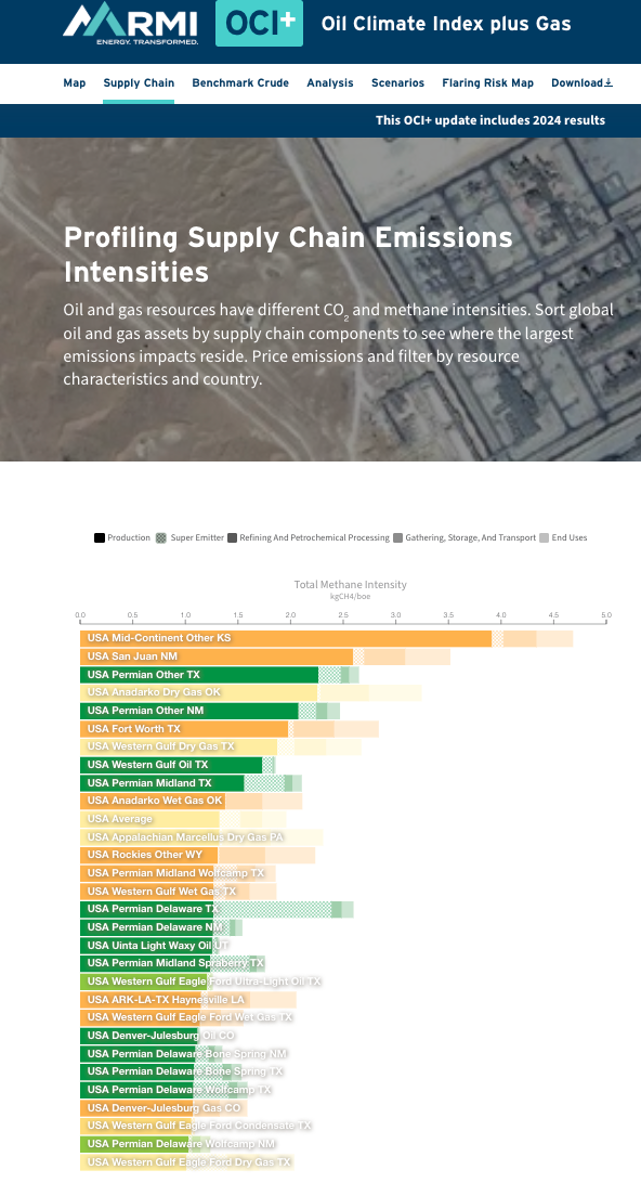
Source: https://ociplus.rmi.org/, accessed February 9, 2025.
RMI then uses the OCI+ to generate oil and gas emissions inventories worldwide on the ClimateTRACE portal and to assess mitigation scenarios. It turns out that the energy waste and emissions vary markedly from field to field and country to country. This is valuable information that banks, insurers, companies, and policymakers are using to make smarter investment, underwriting, operational, and regulatory decisions.
Closing Reaction: Differentiating barrels of oil and gas is the key to a well-functioning market. Without knowing a commodity’s attributes — safety, environmental, economic, and geopolitical — inefficiencies, waste, and risks cannot be managed. As the maxim goes, we can manage what we measure. And this is especially true for critical commodities like oil and gas.
The post Reactions to Landman Season 2: Risky Business Continues in the Oil Patch appeared first on RMI.


