
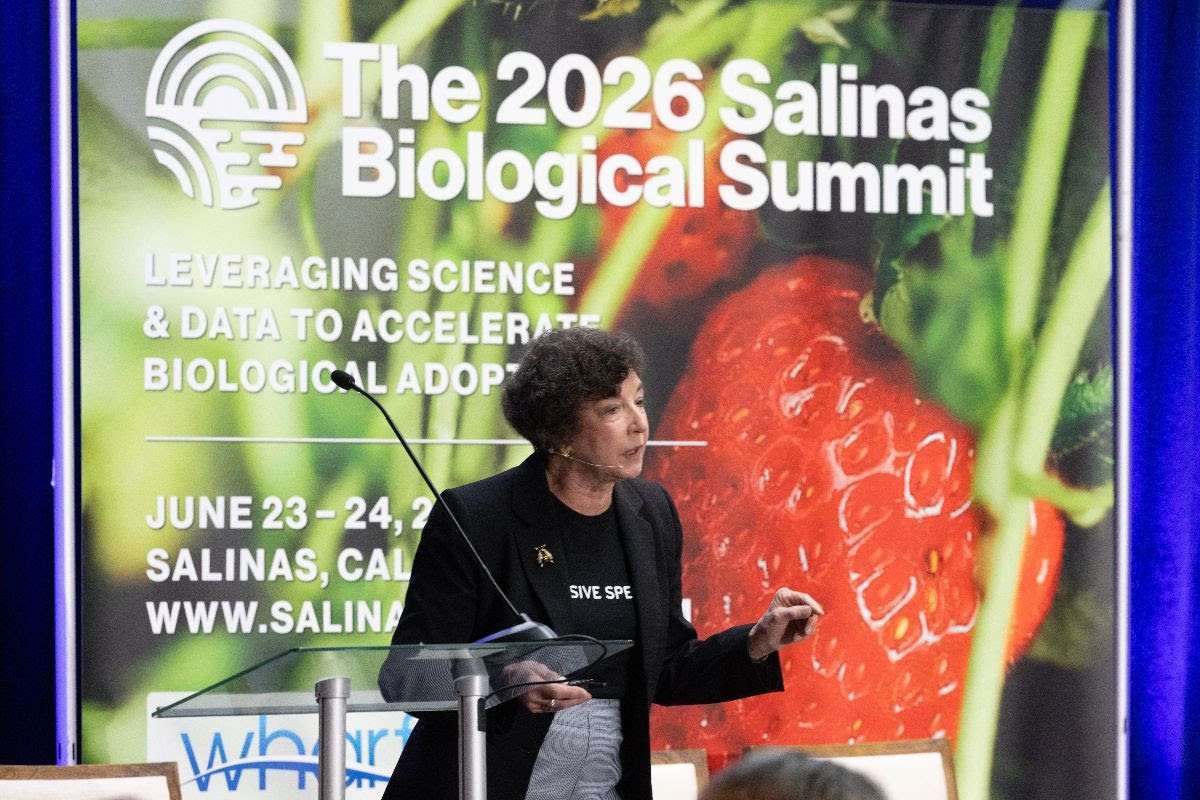
The ag biologicals sector is still making “steady progress” in terms of new products and overall growth, Dr. Pam Marrone, founder and chair of the Invasive Species Corporation, said during her annual presentation at the annual Salinas Biological Summit in California.
This is despite “global economic and political uncertainty and chaos,” not to mention a difficult fundraising and regulatory environment for startups.
Citing data from research firm Dunham-Trimmer, she noted that most biologicals segments are still seeing double-digit growth, albeit slightly lower than last year: 10.65% CAGR for biocontrols, 9.93% for biostimulants, and 11.08% for biofertilizers.
Regionally, the US and Canada still lead for marketshare ($5.68 billion projected for 2027), but thanks to Brazil, Latin America is now a close second ($4.97 billion projected for 2027).
“The growth has been astonishing,” Dr. Marrone said of Brazil, noting that the country had a $1.2 billion ag biologicals market in 2025 across almost 200 million hectares.
The vast majority of this is in row crops, which is unique at a time when most global ag biological markets focus on specialty crops such as berries and almonds.
“What is the secret to Brazil?” she asked during her presentation. “Instead of looking at these things [ag biological products] as standalone against the best cocktail of chemicals, the growers are rapidly integrating them and using all tools on the farm.”
Another possible factor contributing to Brazil’s rapid adoption of biologicals: farmers in the country are on average 10 years younger than those in other parts of the world, and arguably more open to trying new technologies in the field, she said.
Funding dollars flow from Europe
Fewer biologicals startups secured funding in the last 12 months compared to the previous year, said Dr. Marrone. In the US, that’s in no small part due to AI, which is “sucking up all the oxygen in the room” right now.
Much of the money for ag biologicals is currently in Europe, she added. “European investors didn’t get burned in the 2021/2022 high valuations in investment, so now they’re where the money is at.”
Of the eight companies named in her presentation that have recently raised funding, six come from Europe: Mycoverse (Denmark), B-Cos (Germany); Agriodor (France); SugaROx (UK); and Bindbridge (UK).
Meanwhile, private equity continues to buy break-even or profitable companies, a trend that picked up speed last year.
“The multiples on exit are quite high, even for young companies,” noted Dr. Marrone.
She also drew attention to possible exit routes for startups beyond the ag majors (Syngenta, Bayer et. al.) by highlighting “pure-play” biologicals companies, many of which have “become very sizable in revenue” (See Upstream Ag’s full breakdown of this space.) A few names here include Spain-headquartered Rovensa Next, with more than $900 million in revenue, and Belgium’s BioFirst, with nearly $600 million, according to Dr. Marrone’s presentation.
Farmers, investors need more education
The sector still needs education on what ag biologicals are (and are not) and how to use them, which has been an ongoing theme since Salinas Biological Summit began in 2023.
In particular, climate tech and deeptech VCs need education around biologicals being a low capex, low adoption curve tool.
For example, she quoted one deeptech VC who told her, “Microbials as biopesticides is not deeptech unless they are engineered.”
Among farmers, awareness of biologicals is improving, but growers remain unsure of which questions to ask when evaluating possible products.
According to Dr. Marrone, “every sales rep claims X% yield increase,” and farmers can’t easily tell which ones are reputable products. Nor are they sure which questions to ask sales reps to avoid buying “snake oil.”
This relates to lack of trust in product performance, which is still the number one barrier to grower adoption of ag biologicals.
What’s hot
Dr. Marrone highlighted a slew of developments worth watching over the next 12 months. Among them:
- AI-driven design of pesticidal peptides and proteins
- Low-dose elicitor molecules that trigger plant responses to pathogens and reduced stress
- Microbial metabolites
- RNAi with proven delivery methodology and cost effectiveness
- True abiotic stress mitigation
- Inputs that truly help reduce time to regenerative soils
- Integrated programs
- Pesticide enhancers and formulations that stabilize
Keep an eye on herbicides
Growth of the bioherbicide sector still lags behind other areas in the ag biologicals space such as biopesticides and biofertilizers. But this could be changing.
There are new companies to watch, such as Quercus, which is doing AI-based peptide discovery for weed control. Meanwhile, Corteva this announced a $200 million prepayment to partner with FMC on the latter’s proprietary rimisoxafen technology targeting resistant weeds.
Dr. Marrone’s own company, Invasive Species Corporation, is developing a class of bioherbicides harnessing metabolite mixtures with broad-spectrum activity against grasses and broadleaf weeds, including glyphosate-resistant species.
“In our broadleaf studies of pig weeds, it performed almost as well as glyphosate, with just the wholesale broth out of the fermenter,” she said.
“Once we optimize, we’re going to have something special.”
The post Report card from California: Farmers and investors need more education on ag biologicals appeared first on AgFunderNews.


