

Using virtual reality (VR) to show citizens how future agrivoltaics projects will look and work can help increase understanding and acceptance, new research has found.
A research team at Aarhus University in Denmark used immersive virtual reality to examine how citizens evaluate agrivoltaic systems in comparison to conventional solar parks. Their findings are presented in the research paper Cognitive and affective reasoning about agrivoltaics: The influence of experiential engagement on perceived purpose and acceptance intentions, available in the journal Environmental Science & Policy.
The team used VR to show 102 participants three solar configurations – one conventional solar park, a vertical agrivoltaic system, and a horizontal agrivoltaic system – from two standardized viewpoints, one approximately 50 metres away and another 2-3 metres away.
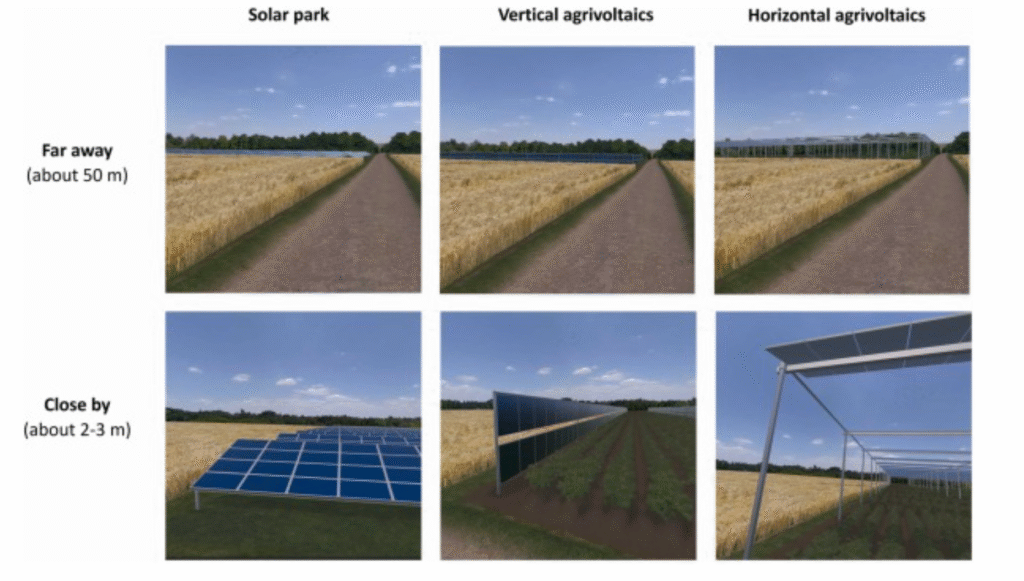
Participants were video recorded during the VR experiment to capture how their evaluations unfolded during exposure to the visualisation, while a pre- and post-VR survey assessed changes in perceptions and acceptance across each installation type.
Gabriele Torma, Assistant Professor at Aarhus University, told pv magazine that most of the participants started with very little familiarity with agrivoltaics.
“At first, they mainly reacted to how the installations looked in the landscape. But as they moved from the distant to the close view and more of the agricultural function became visible, many began to view them differently – not simply as solar panels occupying farmland, but as a way of using the same land for both food and energy production,” Torma explained.
Findings in the research paper highlight that agrivoltaics were evaluated more favorably than solar parks once participants fully understood the dual food–energy use the technology allows.
A quantitative analysis found agrivoltaics were rated substantially higher than conventional solar parks on compatibility with agriculture, environmental friendliness and innovativeness, according to additional analysis from the paper, but acceptance intentions were similarly high across all installation types, leading the paper to explain that unfamiliarity did not translate into lower stated local acceptance after experiential engagement.
Torma also told pv magazine the practical message from the research was that citizens and stakeholders need opportunities to understand what an unfamiliar technology will actually look like and how it is intended to work.
“VR, visualisations or site demonstrations can make both the visual impact and the functional logic of agrivoltaics more tangible, supporting a more informed discussion of benefits, trade-offs and design choices before projects are finalised,” she explained.
Torma added that one important limitation from the research was that all installations in the VR study were approximately one hectare.
“Some participants explicitly indicated that the relatively modest scale mattered to their evaluation, so we would not assume that the same findings necessarily apply to much larger installations,” she explained. “Design and scale still matter, and local context also needs to be considered, so these tools should support dialogue rather than be seen as a way of persuading communities to accept a project”.
Analysis from the research paper adds that the findings offer policy implications for the governance of agrivoltaics, including an implication that formal consultations could be complemented by experimental tools that allow stakeholders to engage directly with the functional logic behind these such systems.
“Deployed before concrete project proposals are finalized, such tools should be understood as complements to formal planning processes, supporting transparent dialogue and helping clarify trade-offs without presupposing agreement or acceptance,” the paper suggests.
It adds that as participants in the study had more informed evaluations of agrivoltaics once they could experience and interpret the system’s functional logic directly, the findings also have implications for social acceptance and land-use governance.
“In contexts where open-space solar development raises concerns about agricultural land conversion or local acceptance, agrivoltaics may offer a socially relevant complement to conventional solar parks, provided that continued agricultural activity remains visible and practically viable,” the paper says.
“While our findings do not speak to agronomic performance directly, the perceived credibility of continued farming was central to public evaluation. Agronomic feasibility, including crop compatibility, machinery access, yield expectations, and land-use efficiency, should therefore be communicated tangibly during planning and consultation.”
Torma added that the VR used in the study is available as freeware for non-commercial use through the HyPErFarm project.
The post Researchers use virtual reality to increase understanding of agrivoltaics appeared first on pv magazine Global.


