
There are numerous automated crop scouting technologies in development, from wheeled units with sensors to adding crop monitoring sensors to sprayer booms to the ability to do leaf tissue testing in the field.
But how about a robot dog?
That’s what the Innovation Farm at Area X.O. in Ottawa is testing.
WHY IT MATTERS: The broad types of technology being tested for use in agriculture are expanding, and that should create more options for farmers.
If you think about it, dogs are mobile and able to get to most places, including between 30-inch rows, the most-common spacing between corn rows.
That’s what drew Andrew Lemke to the Unitree Go2, the Chinese-made robot that had everyone stopping for a look at the Ottawa Valley Farm Show. Lemke had the robot running at the show, stopping and delighting people by shaking a “paw”.
“For a lot of broad-acre crops, like for corn and soy, this guy would be great as he’s just something that could run through the field,” said Lemke.
It’s not just where the robot goes — the big value is what it can see.
The camera on the robot takes about 2,000 images per minute. Those images could be used to geolocate and identify weeds, including by growth stage. Then, a small automated weeding unit could run through the field and till or spray the weeds, with a weed map made from the information from the robot scout.
Lemke also had an Oz small autonomous unit from Naio in the Area X.O. booth at the Ottawa Valley Farm Show.
Identification and mapping of larger weeds would be better done with a drone, said Lemke, but the robot dog would be best to manage smaller weeds.
He added the robot is agile and that’s why Lemke thinks it could work in the uneven environment of a corn field, with roots and stones.
“With intertwines with corn, we find that it has enough power; it kind of kicks itself out of any of those situations,” he said.
In soybeans, there’s a greater chance that it can damage plants when it gets caught, but Lemke says it rarely gets stuck.
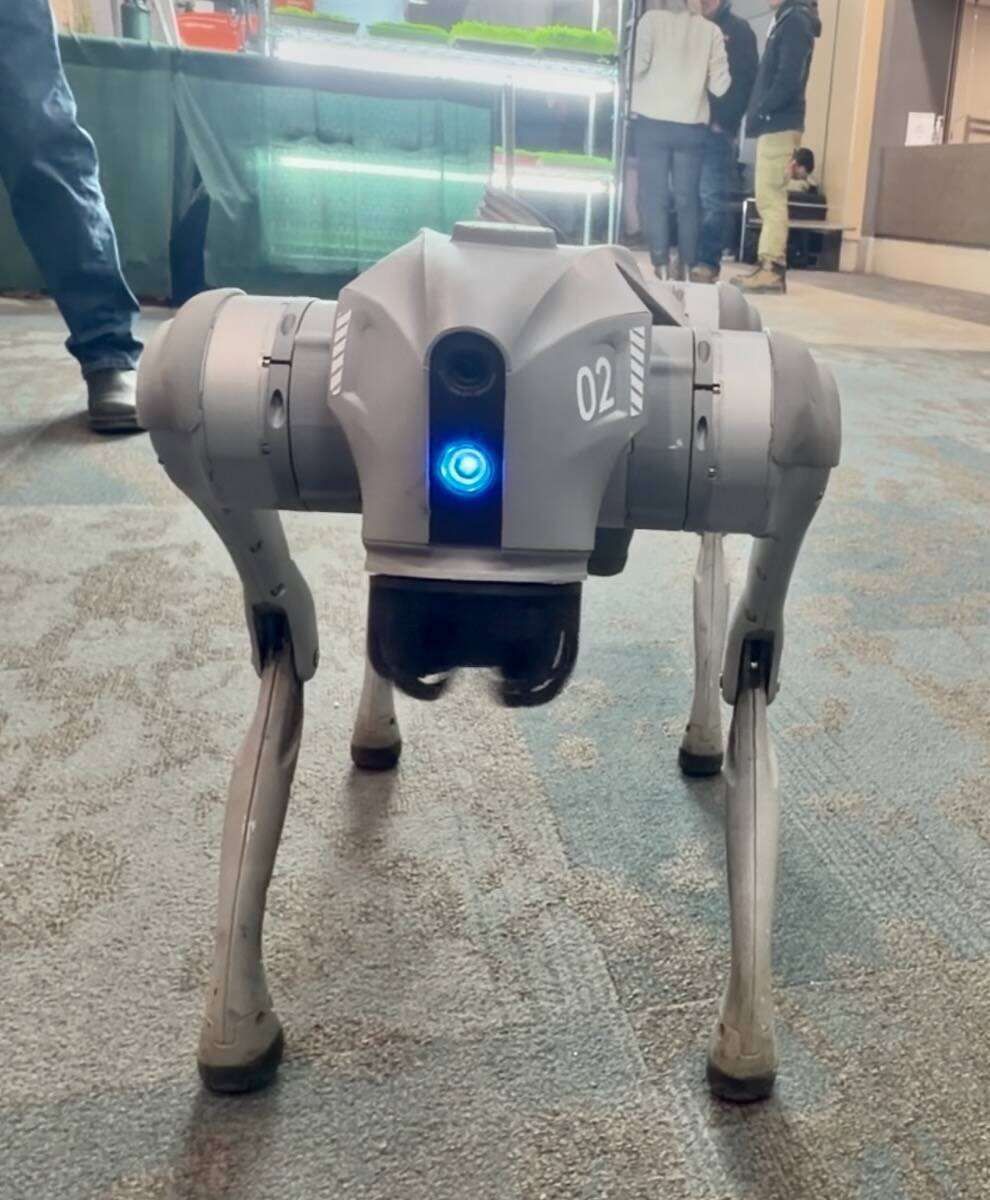
A Unitree Go2, being used to scout crops at the Innovation Farm at Area X.O. in Ottawa, attended the Ottawa Valley Farm Show. Photo: John Greig
That’s important as finding a dog-sized unit in a 50-acre corn field would be a challenge, even if it can be geolocated.
If it gets stuck, it will send a notification and a GPS location.
Field maps have to be created in advance, by a drone, to guide the robot between rows.
“Once you get that, it will stay in between those 30-inch rows.”
Managing large amounts of data
The technical challenge so far hasn’t been in the field; it’s been to manage the data, says Lemke.
Managing the 2,000 images per minute means a need for large data processing capacity that’s accurate and results in useful information after it is processed. Then, that information has to be usable by a weeding unit after it is processed.
Moving data from a Chinese robot to a French-made small robot tillage or spraying system is challenging so far.
“One of the biggest concerns we’re actually finding is the load of photos.”
Area X.O. is working on the software for weed identification as well.
The Area X.O. Innovation Farm is a not-for-profit entity funded by Farm Credit Canada, Innovation Ottawa through the city of Ottawa and some private investors.
“We’re trying to get things like the robot dog that people would never have really thought they’d see in agriculture and adapt it in these agriculture ways.”
The post Robot dog could be crop scouting helper appeared first on Farmtario.


