
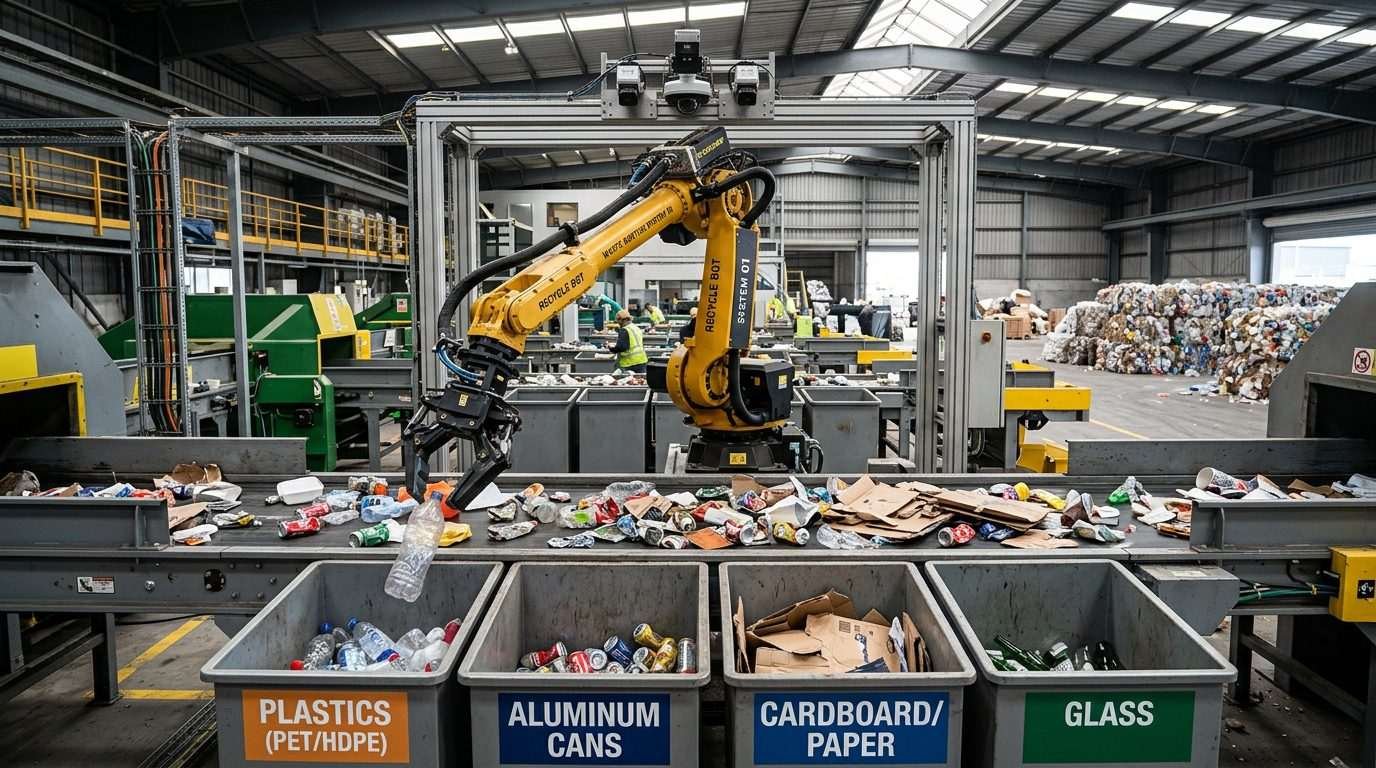
A new £3.6 million research and technology adoption hub will help UK waste and recycling operators test robotic sorting systems under real-world conditions, with the aim of improving material recovery and overcoming barriers to investment in automation.
Kingston University has been selected to lead the National Waste and Recycling Robotics Adoption Hub (NORAH), funded by Innovate UK as part of a wider government programme to accelerate the adoption of robotics across British industry.
Announced on 9 October, the hub will focus on the challenges of deploying robots in waste processing facilities, where mixed, contaminated and irregularly shaped materials can make automated sorting difficult.
According to Kingston University, fewer than 5% of UK waste facilities have adopted automation. The university attributes this partly to uncertainty over how reliably robotic systems can handle complex waste streams, making it difficult for operators to predict performance or calculate a return on investment.1
NORAH aims to address these barriers by providing real-world testbeds where robotic technologies can be evaluated using contaminated, heterogeneous waste streams, including textiles, mixed recyclables and deformable materials.
Using advanced sensing systems, multi-arm robotic sorting cells and digital simulation, the hub will independently benchmark technologies using waste samples supplied by operators. Trials will generate measured data on classification accuracy, processing throughput, contamination handling and material recovery, rather than relying solely on performance claims from equipment vendors.
The results will be combined with site-specific economic modelling to help operators assess investment costs and potential payback periods. NORAH will also provide practical support for integrating robotic equipment into existing materials recovery facilities (MRFs), including sites with constrained layouts, legacy infrastructure or variable incoming waste streams.
Other activities will include workforce training focused on the safe operation of robotic systems in contaminated environments, alongside innovation programmes addressing challenges such as mixed-fibre sorting, contamination removal and automated disassembly. Access to waste operators, local authorities and commercial facilities will provide opportunities for further testing and validation under operational conditions.
The project will be led by Professor Vasilis Argyriou, an expert in computer vision and artificial intelligence at Kingston University. The consortium includes the University of Kent, West London Waste Authority, robotics developers, waste operators and local authorities.
Professor Argyriou said the project aims to support more than 150 organisations and facilitate the deployment of robotic technologies in operational waste facilities by 2030.
“The National Waste and Recycling Robotics Adoption Hub will help UK recyclers move proven robotics from the lab into live operations, keeping valuable materials out of landfill, cutting carbon emissions, creating skilled jobs and accelerating the circular economy,” he said.
Of the £3.6 million project funding, £1.5 million is allocated to Kingston University.
NORAH is one of eight Robotics Adoption Hubs being established across the UK under a £40 million government initiative announced on 9 October. The wider programme covers sectors including manufacturing, agriculture, healthcare and logistics.2
The hubs are intended to provide independent advice, demonstrations and practical support to organisations considering robotic technologies, helping them assess the costs and benefits before committing to deployment.
The initiative forms part of a broader robotics adoption programme running until March 2030, with an emphasis on bringing existing technologies into practical use rather than developing early-stage research concepts.3
Notes
[1] Kingston University, “Kingston University chosen to lead UK’s first waste and recycling robotics hub”, 9 October 2026.
[2] UK Government, “Brits to benefit from faster recovery from surgeries and better harvests through new backing for robotics”, 9 October 2026.
[3] UK Research and Innovation, “Robotics adoption programme”.


