
- Enhanced Rock Weathering (ERW) is gaining attention as a scalable carbon removal solution. A recent study suggests the method could remove up to 350 million tonnes of CO₂ per year by 2050 if widely deployed.
What is Enhanced Rock Weathering?
Enhanced Rock Weathering is a carbon removal method that speeds up a natural geological process. Rocks such as basalt and silicates naturally react with carbon dioxide (CO₂) over thousands of years.
ERW involves crushing these rocks into fine powder and spreading them on the soil. The larger surface area makes the rocks react faster with CO₂ in the air and soil. Scientists believe this could permanently capture and store carbon as stable minerals or ocean carbon pools.
This carbon removal has emerged as a promising part of the climate toolkit to help lower atmospheric CO₂ levels.
How ERW Removes Carbon
Natural rock weathering already captures about 1.1 billion tonnes of CO₂ per year from the atmosphere. ERW accelerates this process by increasing the rock’s contact with CO₂.
When rainwater dissolves CO₂, it forms carbonic acid, which reacts with silicate rocks. This reaction locks carbon into bicarbonate ions. Some of the ions wash into rivers and reach the ocean, where they can stay for thousands of years. Because the carbon is stored this way, it is unlikely to return to the atmosphere soon.
In agriculture, ground rocks applied to the soil enhance this process. The rocks react with CO₂ around plant roots and soil microbes. Some companies source rock dust from quarries. They use industrial byproducts instead of new mining.
350 Million Tonnes: The Mid-Century Potential
New research shows that ERW could make a major contribution to climate goals by mid-century. Scaling ERW on suitable agricultural land and other surfaces worldwide could remove an estimated 350 million tonnes of CO₂ per year by 2050. This would come from fast-tracking the natural weathering process across large areas of cropland.
Global modelling studies also suggest even bigger potential. ERW could cut hundreds of millions to billions of tonnes of CO₂ each year by 2050. This depends on widespread use, strong policy support, and proper infrastructure.
Some studies focused on the United States have reported similar potential. Research shows that ERW in U.S. agriculture could cut CO₂ by 160 to 300 million tonnes each year by 2050. If expanded, this number could reach 250 to 490 million tonnes by 2070.
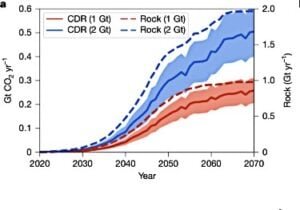
This 350 million-tonne figure sits within a broader picture of potential CDR capacity. Some analyses suggest that ERW could remove billions of tonnes every year. This would occur if the method is used widely across continents with big agricultural sectors.
Why ERW Stands Out in the Carbon Removal Race
One key reason ERW attracts attention is its durability. Carbon captured through rock weathering is stored in stable forms that can last thousands to millions of years. This permanence can make ERW more durable than some nature-based solutions that store carbon only for the lifetime of trees or plants.
ERW also builds on existing farming and mining systems. The technology uses known equipment and methods for crushing and spreading rock. This means ERW is likely easier to use widely than complex methods like direct air capture (DAC). DAC needs big new facilities and a lot of energy.
Enhanced rock weathering has additional benefits beyond carbon capture. When applied to agricultural soils, silicate rock dust can improve soil nutrition and structure. This can enhance crop yields and reduce the need for some fertilizers. Some research has even shown that certain enhanced weathering practices can improve crop performance while removing CO₂.
ERW Carbon Removal Credits Snapshot
ERW has begun to enter this market with real, verified credits. In early 2025, InPlanet and Isometric issued the first independently verified ERW carbon removal credits. These credits show long-lasting CO₂ removal. They are certified with strict monitoring, reporting, and verification (MRV) protocols.
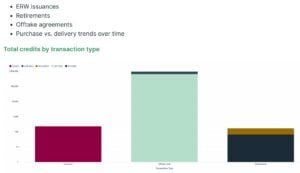
While ERW still makes up a very small share of total credits traded in 2025, its emergence marks a milestone for carbon removal markets. Early tracking shows that nearly one million ERW credits have been sold, and the total investment in ERW projects is about US$121 million. This reflects increasing interest from companies and offset buyers.

ERW carbon credit prices now range from $200–$500 per tonne. This spread comes from differences in project size, location, and how mature each method is.
Early ERW credits add variety to the carbon market. They focus on carbon removal, which is attracting buyers like Google and Microsoft. They want long-term, verified removal credits along with avoidance credits.
- SEE MORE: Microsoft Backs InPlanet’s Enhanced Rock Weathering Push to Remove 28,500 Tons of CO₂ in Brazil
Scaling Up: Verification, Logistics, and Adoption Hurdles
Despite its promise, ERW faces several challenges before it can deliver on its full potential by 2050.
- Monitoring and verification: Measuring exactly how much CO₂ ERW removes is complex. The process occurs over time and involves soil chemistry, water movement, and geological cycles. Accurate monitoring, reporting, and verification (MRV) systems are needed to ensure that carbon removal amounts are real and not overstated.
- Deployment logistics: Scaling ERW globally would require vast amounts of crushed rock. This means expanded quarrying, crushing, transport, and spreading infrastructure. These steps must be done efficiently to avoid high emissions from transport and machinery.
- Agronomic adoption: Farmers and landowners would need incentives and support to adopt ERW. Also, the use of rock dust must align with soil types, crops, and local farming practices. Long-term studies are ongoing to determine the best application rates and conditions for different regions.
- Environmental questions: While ERW can benefit soil fertility, some uncertainties remain about long-term ecosystem impacts and potential side effects. Careful planning and studies are needed before very large-scale deployments can occur.
A Key Piece in the Net-Zero Puzzle
Climate models show that reducing emissions alone won’t be enough to meet the Paris Agreement’s goals. Many experts argue that carbon dioxide removal (CDR) must play a role in keeping the temperature rise below 1.5°C. ERW is one of several CDR methods being considered.
Other CDR approaches include direct air capture (DAC) and bioenergy with carbon capture and storage (BECCS). DAC uses machines to pull CO₂ directly from the air, but it is still expensive and energy-intensive.
BECCS captures CO₂ from biomass energy but depends on large dedicated biomass supplies. ERW, by contrast, can leverage natural soil processes and agricultural lands for scalable removal.
Policy makers and climate planners see enhanced rock weathering as one piece of a broader carbon removal portfolio. ERW, along with strong emissions cuts, nature-based solutions like reforestation, and new technologies, can help balance hard-to-abate emissions in sectors such as industry and agriculture.
To reach 350 million tonnes of CO₂ removal per year by 2050, ERW must scale rapidly. This will require stronger global commitment from governments, research institutions, and private investors.
Moreover, investment in field trials and pilot programs will help refine practices and decrease uncertainty. As more data becomes available, ERW techniques can be optimized for different soils, climates, and crop systems.
Public policy support will also be key. Carbon markets, incentives, and crediting systems that recognize verified removal could help fund large-scale ERW deployment. If aligned with broader climate goals, ERW could become a major contributor to meeting global net-zero targets.
The post Rocking the Carbon Clock: ERW Could Cut 350 Million Tonnes of CO₂ Annually by 2050 appeared first on Carbon Credits.


